
Introduction
Breastfeeding offers many benefits for both a mother and her baby. Along with being a complete source of nutrients for the baby, breastfeeding is also associated with improved health outcomes for mothers. While the benefits are clear, many new mothers face challenges when beginning their breastfeeding journey. Offering any amount of breastmilk is beneficial, however the American Academy of Pediatrics states that it is ideal to feed infants only breast milk for the first six months, then continue breastfeeding while adding solid foods for at least two years, or longer if desired. This blog will cover some breastfeeding basics and share tips for getting the best start.
The Golden Hour
The first hour after birth is an ideal time to establish a strong foundation for breastfeeding. This “Golden Hour” is meant to be a time of uninterrupted skin to skin contact for the mother and baby. It has numerous benefits including stabilizing vital signs, promoting bonding, and supporting successful breastfeeding initiation. Skin to skin contact is a vital part of the golden hour, and helps babies stay warm, calm, and ready for their first feed. Even after a C-section or if there is maternal separation, partners can provide skin to skin contact. Encouraging babies to latch on their own during this first hour also helps promote early breastfeeding success. When the infant is allowed to explore on the mother’s bare chest, infants naturally move toward the breast and latch for their first feed.
The golden hour should be calm, quiet, and uninterrupted whenever medically possible, allowing mother and baby to focus entirely on each other.
See the “Golden Hour” in action here.
The First Month
The beginning of a breastfeeding journey is often full of ups and downs. So, what can parents expect after delivery regarding feedings and newborn activity?
Days 1-3
A mother can expect to produce the infant’s first milk, called colostrum, within the first three days after giving birth. This milk is full of nutrients and antibodies for the newborn. It is very concentrated, so the baby may only need a tiny amount at each feed. Frequent feeding in the early days helps stimulate milk supply and teaches the baby to nurse effectively. Colostrum also helps infants pass their first stool, which will be dark in color.
Days 4-7
Around days 4-7, milk volume increases as colostrum transitions into mature milk. This milk is thinner and has a high water content. Mothers may also experience signs of engorgement as this mature milk begins to come in. Engorgement is often described as breasts that may feel very full and uncomfortable. Frequent feedings or milk removal are key to preventing this problem. Infant bowel movements will also begin to transition to a yellow color around this time. By the end of the first week, infants are expected to have regular wet and dirty diapers, look for four dirty diapers and at least six wet diapers by four days old.
Weeks 2-4
During this stage, milk supply establishment is in full swing. Infants will continue to require frequent feedings throughout the day and night as their stomachs are still tiny. As breastfeeding is being established in the early days after birth, it is not uncommon for infants to lose a small amount of weight. However, an infant’s growth will be monitored by their pediatrician at regular checkups to ensure healthy progress.
Milk Production
Producing enough breast milk is a common concern for breastfeeding mothers. Milk supply is established and maintained through frequent feedings. During the newborn period, infants should nurse ten to twelve times per day to support an adequate supply. Common factors that can reduce milk production include long gaps between feedings, missed feedings, and wearing tight bras. Formula supplementation can also lower supply because if milk is not removed, the breasts make less milk as a result.
What are the ways to tell if a baby is getting enough milk?
Output is one main factor so, continue to monitor the number of wet and dirty diapers per day. Infant weight gain and behavior are also important to watch closely. A baby who appears content after feeding and breasts that feel softer afterward show milk was effectively transferred. Connecting with a Certified Lactation Counselor (CLC) is the best way to evaluate any milk supply concerns.
Feeding Time
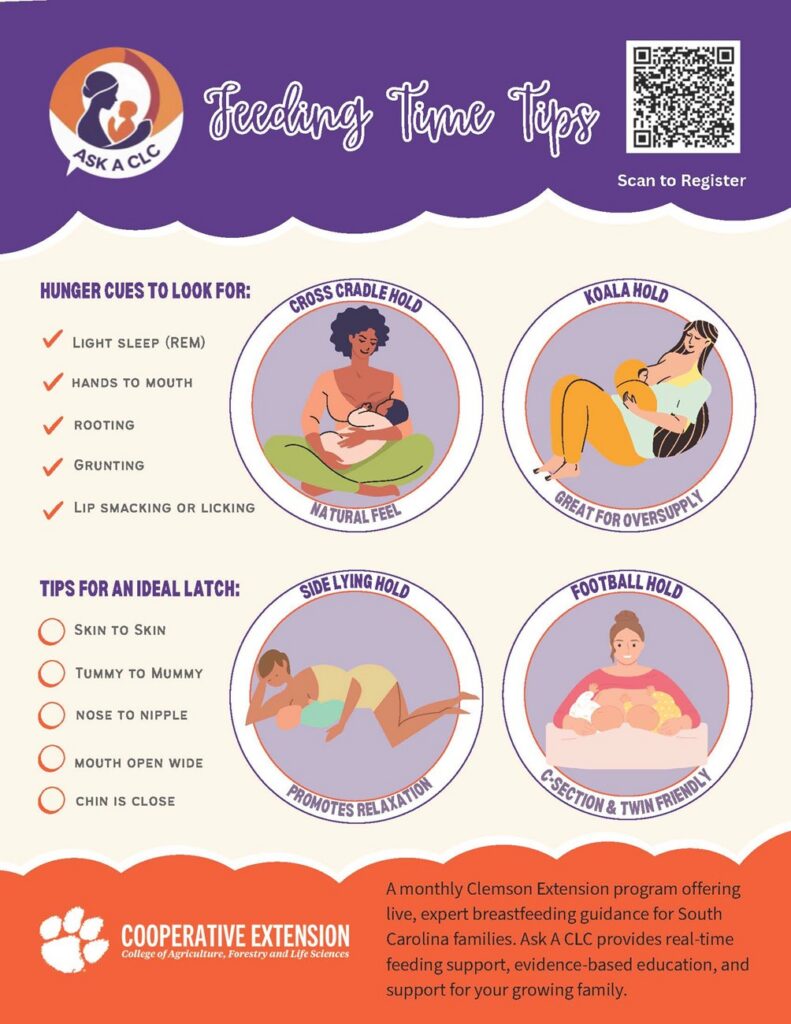
Newborns show many signs when they are ready to feed. Watching for early hunger cues allows for calm, effective feedings before becoming too hungry or frantic.
Early cues include:
- Light sleep with rapid eye movement
- Sucking hands or fists
- Rooting (turning their head to search for the nipple)
- Lip smacking or licking
- Grunting
Late cues, including crying, may cause the baby to become too upset to feed effectively. When the baby shows early hunger cues, position the infant skin to skin with their tummy against the mother’s tummy. Align the baby’s nose with the mother’s nipple to encourage a wide mouth for a deep latch. When latched correctly, the mother should feel comfortable and audible swallowing will be heard. There are several holding positions a mother can use to breastfeed comfortably, as shown in the graphic below. Consulting with a CLC can help address any latching difficulties or pain.
Resources for Support
For any mother who experiences breastfeeding challenges, there are lactation care providers eager to help. The Academy of Lactation Policy and Practice website offers a link to find a Certified Lactation Counselor in any area. Local hospital systems often have these providers on staff and may offer in-person support groups as well. Clemson Extension provides several free breastfeeding resources, including a breastfeeding-centered live Q&A series, Ask a CLC, and the 1-hour online program Breastfeeding 101. Knowing what to expect in the beginning of a breastfeeding journey can make this stage easier and help families recognize when to seek support instead of struggling through challenges.
Related Articles:
The Benefits of Breastfeeding for Mom and Baby
References:
- Centers for Disease Control and Prevention. (2025, March 20). What to expect while breastfeeding. https://www.cdc.gov/infant-toddler-nutrition/breastfeeding/what-to-expect-while-breastfeeding.html
- Healthy Children Project, Inc. Center for Breastfeeding. (2025). Lactation Counselor Training Course [Course Handouts]. Unpublished material.
- Meek, Joan Younger, and Lawrence Noble, et al. Policy Statement: Breastfeeding and the Use of Human Milk. Pediatrics, vol. 150, no. 1, 2022, article e2022057988, American Academy of Pediatrics, https://publications.aap.org/pediatrics/article/150/1/e2022057988. doi:10.1542/peds.2022-057988.
Authors:
- Hannah Shifflette, Rural Health and Nutrition, Chester and York Counties
Reviewed by:
- Melissa Bales, Extension Associate, Rural Health and Nutrition
