CHRISTOPHER LeMASTER JR, Clemson Extension Livestock & Forages Agent
After a dry spring, many producers are asking the same question: how do we make up lost forage?
For a lot of operations this year, the answer is summer annuals.
Why summer annuals?
Summer annuals are fast-growing, high-quality forages that can help fill gaps when perennial systems fall short. In the Southeast, they’re typically planted from April through June and can be used for grazing, baleage, or hay.
Under good conditions, they can produce 5,000 to 10,000 pounds per acre with 15%+ crude protein—a strong option coming out of a poor spring. They are an excellent alternative to the increased risk of fescue toxicity across the summer months. Of course, that still depends on rainfall and management.
Even with risk, farmers are planting.
This isn’t a low-risk move.
Ongoing drought, elevated fuel and fertilizer prices make this a difficult decision. After looking at several extension enterprise budgets, some summer annuals could easily land in the $200/acre ballpark. However, doing nothing has a cost too!
Start with your goal.
Before planting, think about what you need most:
Dry hay – Possible, but challenging due to thick stems. Higher seeding rates and a mower conditioner can help.
Baleage – Strong option for hard-to-dry crops. Ensilation can also decrease nitrates
Grazing – A great way to stretch forage, improve cattle performance, and give Fescue pastures a break heading into fall and punch through the summer slump.
Don’t overlook mixtures.
Mixtures are getting more attention—and for good reason.
Adding legumes can:
Reduce nitrogen needs
Maintain yield and quality
Improve soil health and resilience
They can also help buffer against drought and extend the grazing season. Just keep in mind that herbicide options may be more limited.
A quick word on risk
Not all summer annuals handle stress the same.
Pearl millet offers good drought tolerance and avoids prussic acid risk (though nitrates are still possible).
Sorghum and sorghum-sudan can be high-yielding but require careful management due to prussic acid and nitrate concerns.
Crabgrass performs well but needs consistent moisture
Final thoughts
Summer annuals aren’t a silver bullet—but they can help bridge the forage gap after a dry spring.
This isn’t an exhaustive list—just a starting point.
If you’re trying to decide what fits your operation, reach out or check out our other forage resources. We’re happy to help you think through your options.
Andy Rollins Commercial Horticulture Agent Spartanburg County
I am currently planning a replicated on-farm herbicide trial on jalapeño peppers at the farm of Ignacio Estrada Jr in Greenville County. The trial will evaluate the viability of Spartan herbicide as a weed control option. This project is being coordinated with Dr. Mathew Cutulle, a Clemson University specialist based at the Coastal Research and Education Center in Charleston, SC.
I recently completed the Upstate Strawberry Production Meeting at the Spartanburg Community College Cherokee Campus “Institute for Innovation,” a new venue for me. The meeting attracted growers from at least four counties across South Carolina, as well as two farms from North Carolina.
I will also continue my work on thinning peaches using Ethylene. I have experienced difficulty thinning varieties such as Scarlet Prince and July Prince. To address this, I will use a two-pronged approach: thinning during bloom with Ammonium Thiosulfate (ATS), followed by thinning at the fruitlet stage with Ethephon 2 SL. Peach growers currently rely on hand thinning, which is the most expensive labor input in peach production. This makes the development of effective chemical thinning strategies especially important for peach growers in the Upstate of South Carolina.
My final spring training for Upstate vegetable growers will be held on March 12.
One of the four H’s in 4-H stands for “Hands to Larger Service”. Spartanburg 4-H members, parents and volunteers stay busy serving our local community throughout the year.
Our youth have a sweet friendship with the residents at Restoration Senior Living. Teen Council can be found there several evenings throughout the year playing an exciting game of BINGO. A Gingerbread House competition has become an annual holiday tradition of our Homeschool Club. They bring the supplies, construct the houses on site, much to the residents’ enjoyment, and then the residents pick the winners! Other youth have planted a pollinator garden and enjoyed a “Slip and Slide” event to cool off during the summer months.
In addition to serving the older members of our community, Spartanburg 4-H collects hygiene supplies for the Miracle Hill Rescue Mission in Spartanburg. Our youth collect individual supplies and pack them into gallon-sized resealable bags and include an encouraging note to the recipients.
As the Spartanburg 4-H Agent, I get to observe this kindness, compassion, and generosity up close and am blown away by how eager our youth are to help their neighbors and keep their pledge to use their hands for larger service!
Margaret Estridge Rural Health & Nutrition Agent Cherokee, Spartanburg, & Union Counties
As the new Rural Health & Nutrition Agent, I have been working to build relationships with high priority communities in Spartanburg County as well as beginning to provide health and nutrition programming with organizations such as Spartanburg County Vocational Rehabilitation, Summit Hills Senior Living, and Project R.E.S.T.
Additionally, I have been training to facilitate three programs: Health Extension for Diabetes, Keys to Diabetes and Better Health and Growing Health. I have been meeting with organizations such as Spartanburg Regional Hospital System’s Diabetes Management program and Heart Wellness Program and P.A.L. to enhance program promotion and partnership as well as St. Luke’s Free Medical Clinic for programming opportunities in 2026.
If interested, please call or email Margaret Estridge at 864.795.0101 or mbarest@Clemson.edu if interested in Health Extension for Diabetes, an 8-session series for those diagnosed with diabetes or Keys to Better Health and Diabetes, which is a one-hour health lesson for anyone interested in learning more.
I am excited to facilitate four sessions of Growing Health this year at the Spartanburg County Extension office alongside Horticulture Agent, Nicole Goodman. This free course teaches individuals about specific vegetables from seed to table and allows participants to take materials with them to grow their own veggies.
Eventbrite links: (all classes are from 10:00am-11:00am)
Nicole Goodman Horticulture Agent Spartanburg County
For the first time since 2023, Spartanburg County proudly offered the Master Gardener Volunteer Training once again—and it would not have been possible without the dedication, curiosity, and generosity of our Master Gardener Volunteer community.
Between August and December 2025, fifteen enthusiastic students completed the 16-week training focused on growing better, healthier gardens. Coursework covered a wide range of topics, including lawn care, native plant identification, hands-on invasive plant removal, and soil health for a more bountiful harvest. Their commitment culminated in a rigorous four-hour final exam in early December, which they passed with flying colors, demonstrating both knowledge and determination.
Graduation, however, is just the beginning. Each new Master Gardener Volunteer now contributes 40 hours of educational service, sharing science-based gardening practices throughout the county. Many are already actively serving—offering lectures at local libraries, teaching garden club classes, introducing young visitors to the beauty of Hatcher Garden, or guiding community members during monthly workdays at St. Luke’s Free Medical Clinic in downtown Spartanburg.
Our Master Gardener Volunteers are more than educators; they are stewards of growth, connection, and care. Through their service, they leave a lasting mark on Spartanburg County—one garden, one lesson, and one shared moment at a time.
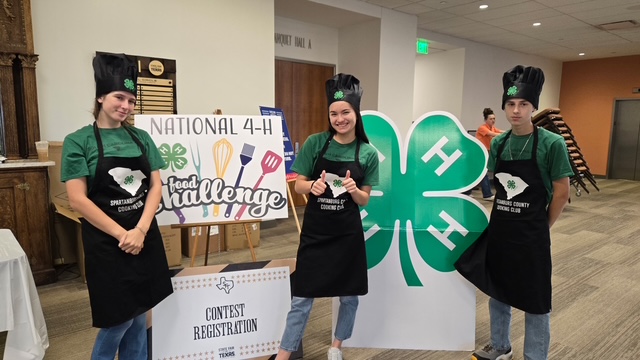
Three talented teen members of Spartanburg County 4-H recently took their cooking skills—and their 4-H journey—to the next level. They earned a coveted spot at the National 4-H Food Challenge Competition, held at the State Fair of Texas!
Ada Jarrett, John Jarrett, and Anna Vidrine have been active in Spartanburg County 4-H since their Cloverbud years. Over the past two years, this dynamic trio has sharpened their culinary skills by attending the South Carolina 4-H Cooking Like a Chef Summit and leading the Spartanburg County 4-H Cooking Like a Chef Camp.
In April, the team, joined by fellow member Micah Marsh, competed in the South Carolina Team Cooking Challenge and placed third statewide. That strong finish opened the door for Ada, John, and Anna to represent South Carolina on the national stage.
All summer long, the team met weekly to practice preparing appetizers, main dishes, and side dishes. Their dedication paid off. While they did not place in the top three, they proudly represented both our county and our state—making history as the first Spartanburg County 4-H Cooking Team to compete nationally!
We are incredibly proud of these youth and excited to see where their skills and leadership take them next. Their success marks just the beginning of a growing 4-H Cooking Program in Spartanburg County.
If you would like to support opportunities like this—whether by volunteering to lead a club or sponsoring the cost of ingredients for monthly meetings—please contact Spartanburg County 4-H Agent, Laura Haddon. Together, we can help even more young people discover their potential through 4-H.
Andy Rollins Commercial Horticulture Agent Spartanburg County
Andy Rollins has made significant progress in chemically thinning peaches using ethylene. Ethylene is a naturally occurring gas that increases as many fruits ripen. A common example of its use is placing a ripe banana peel in a paper bag with an unripe tomato, which helps accelerate the tomato’s ripening process.
In commercial peach production, thinning is typically done by hand after the risk of the last frost has passed—generally around April 15th, although this can vary. However, the rapidly rising cost of legal H2A labor, combined with widespread inflation across other farm inputs, has severely eroded profit margins. Many farms are now uncertain whether they can remain operational even for another year.
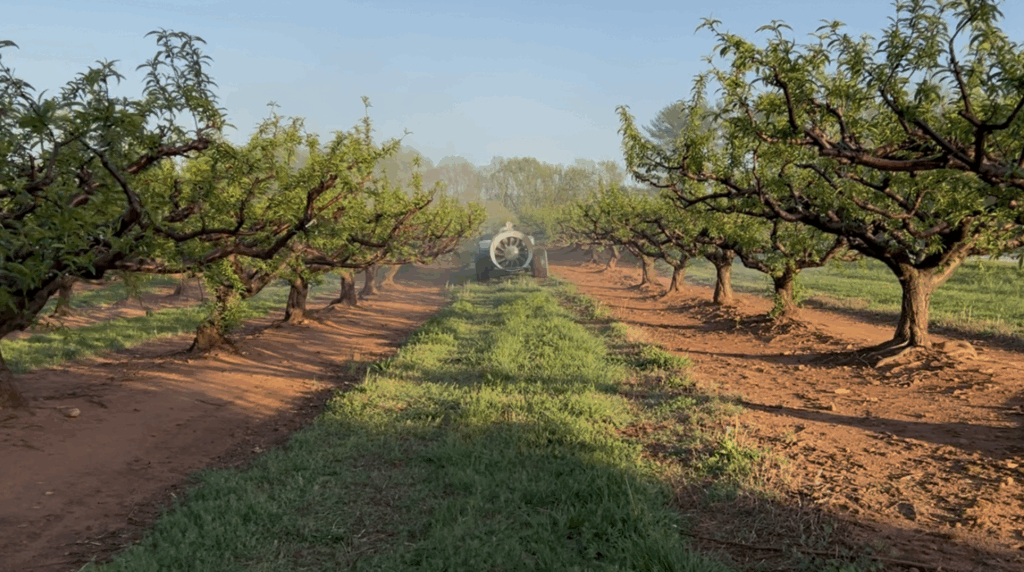
Rollins has applied ethylene in liquid form to young peach flowers and fruit, which causes the trees to naturally abort a portion of the developing fruit. This spring, he was able to thin 50–60% of the fruit from multiple peach varieties at a cost of just $1.67 per acre (approximately 150 trees), excluding labor for application. In contrast, traditional hand thinning can cost $8–10 per tree. While he encountered some challenges thinning certain varieties, he plans to continue refining the process next year, believing it to be a critical step forward for the future of peach production.
In addition to his work with ethylene, Rollins is also exploring the use of a new biological fumigant applied through an innovative method. Fumigants are essential in commercial agriculture to combat soil-borne diseases, weeds, and pests that can severely damage crops. These substances are highly dangerous, but by using inline injection through irrigation drip tape, exposure to harmful gases is reduced and the fumigant remains concentrated in the soil, where it can effectively target plant pathogens and pests.
This method has gained popularity since Rollins began working with it. He is scheduled to demonstrate the technique at the NC Strawberry Growers Association meeting on November 11, 2025. During the demonstration, he will use blue dye through the irrigation system to simulate the fumigant, highlighting the importance of saturating the entire root zone to ensure maximum efficacy.
Further educational meetings on these practices are currently being planned for early next year.
Nicole Goodman Horticulture Agent Spartanburg County
Nicole Goodman has fully stepped into her role as the Urban Horticulture Agent in our county. In addition to offering regular workshops on gardening topics (announced through our Facebook Page) and assisting residents daily, Nicole is dedicated to fostering broader community impact through the work of the local Master Gardener Volunteers.
One project particularly close to her heart is the Teaching Garden at St. Luke’s Free Medical Clinic in Downtown Spartanburg. This initiative is designed to educate the community on growing nutritious food, practicing safe food handling, and promoting both mental and physical well-being.
Through collaboration with the clinic’s dietitian, JuliSu, and director Ms. Smith, the garden has become a thriving partnership. Monthly volunteer workdays continue to transform the property into a fully functioning edible and teaching garden.
Project Highlight This season’s major milestone has been the beginning of terracing the steep east hillside of the property. Thanks to the enthusiasm of this year’s Master Gardener Volunteer students, the project is progressing smoothly. Volunteers—both experienced gardeners and community members new to the field—are not only learning about plants, but also about safe building practices that turn unusable slopes into productive spaces.
While tremendous progress has been made, the garden still requires the removal of several large trees to improve sunlight access and support the continued success of edible plantings. For ongoing updates, follow the Teaching Garden’s Facebook page: Teaching Garden of St. Luke’s Free Medical Clinic (green logo with three hands).
Margaret Estridge Rural Health & Nutrition Agent Cherokee, Spartanburg, & Union Counties
Hello! My name is Margaret Estridge and I am excited to be able to work with the Spartanburg, Union and Cherokee communities as a Rural Health & Nutrition agent. As a Clemson graduate, I am thrilled to return after working in health education and coaching in both health systems and corporate wellness. My passion lies in empowering individuals and communities to take charge of their health through nutrition and prevention. When not working, I love to hike and ride my bike so I hope to see you out on the trails of this beautiful region!
Spartanburg EFNEP has been partnering with the Bethlehem Center to bring nutrition education to their afterschool groups this school year. The second-grade class enjoyed a six-week series learning the Show Me Nutrition curriculum.
During this time, the children were introduced to MyPlate by playing games with the five food groups and diving deeper into each category each week. The class enjoyed tasting a myriad of recipes including a fruit smoothie, colorful fruit skewers, food group sandwiches, and more.
Over six sessions, the children studied how to build strong bones, power up with protein, eat a rainbow of fruits and a variety of vegetables in addition to moving their bodies more. They enjoyed playing games and creating their own personalized MyPlates to set healthier goals for themselves.
These students are ready to tackle all that the remainder of the school year has to bring with healthy and active mindsets!