Clemson Extension Upstate District

Kicking Off the 51st South Carolina 4-H Dairy Heifer Project

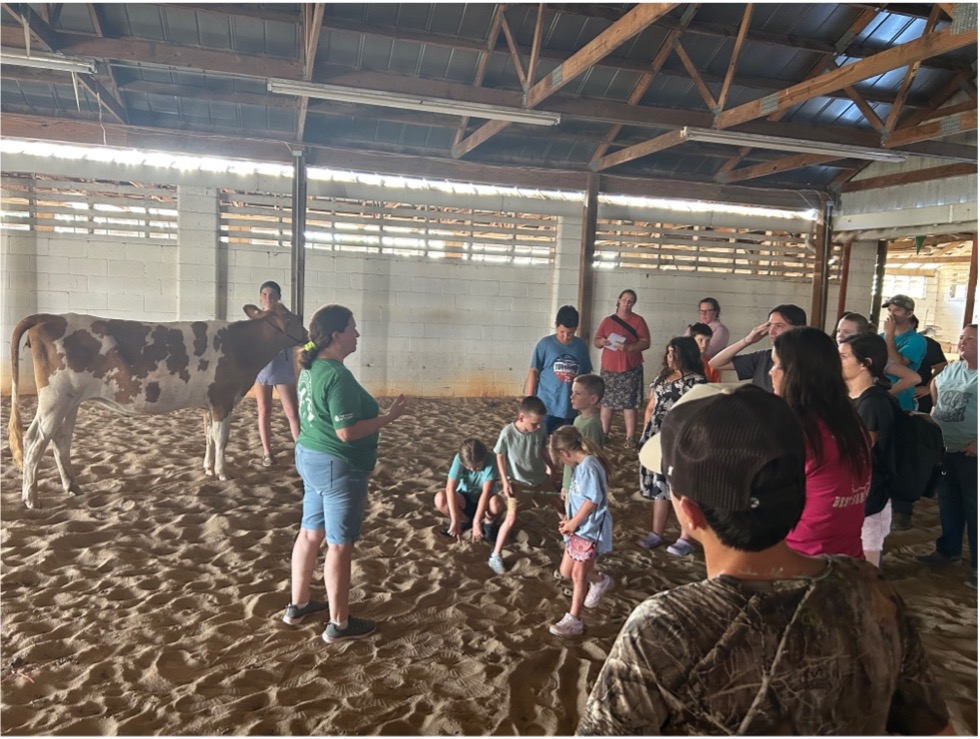
July marked the exciting start of the 51st South Carolina 4-H Dairy Heifer Project! This long-standing tradition continues to provide opportunities for youth to learn about dairying and the dairy industry. The Dairy Heifer Project began in 1974 and was designed to provide boys and girls in South Carolina an opportunity to raise a dairy heifer and experience the dairy industry and then sell their heifer at the South Carolina 4-H Bred Dairy Heifer Sale before she begins milking. The project is a long-term project. This year, 24 participants from all corners of South Carolina received heifers. Youth received a dairy calf of one of four breeds: Holstein, Jersey, Guernsey, or Brown Swiss. Over the next 20 months, these young people will raise and care for their heifers, gaining invaluable skills in animal husbandry, responsibility, and showmanship. The journey culminates in the spring of 2027, when the now-bred dairy heifers will be marketed and sold to dairymen across the country through an online auction. The SC Dairy Bred Heifer Sale serves as an excellent source of herd replacements for South Carolina dairymen. In past years, heifers raised in South Carolina have gone on to begin their careers as milk producers in as many as eight different states! 

This year is especially exciting, as we welcomed 10 new families into the program—proof that the spirit of agriculture is alive and growing. The 4-H Dairy Heifer Committee is thrilled to see so many youth eager to step into the world of agriculture, many for the very first time.

With the 4-H motto being “learn by doing”, we believe one of the best ways to learn… is with an animal in hand.
Confined Animal Manure Manager Trainings – Virtual and In-Person

Bryan Smith, Area Extension Agent-Agricultural Engineer

Confined Animal Manure Managers Program

SC State Regulation R.61-43 requires all confined animal facility operators to attend the Confined Animal Manure Manager (CAMM) certification program provided by Clemson Extension.  The CAMM team has worked hard to provide trainings for South Carolina’s confined animal facility operators this year.  From July 1, 2024 through June 30, 2025 Bryan Smith (Laurens), Brian Beer (Lancaster), Lee van Vlake (Florence), and Amber Starnes (Chesterfield) worked together to offer two initial, full day trainings and also worked with local county agents across the state to provide 65 recertification trainings including 53 in-person trainings and 12 online Zoom trainings.

Presenters included Bryan Smith, Dr. Julie Helm (Livestock Poultry Health), Dr. John Chastain (Clemson University), Dr. Sean Eastman (Livestock Poultry Health), Lee van Vlake, Brian Beer, and Tonya O’Cain (SCDES).  Topics included “Crop Utilization of Manure Nutrients and Soil Fertility,” “Vectors and Vector Control,” “Horse Manure Issues and Management,” “Mortality and Composting,” “Energy Saving Opportunities for Swine Facilities,” “Beef Grazing Systems and Water Quality Protection,” “Poultry Litter Fertilization for Hybrid Bermudagrass,”  and “Tunnel Ventilation & Evaporative Cooling: Heat Stress Reduction, Performance, and Energy Use,” as well as several others.

597 growers attended the in-person recertification trainings and 435 growers attended the online recertification trainings.  60 growers attended the two initial, full-day trainings.

The team plans to offer two initial, full-day trainings in February 2026 and a slate of recertification trainings for our growers from January through March 2026 and another slate from late April through August 2026.  More information about the training program may be found at www.clemson.edu/camm .

Succession Planning Workshop was a Success

Succession Planning Workshop in Pacolet, SC

Over 97% of US farms are family-owned, and less than one-third have a formal succession plan.

Let’s try to imagine a business that is worth over a million dollars in assets and holdings. A new investor/partner has started with the company and scheduled a meeting with the CEO/Founder to discuss the transition plan. The CEO obliges, but instead of meeting in an office, they meet at the CEO’s kitchen table. The table is covered with invoices, receipts, seed, parts list and so forth. During the meeting, the CEO’s phone constantly rings with calls about fences, hay, and other “urgencies.” Both parties are beginning to wonder if this is a waste of time; unfortunately, the meeting gets cut short by an issue with a hay baler in the field. No progress was made.

This is a common scene in our family-run farms. Everyone would agree that developing a succession plan is a high-value task for our farm families. Still, the small, less valuable task often takes precedence due to its perceived urgency. 

On September 21st, there were over 75 farmers at the succession planning workshop in Pacolet, South Carolina. Speakers from FSA, SC land, and Clemson Extension gave farm families the tools necessary to get started with this vital task. We covered much ground but only scratched the surface of these critical topics. We are working on suggestions and feedback for the next installment of this workshop series. There were farmers from several counties in our region, and we had a great deal of support from our sponsors.

We look forward to equipping farmers now so these farms will still be in farmland tomorrow. Farms are businesses, and successful businesses need a good plan for carrying on to the next generation.

Meet the Agent

Hello all!  My name is Sydney Rentz! I am beyond excited to start as the new Area Livestock Agent for Newberry, Laurens, and Greenwood Counties! I am from Ehrhardt, South Carolina, where I grew up on my family’s beef stocker cattle, row crop, and custom harvesting operation.  I recently graduated from Abraham Baldwin Agricultural College (ABAC) in May where I earned my Bachelor of Science in Agriculture with a concentration in Livestock Production and a minor in Agribusiness.  While at ABAC, my studies focused on beef and dairy cattle production, and I was able to gain hands-on knowledge about both through classes and internships.  I also served as the 2024-2025 Secretary for the ABAC Cattlemen’s Association.  Once again, I am excited to join the Clemson Extension Family, and I look forward to serving Newberry, Laurens, and Greenwood Counties to the best of my ability!

Heifer Selection Program: Using Genetic Test Results for Heifer Selection in Commercial Cattle Herds

Heifer Selection Program
Horned M Ranch, 4874 Patrick Road, White Oak, SC

October 16, 2025, 5:30 – 7:00 PM

Join us at Horned M Ranch in White Oak and learn how to incorporate genetic test results into your replacement heifer selection.

 Mr. Jim Johnson with Zoetis will review the INHERIT genetic test and how to use the information to select replacement heifers. Tested heifers will be on site, and you will get to see how your traditional replacement methods match with the genetic test results.

Agenda:

  • Live animal selection – Participants will pick which heifer they would select as replacements
  • Traditional, phenotype-based selection of replacement heifers by Mr. Brian Beer, Area Livestock & Forages Extension Agent, Clemson Extension.
  • Meal
  • Using Zoetis INHERIT genetic testing to aid in selecting superior replacement heifers by Mr. Jim Johnson, Zoetis
  • Heifer selection with genetic test results – Participants will review their selected replacement heifers and see how their picks compare to the genetic test results.

This event is free thanks to our sponsors, Carolinas Animal Health, CPC Feeds, and Zoetis. Registration is required using Eventbrite.

Click Here to Register

Contact Brian Beer, Area Livestock and Forages Extension Agent. Email: bbeer@clemson.edu. Phone or text: 803-320-9360.

Gearing Up for Growth

Christopher LeMaster, Area Livestock & Forage Agent
Cherokee, Spartanburg, & Union Counties

Loss of Farmland is a top concern among our stakeholders as South Carolina continues to grow at an unprecedented rate. Last year, over 90,000 people moved to our state (which is more than the population of the city of Greenville). Additionally, Industry is quickly relocating to the Sunbelt states. Even in Cherokee County, we are experiencing development pressure compounded by the rising average age of farmers. I don’t have to explain the importance of farmland to this group, but without farms and farmland, we increase our dependency on something we need at least 3 times a day. I appreciate the opportunities that come with this growth, but I think we are justified in our concerns about this rapid loss of farmland. There’s no simple solution; it involves advocacy, education, zoning, regulation, and, most importantly, profitable farms.  Yes, farms need to be profitable and enjoyable to survive. Farming is hard work, both physically and mentally, and many of our farmers are aging out. Nothing ages you faster than hard, unpleasant work for no money.

                My goal for 2025 is to offer classes focusing on profitability and ways to bring another farming generation on board. The classes I have planned for this year will challenge farmers to look at their farms as businesses and break their operations down into enterprises to assess profitability and viability and hopefully identify solutions for some of the drudgery of farming. I invite you to attend the Beef Market Outlook and Profitability Workshop on 3/20 and the Succession Planning for Farm Families and Conservation Easements Workshop on 8/21. Both programs will be in Pacolet for a central location to my counties (Cherokee, Union, and Spartanburg).  Additionally, we have teamed up with a few like-minded organizations to form the Broad River Conservation Partnership to offer field days to assist landowners with conservation practices such as prescribed fire, native grass establishment, and conservation easements.

                I hope to see you at one of these programs this spring. Here are a few other workshops to look forward to.

3/11

3/20


3/21-22

3/25

3/28

3/28

4/5

4/11-12

4/18

4/29

5/9

5/27

6/24

7/29

Wheat/Soybean Production Meeting

Beef Market Outlook & How to Assess Your Operation’s Profitability

Peach Country Livestock Show

Home Gardening Series: Beekeeping for Beginners

Backyard Poultry Processing

Down on the Farm Day

Urban Homesteading Poultry

Union Livestock Rodeo

Small Ruminants Field Day

Home Gardening Series: Sustainable Pest Management

Broad River Conservation Partnership Field Day

Home Gardening Series: Pruning & Turf Care

Home Gardening Series: Small Fruit Production

Home Gardening Series: Global Seed Diversity

Gaffney, SC

Pacolet, SC


Spartanburg, SC

Gaffney, SC

Orangeburg, SC

Cherokee County, SC

Spartanburg, SC

Union, SC

Union, SC

Gaffney, SC

Union, SC

Gaffney, SC

Gaffney, SC

Gaffney, SC

Meet Your Livestock and Forages Agent

Hannah Conover, Area Livestock and Forages Agent

Hannah Conover recently joined the Livestock and Forages Team as the agent covering Greenville County, as well as Anderson and Pickens counties.  A native of Starr, SC, she is proud to serve the communities where she grew up.

After graduating from Crescent High School, Hannah attended Clemson University, where she earned a Bachelor’s degree in Animal and Veterinary Science with a minor in Business. After completing her degree, she served as an AmeriCorps member with the Georgia 4-H program in Banks County. During this time, she helped foster agricultural education and youth development through various programs and events. Hannah also spent several years showing cattle across the state and nation, and she was a junior member of multiple breed associations, including Shorthorn, Angus, Gelbvieh, and Charolais.

As the Livestock and Forages Agent for Greenville County, Hannah looks forward to serving as a resource for a variety of folks in the industry, from large-scale cattle producers to those with backyard poultry flocks and homesteading goals. She is excited to begin offering programs and workshops pertaining to community needs as well. Be on the lookout for updates on events via the Clemson Events Calendar and social media, and feel free to reach out to her at (864) 359-3382 or hfwoote@clemson.edu.

Clemson Extension Launches Small Scale Farming Series

The growing importance consumers have placed on knowing where their food comes from has resulted in an increase in small-scale and backyard farming. A series of learning sessions and workshops aimed to educate those who are or are considering on producing their own meat, milk, or eggs has begun in York and surrounding counties by Clemson Extension Livestock and Forage agents. To date, four poultry, one goat, and one dairy workshop have been delivered with over 100 participants attending at least one. These programs have been held in conjunction with the Clover and Fort Mill Libraries and at local farms. The goal for these initial programs is to help participants determine if small-scale or backyard farming is right for them and the steps that need to be taken to get started. More in-depth workshops are being planned so if you are interested please contact the York County Extension Office.

Tina Horne
Livestock and Forages Agent
State Dairy Program Coordinator
thorn@clemson.edu

Armyworms Invade Laurens County

Bryan Smith, Area Extension Agent-Agricultural Engineer

This fall a huge number of Fall Armyworms invaded Laurens County.  Fall Armyworms are usually in our county in some small number each year, but this year’s numbers created quite a bit of damage in landscapes, pastures, and hayfields.

Fall Armyworms migrate northward each year from the Gulf coast and may arrive in Laurens County as early as August.  There may be as many as three “waves” of armyworms each year depending on many factors.  The Fall Armyworm life cycle is typically 30 days in the summer, with the larval or caterpillar stage being the destructive one.  Fall Armyworms remain in the caterpillar stage for 14 days and are most destructive during the last 4 days of that stage.  They then pupate and emerge as moths, which feed on nectar from various flowers and are not destructive.

Fall Armyworms seem to prefer bermudagrass, crabgrass, johnsongrass, millet, and sorghums.  They will ignore other grasses such as fescue and bahia while sufficient quantities of their preferred foods are present.  However, if those food sources are exhausted before they pupate they will move to less desirable species and decimate them as well.  This happened in 1977 in Laurens County when Fall Armyworms killed entire pastures of fescue after they had eaten their preferred crops.

Rainfall does encourage the growth of fungi that are detrimental to Fall Armyworms, but it does not kill them.  Clemson Extension recommends that insecticides be used to control them when growers see 3 armyworms in a one square foot area.  If Fall Armyworms are found in a hay crop we recommend that the hay be harvested if it has enough growth to do so – Fall Armyworms eat green growth and will not eat cured hay.  Local Extension Offices can provide a list of insecticides labelled for use in lawns, pastures, or hay fields.

Fall Armyworm damage in a home lawn. Remaining green areas are fescue or bahia.
Fall Armyworm damage in a home lawn. Remaining green areas are fescue or bahia. Image credit: Bryan Smith


Farmers are Hard to Replace

Chris LeMaster
Livestock & Forages Agent
Cherokee, Spartanburg, & Union Counties

Safety data (2019) by the U.S. Bureau of Labor Statistics indicates that the agriculture sector continues to be the most dangerous in America with 573 fatalities, or an equivalent of 23.1 deaths per 100,000 workers. Even in Cherokee County, we have had two ag-related fatalities less than a year apart. As we prepare for the busyness of fall hay harvest, a reminder about farm safety is much needed.

On August 1st we held a farm safety workshop tailored for cattle and hay producers. Typically, safety talks bring about a glazed and yawning audience. However, our speaker, Marion Barnes, used many real-life examples from around our state. He shared startling facts about the dangers of youth around farms. One point that shapes the deadly youth statistics is that on most farms, there is no separation between the barnyard and the children’s play area . This leads to complacency around dangerous equipment for both the youth and the parents.

Aside from the loss of limb or life, accidents on the farm are very costly and, in many cases, can bankrupt a farm. If you want to see your farm passed down another generation, you had better make good decisions on your “calculated” risks around equipment and livestock.

After the presentation, many stories were shared with the audience about ag-related deaths and injuries in our county from the past couple of decades. I received several calls after the workshop from farmers stating they appreciated the safety talk and planned to implement changes in their operations.

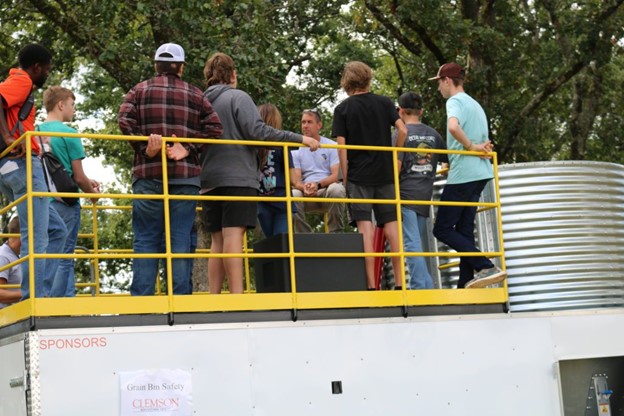
Grain Bin Safety Trailer

This program stemmed from an in-service training held on June 3rd at the Sandhills Experiment Station. Agents and specialists from across the state received presentations and demonstrations on farm safety topics. The demonstrations included legally transporting equipment, Rollover protection systems, and grain bin rescue. The grain bin rescue simulator was the most impressive demonstration. It was designed and constructed by the Ag Mechanization department to fit a small grain bin on top of an enclosed trailer that houses specialized equipment for the extraction demonstration. This trailer has been all over the state to help rescue teams train for grain bin entrapment. We plan to have this trailer visit some local fire departments in our farming communities.

Farmers are hard to replace, and so many people count on us. Please slow down and think about any avoidable risks. We need our farmers, and your families need you. For more information on farm safety and mental health for farmers, visit the links below:

http://blogs.clemson.edu/agsafety/

https://www.clemson.edu/extension/agribusiness/resources/farm-stress.html