Department of Languages

News from French and Spanish student societies

FPS members Sheridan Cofer, Mari Lentini, Anna-Caroline Bridgeman, and Kelly Burns (far end of table) with the French-American Chamber of Commerce of the Carolinas at a networking event in Greer. Photo courtesy of Mari Lentini.
French:

The French Professional Society (FPS) is a pre-professional society for students with a strong interest and background in French and/or French-American relations that wish to apply these interests to their career. FPS meets monthly as a club as well as informally with individual members who want to learn more about the opportunities available to French L&IT/L&IH majors. Meetings throughout the semester focus on professional development and aim to introduce and inform members about study abroad, internships, and career paths.

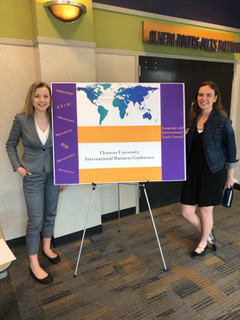
FPS member Kelly Burns (right) at the Language and International Business Conference. Photo courtesy of Mari Lentini.

The Spring 2019 semester began with a joint meeting with the Clemson French Club where students learned from the editor of the on-campus international affairs magazine, The Pendulum, about the opportunity to write an article of an international affairs topic of their choosing, experience the research and editing process, and become published in a magazine. As part of the Language and International Trade Council, FPS helped to plan and develop the 2019 Language and International Business Conference. The society also strengthened its relationship with the French-American Chamber of Commerce of the Carolinas (FACCC) and partnered with them for a networking night in Greer and attended FACCC networking nights in Columbia. At these events, FPS members connected with French Language and International Trade alumni and American and French business associates in the upstate region.

The incoming 2019-2020 FPS President is Mary Veideman. More information is available on the FPS Facebook page.

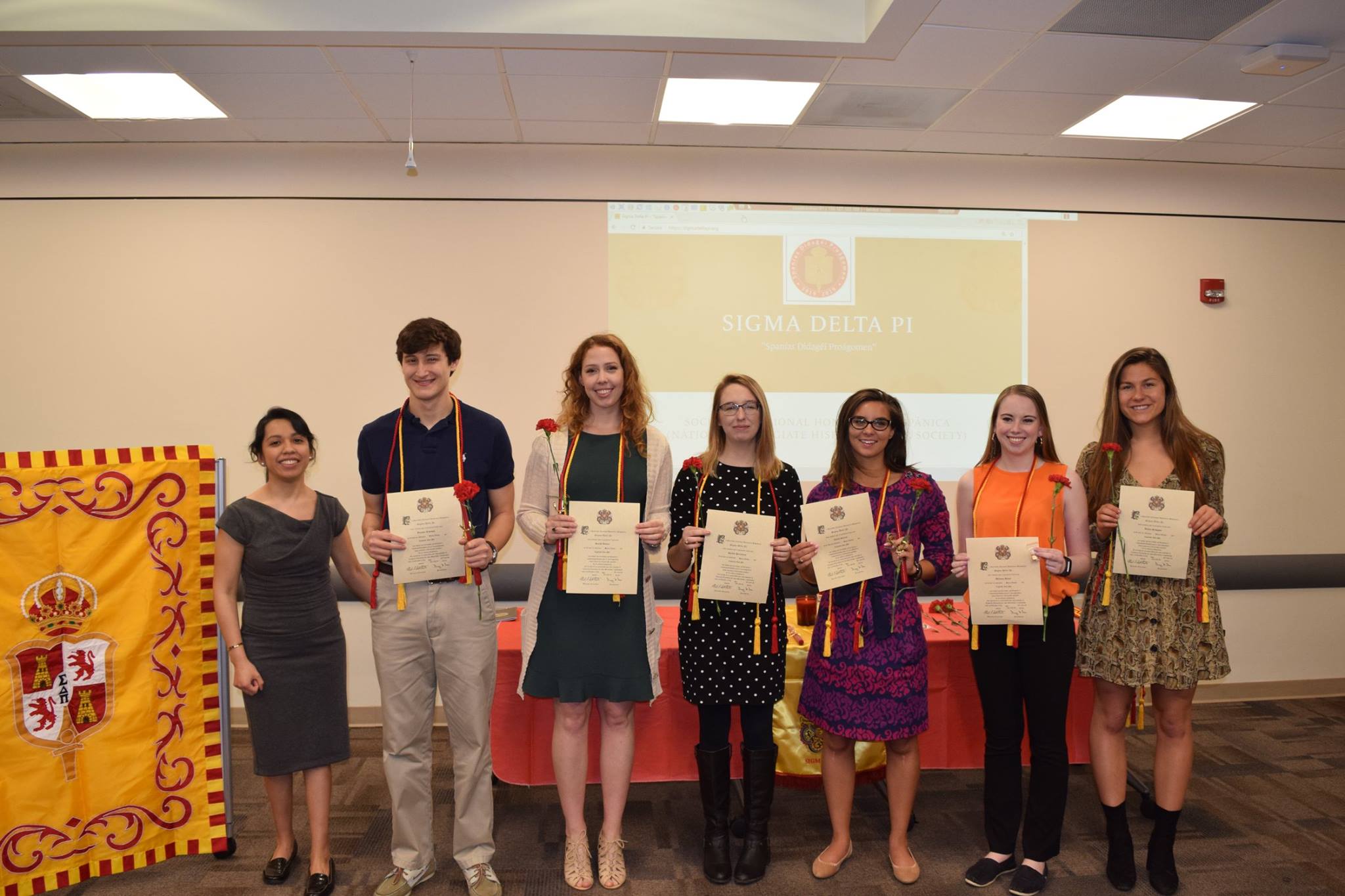
Sigma Delta Pi 2019 induction ceremony. Photo courtesy of Anna Whitfield.
Spanish:

The Iota Phi Chapter of Sigma Delta Pi, the National Collegiate Hispanic Honor Society, hosted its annual induction ceremony on March 2nd in The Brown Room of Cooper Library. Six new members were inducted. During the ceremony, Angelica Werth gave a presentation about her experience studying abroad in Córdoba, Argentina. The event was organized by chapter sponsor Rosa Pillcurima, lecturer of Spanish.

Spanish student presents research at national conference

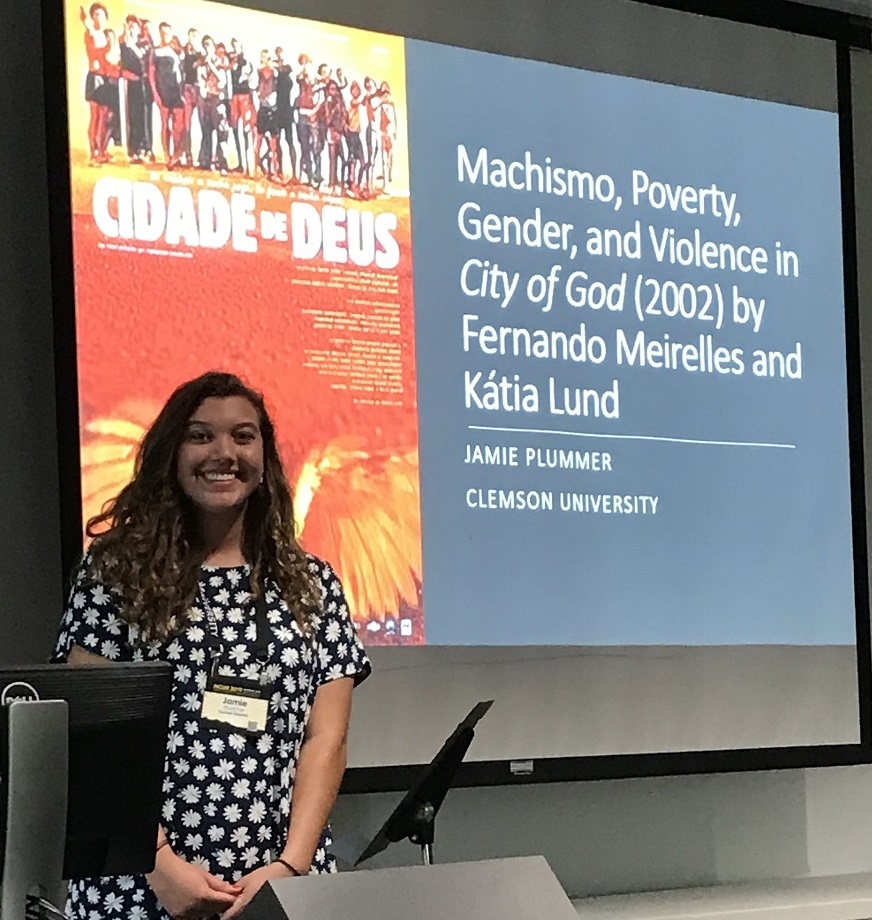
Jamie Plummer at the conference. Photo courtesy of Graciela Tissera.

Jamie Plummer, a psychology major and Spanish minor, completed her research in SPAN 4970 (Creative Inquiry Project: The Hispanic World through Film, Literature, and Media) offered by Dr. Graciela Tissera in the Spring 2019 semester. Jamie presented her research paper “Machismo, Poverty, and Gender Violence in City of God (2002) by Fernando Meirelles and Kátia Lund” at the National Conference on Undergraduate Research at Kennesaw State University, April 10-13, 2019. Her presentation discussed the impact of machismo, poverty, and gender violence on the lives of people portrayed in the film City of God (Cidade de Deus), directed by Meirelles and Lund (Brazil, 2002). Based on the 1997 novel of the same name written by Paulo Lins, the film portrays life in a favela in Rio de Janeiro and the realities of urban poverty. Examples of these realities include juvenile delinquency, gang violence, gender violence, drug trafficking, and power corruption. Jamie’s research explored characters, conflicts, themes, symbols, and techniques in the context of the social environment, connections among diverse groups of people, levels of education, and economic resources. Her presentation at the national conference was made possible through a travel grant awarded by the Creative Inquiry Program.

Department hosts annual International Business Conference

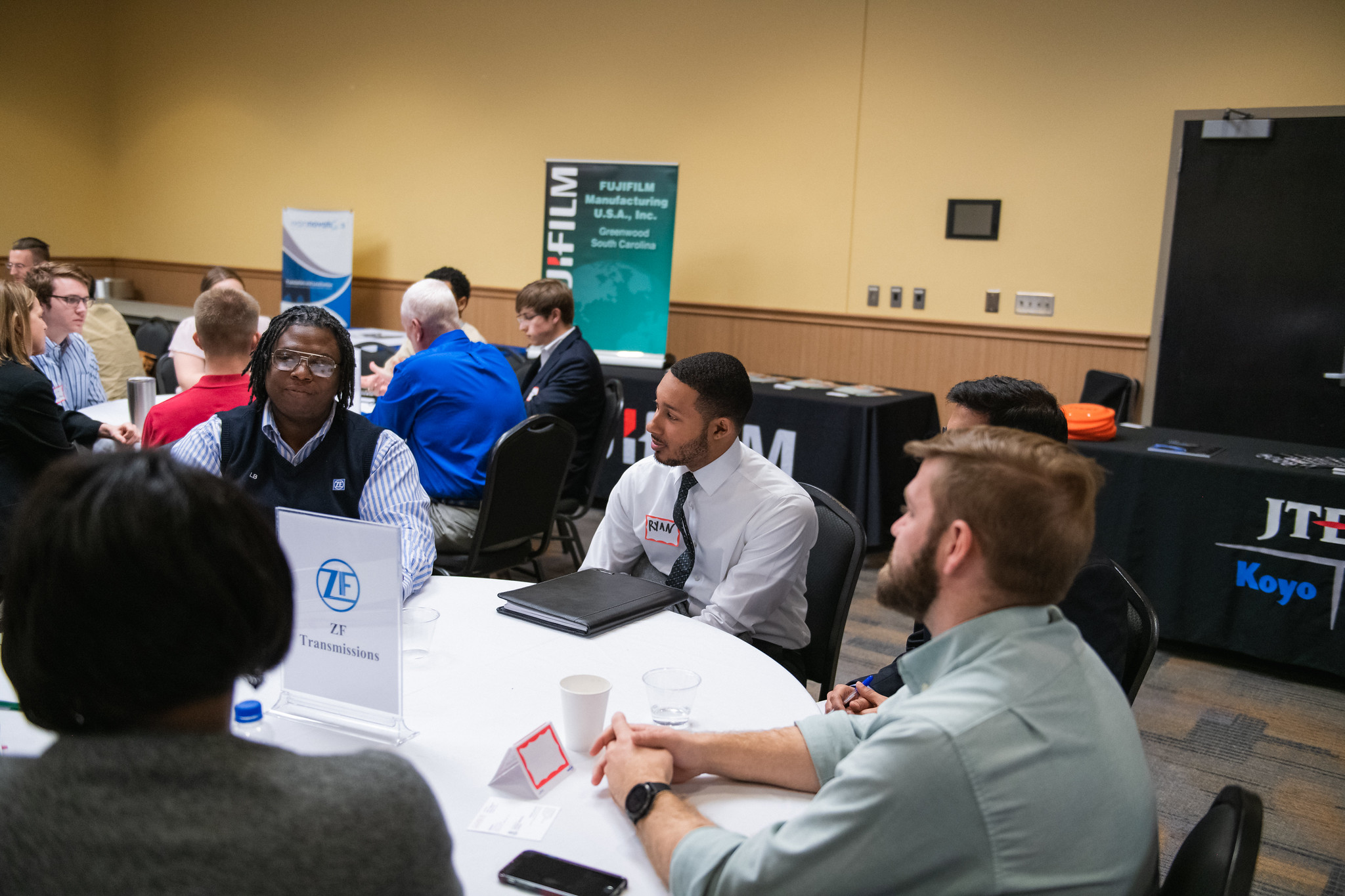
Students at a roundtable discussion. Photo courtesy of Clemson University.

The Department of Languages hosted the annual Language and International Business Conference (formerly the Language and International Trade Conference) on March 13 in the Hendrix Student Center. The conference provides leadership opportunities to students of foreign languages, promotes awareness of international businesses in Upstate South Carolina, and gives students networking and job opportunities. The theme of this year’s event was “applying language in the global marketplace.” The 2019 conference included a keynote speech by Justin Prescott, a Clemson alumnus and Senior Consultant at Ernst and Young in Tokyo; a panel discussion with Chamber of Commerce members; and a roundtable discussion with Clemson students and international business leaders.

Faculty member receives CU SEED grant

Congratulations to Gabriela Stoicea, assistant professor of German, for earning a 2019 Tier One CU SEED grant. Her book project is titled Fictions of Legibility: The Human Face and Body in Modern German Novels from Sophie von La Roche to Alfred Döblin. Gabi also received a Humanities Fellowship from the Clemson Humanities Hub to fund this project.

Another faculty member in the Department of Languages, Kelly Peebles, associate professor of French, was awarded a 2017 Tier One CU SEED grant for her book Portraits of Renée de France. Her project was highlighted at a recent Board of Trustees meeting by Diana Thrasher, associate director of the Office of Sponsored Programs, Division of Research.

The Clemson Support for Early Exploration and Development (CU SEED) Grant Program provides two tiers of funding support to eligible Clemson faculty in either the initiation of research activities or the completion of a scholarly project or product. Priority consideration is given to faculty who may not have large start-up packages and/or significant financial research support and resources. Initiation activities can include establishing baseline data, completing a phase of a research project that will lead to greater funding opportunities, or developing research partnerships with collaborators at other institutions. Projects or products for completion can include finalizing peer-reviewed publications, scholarly books, chapters in books, or showings, as in the case of the visual and performing arts.

Faculty news, Fall 2018

Jody H. Cripps, assistant professor of ASL, served as editor-in-chief of the Society for American Sign Language Journal, which released its second volume. He presented his article from the journal “Stuttering-Like Behaviors in American Sign Language” at the American Speech-Language-Hearing Association convention in Boston. Cripps published another article, “Exploring Signed Language Pathology: A Case Study of Professionals Working With Deaf Students Who Have Delay/Disorders in Signed Language Development,” in conjunction with his undergraduate student who was doing a research study at a residential school for the deaf on the topic of signed language pathology.

Stephen Fitzmaurice, assistant professor of Interpreting: ASL, published the chapter Teaching to Self-Assess: Developing Critical Thinking Skills for Student Interpreters” in “The Next Generation of Research in Interpreter Education,” edited by Cynthia Roy and Elizabeth Winston (Gallaudet University Press). The South Carolina Educational Interpreting Center grant he received in 2016 was renewed and its funder has published the 2018 Annual Report. Fitzmaurice also presented “Reducing Your Grading Time: Student Self-Assessment Practices That Work” at the international Conference of Interpreter Trainers in Salt Lake City. He was elected to a four-year term as secretary on the board of directors for the Conference of Interpreter Trainers. He was also an invited presenter at the Southeastern Regional Symposium for College Educators of Teachers of the Deaf, and Educational Interpreters, in Greensboro, North Carolina, where he presented new empirical evidence regarding “Predicting Interpreter Performance.”

Joseph Mai, associate professor of French, published an extensive review of the Cambodian filmmaker Rithy Panh’s most recent film, “Graves Without a Name,” in The Mekong Review. This poetic documentary is an autobiographical exploration of mourning and reconciliation, 40 years after genocide during the Pol Pot regime.

Tiffany Creegan Miller, assistant professor of Spanish, gave the presentation “Uk’u’x kaj, uk’u’x ulew: Ecocritical and Ecofeminist Kaqchikel Maya Epistemologies in the Film ‘Ixcanul’ (2015)” at the Association for the Study of the Arts of the Present (ASAP/10) held Oct. 17-20 in New Orleans. Miller also gave a guest lecture by videoconference on Oct. 22 to a medical Spanish class at Brown University about her work with underserved Kaqchikel Maya patients in Guatemala.

Salvador Oropesa, professor of Spanish and Department Chair, participated in the roundtable discussion by language department chairs on October 15 at the Mountain Interstate Foreign Languages Conference at the University of Tennessee, Knoxville.

Roberto Risso, assistant professor of Italian, published a book, “La penna è chiacchierona: Edmondo De Amicis e l’arte del narrare,” about Edmondo De Amicis (1846-1908), an Italian novelist, journalist, poet and writer of short stories. Risso’s book is the first to explore the entirety of De Amicis’s vast body of work.

Kumiko Saito, assistant professor of Japanese, appeared on “Writing Dystopia Now,” a radio program in The Cultural Frontline series on BBC World Service. On the Decemeber 9 broadcast, she spoke about cyberpunk and Japanese popular culture. The program is available on demand.

Daniel Smith, associate professor of Spanish, has been listed as an advisory board member on a European Research Council Advanced Grant application, “Cross-Community Bilingual Usage Patterns and Their Acquisition by Children.” His research on Spanish-English bilingualism in northeast Georgia is cited in the proposal for a potential project at the University of Cambridge. This will be the first major study of its kind to conduct a cross-community investigation of geographically separated groups of people who are nevertheless speakers of the same pair of languages, Spanish and English, in various locations in Europe and the Americas. He also presented “The Order of Morpheme Acquisition: Spanish and English in Contact” at the Mountain Interstate Foreign Language Conference at the University of Tennessee, Knoxville.

Jae Takeuchi, assistant professor of Japanese, was invited to give a lecture at the University of Washington in Seattle as part of their Japan Studies Program Lecture Series. The title of the talk was “Who Knew? How Japanese Language Learners Negotiate the Challenges of Dialect in Small-Town Japan.

Graciela Tissera, associate professor of Spanish, published “‘The Appeared’ (2007) by Paco Cabezas: Redefining the Book of Hidden Memories and Cyclical Time” in “Terrifying Texts. Essays on Good and Evil in Horror Cinema,” edited by Cynthia J. Miller and A. Bowdoin Van Riper (McFarland & Company). She presented the research paper “Los castillos en la ficción cinematográfica: sobre los enigmas del espacio laberíntico” at the III Congreso Xàtiva: Historia, cultura e identidad. The conference on the theme of castles in history and fiction was held October 17-19 in Xàtiva, Spain, and was organized by the Universitat de València, Institució Alfons el Magnànim and city of Xàtiva. She also explored the historical memory of the civic-military dictatorship of Argentina (1976-1983) in her paper “Argentina ante la memoria de la última dictadura: percepciones fílmicas de la intrahistoria.” She presented her research at the conference “III Congreso Internacional Art-Kiné: estéticas de la memoria. Prácticas sociales del recuerdo: el cine, los medios de comunicación y la cultura,” which was held November 6-9 at the Universidad de Buenos Aires, Argentina.

Eric Touya, professor of French, read a paper titled “Claudel dans/pour l’avenir: diplomatie, économie, éco-critique” at the Colloque International Paul Claudel Résolument Contemporain, sponsored by Sorbonne University, the National Library and the Comédie Française at the Université de Paris IV Sorbonne in Paris. He gave the presentation “Bonnefoy, Badiou, et l’avenir de la poésie: divergences et rapprochements at the 2018 Rocky Mountain Modern Language Association Conference in Cheyenne, Wyoming. He also presented “Teaching Hélé Béji, Post-Colonialism, and the Arab Spring: Perspectives From Baudrillard, McClintock, Giroux” at the conference’s Teaching Women in French Roundtable. Touya published an article, “Le poète et le philosophe: Bonnefoy, Badiou, et l’avenir de la poésie,” in Revue européenne de recherches sur la poésieNo. 4. Paris: Classiques Garnier, and a book chapter titled “Teaching Hélé Béji, Post-Colonialism, and the Arab Spring: Perspectives From Baudrillard, McClintock, Giroux” in “Rethinking the French Classroom: New Approaches to Teaching Contemporary French and Francophone Women,” edited by E. Nicole Meyer and Joyce Johnston (Routledge, New York).
Student spotlight – Mari Lentini

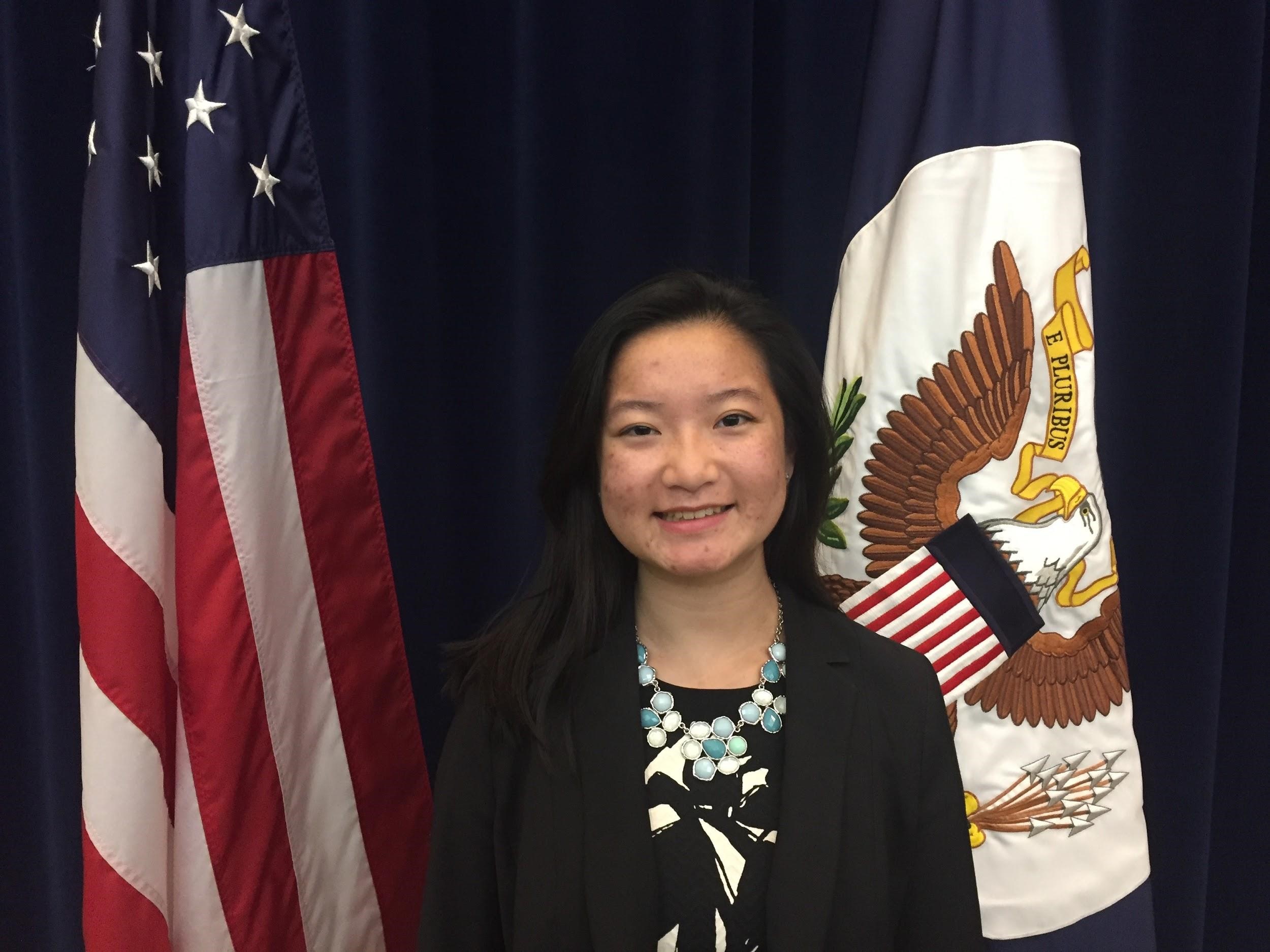
French L&IT Senior Mari Lentini. (Photo courtesy of Mari Lentini.)
L&IT-French Senior Mari Lentini. (Photo courtesy of Mari Lentini.)

Mari Lentini is a graduating senior in the Language and International Trade (L&IT) program. She studied in France, interned with the U.S. Department of State, and is President of the French Professional Society. Let’s learn more about Mari and her accomplishments.

Where are you from and why did you choose to come to Clemson?

I am from Houston, Texas, although for the past couple of years, my home has been Maggie Valley in the mountains of western North Carolina. It’s about two hours away from Clemson and I chose Clemson because of its close proximity and how the Language and International Trade major combined a language program with business courses. The versatility of the L&IT program to achieve and apply language mastery in the global marketplace is incredible – my L&IT friends have followed their passions into industries such as commerce and trade, fashion, government and politics, teaching, nonprofit work, and more.

How would you describe yourself? What do you like to do in your free time?

I am a curious person and like to learn new concepts and explore new places. My frequent travel experiences taught me how to plan ahead and be organized as well as to be adaptable and spontaneous. In my free time, I enjoy running, studying new languages, hiking, and going to concerts.

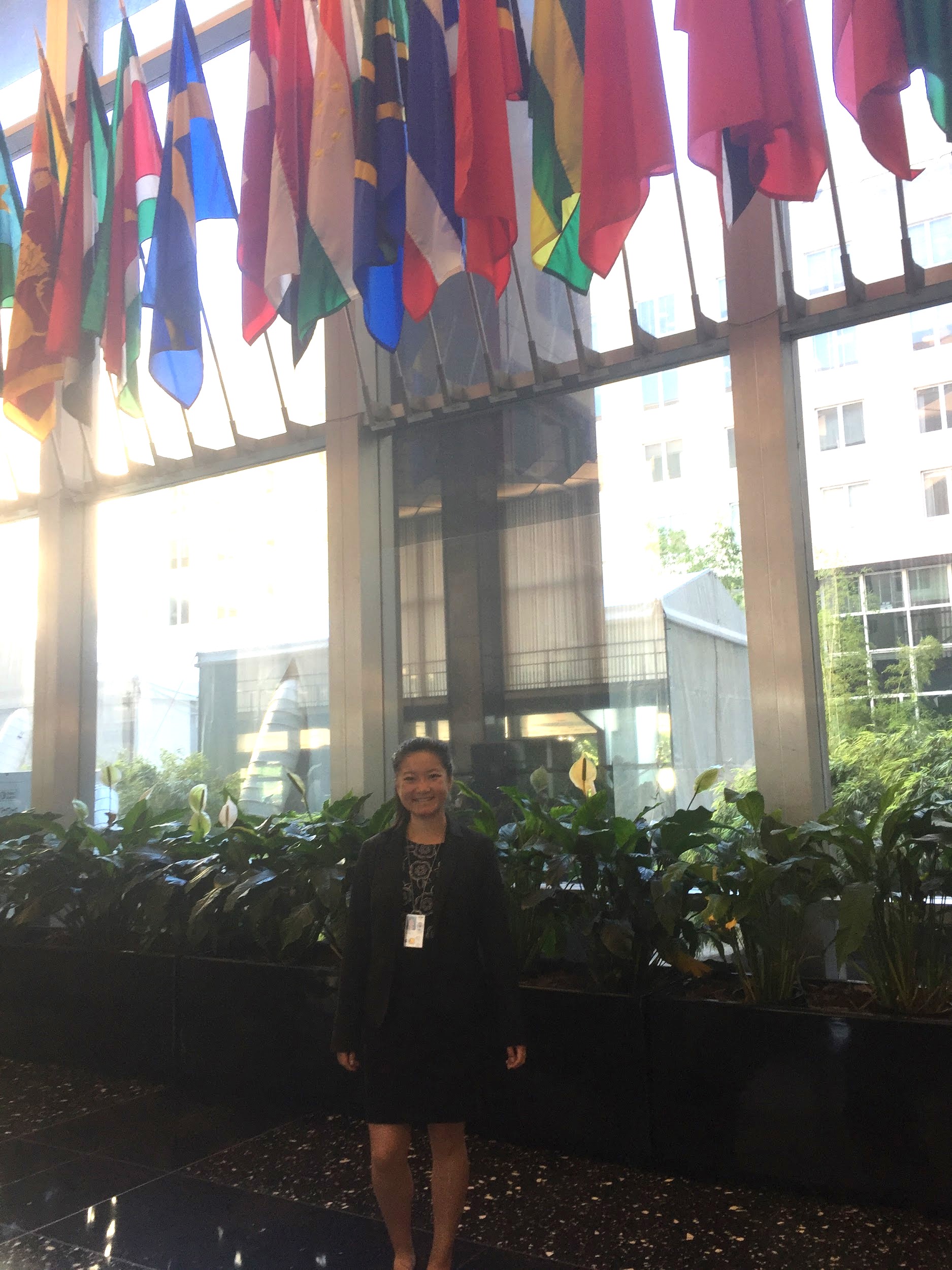
Mari during her internship at the U.S. Department of State, Washington, D.C. (Photo courtesy of Mari Lentini.)

Why did you select your major(s)? Have you studied abroad or done internships related to your studies?

I knew that I wanted to study abroad while in college. I absolutely could not wait to go to France and use French in my daily life. L&IT really interested me because in addition to the class requirements, there are two education enrichment requirements: one is to study abroad in a country with your target language and the second is to complete an internship at a company that uses your language. These components demonstrated to me that Clemson cared about my growth and development in language and cultural fluency.

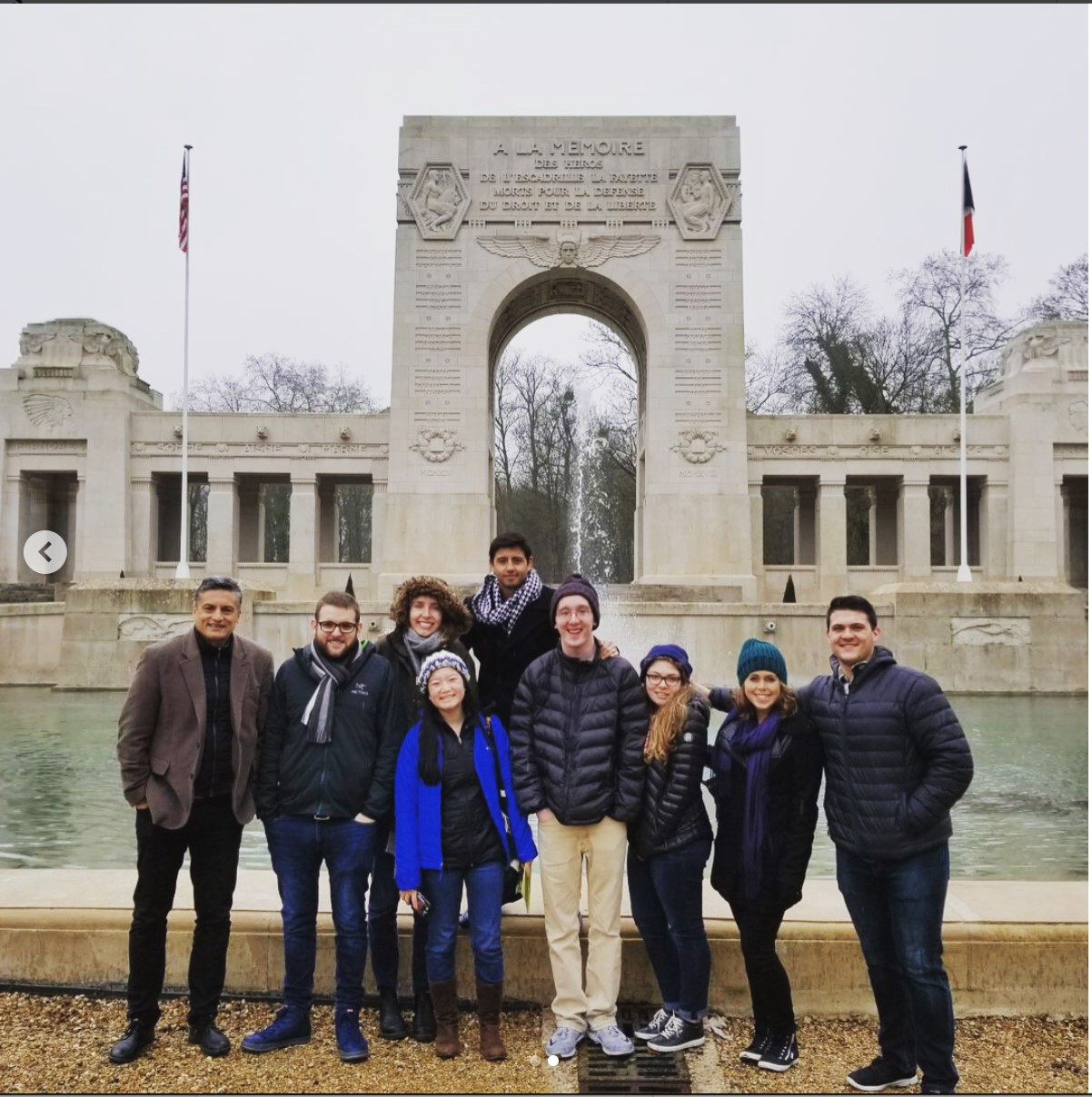
My minor is in Global Politics, which shaped my study abroad experience. I completed two study abroad programs back-to-back. First, in winter 2017 with the Institute of American Universities College, I had the amazing opportunity to explore how American diplomacy and its institutions are implemented abroad, specifically in Morocco, Belgium, and France. This included understanding the structure of U.S. embassies, meeting with diplomats at the U.S. Consulate General in Casablanca, the U.S. Mission to the EU, and the U.S. Mission to NATO, and visiting non-governmental organizations to grasp the effectiveness of the track II diplomacy approach in assisting with conflict resolution and the achievement of foreign policy goals.

Immediately following this, I studied for a full semester in the south of France with IAU College at Aix-en-Provence. I did a homestay to fully immerse myself in the French language and culture. My classes included courses such as Arabic (at the moment, Arabic is not offered at Clemson, so I jumped on the opportunity to learn a new language while abroad!), International Economics and the EU, and French Children’s Literature, to name a few.

Mari with the 2018 American Diplomacy study abroad cohort in Paris, France. (Photo courtesy of Mari Lentini.)

If you would like to read more about my experiences and see pictures, feel free to check out my study abroad blog: www.aixperiencefrance.wordpress.com.

For my internship, I interned in Washington, D.C. with the U.S. Department of State in Summer 2018. I was an Orientation intern at the Foreign Service Institute. Orientation, colloquially known as A-100, for newly-hired U.S. diplomats is where they learn more about the State Department and skills they need to be successful for their career in the Foreign Service. I helped to coordinate and participate in their workshops, and this experience provided invaluable insight in my decision to pursue a future in foreign policy.

What advice would you give to other students in your major?

I would encourage students to develop strong and meaningful relationships with one another and their faculty. Get to know your advisor and other people in the major early on inside and outside of the classroom – the Introduction to L&IT class is a great place to start as well as your language’s professional society. Participate in your language club’s events, like the film showings and their conversation tables. Reach out to past students who have gone abroad or interned and hear why they picked the city or program that they did, and then continue to stay in touch with them!

Are you involved in any extra-curricular organizations, and what is your role?

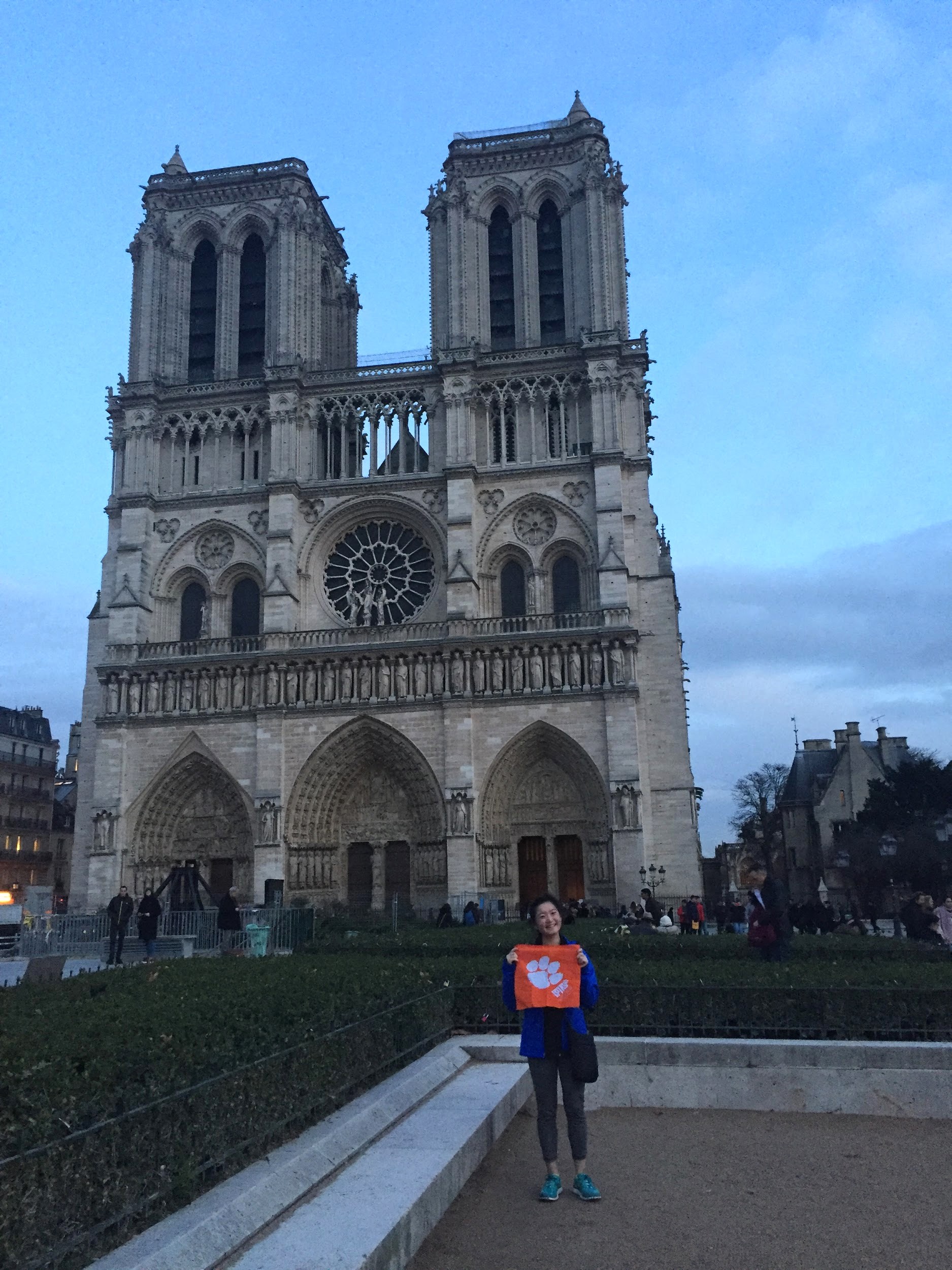
Mari at Notre-Dame Cathedral in Paris, France. (Photo courtesy of Mari Lentini.)

I am someone who likes to be busy and involved in my community, and I am still discovering new clubs that match my interests in languages, foreign policy, and music. Currently, I am the President of the French Professional Society and am helping to plan the upcoming L&IT conference in March 2019. I also am a delegate for the university’s Model United Nations team and chaired for committees at the Clemson University Model United Nations Conference and a French collegiate conference in Aix-en-Provence. I serve in the judicial branch of Student Government and manage finances for my service sorority, Gamma Sigma Sigma. I also love concerts and country music, which is why I became part of CMA EDU. As Vice President of Special Events, I help to plan and coordinate the events for our members, including opportunities to learn more about careers in the music industry and the business side of it from professionals.

What are your future plans?

I am searching for a business or foreign policy internship for the upcoming summer. I am also in the process of researching fellowship programs that will help make graduate school more accessible for me. I would love to continue my learning in area studies, specifically in the effects of French colonization on the development of North African societies, or in the field of international law. My dream career is to join the U.S. Department of State as part of their Foreign Service.

Meet a Tiger: Stephen Fitzmaurice

From the Newsstand:

Taylor Summey, Class of 2021
December 10, 2018

This Tiger helped develop Clemson’s American Sign Language (ASL) educational interpreting program, which gives students the necessary knowledge and experience to work with deaf children in mainstream school systems. Educational interpreting is offered in only seven programs across the country. Clemson is the only higher-education institution in the state that offers a four-year degree in ASL.

Meet Stephen Fitzmaurice.

Title: Assistant professor of ASL interpreting

Years at Clemson: Nine. I started at Clemson as a visiting assistant professor with the goal of launching an interpreting program. Five years ago, I was offered a tenure–track position.

What I do at Clemson: I teach upper-level ASL coursework, mostly related to linguistics and ASL-English educational interpreting. I am also the principal investigator for a large grant from the South Carolina Department of Education to manage the South Carolina Educational Interpreting Center.

What I love about Clemson: I absolutely love Clemson students. The students I meet, teach and advise carry with them an effervescent yearning to learn and a passion to serve the greater good. The other thing I love, particularly about the department of languages, is we have such a culturally and scholarly diverse faculty – the opportunities to engage with teachers and scholars from such different backgrounds is always thrilling. Finally, I love that Clemson is the only institution in South Carolina offering a four-year degree in ASL and is home to one of only a handful of educational interpreting programs in the nation.

My defining moment at Clemson: One defining moment for me was attending the graduation ceremony and witnessing the first modern languages (ASL) students receiving their degrees. I knew each one of the students to be exceptionally talented Tigers. They all had job offers when they walked across the stage.

Accomplishment I’m most proud of: I am most proud our alumni. They are all gainfully employed and are scoring significantly higher on their exams than the national mean. I am also proud of the fact that I was able to complete my doctoral degree at Gallaudet University while raising two amazing kids and working at Clemson full time.

Where I see myself in five years: I see myself wearing Clemson orange and continuing to grow our program.

Last thing I watched on TV: Aside from Clemson football and Clemson men’s and women’s soccer – Madame Secretary.

Guilty pleasure: I love Lindt dark chocolate with chili peppers.

One thing most people don’t know about me: I am originally from Canada but have lived in South Carolina for the last 20 years. And, although I am left-handed, I sign right-handed.

https://youtu.be/hN-026t3qBo

Spanish students present research

Students in two 3000-level Spanish courses presented their research on literary themes as well as on social, economic, and political topics.

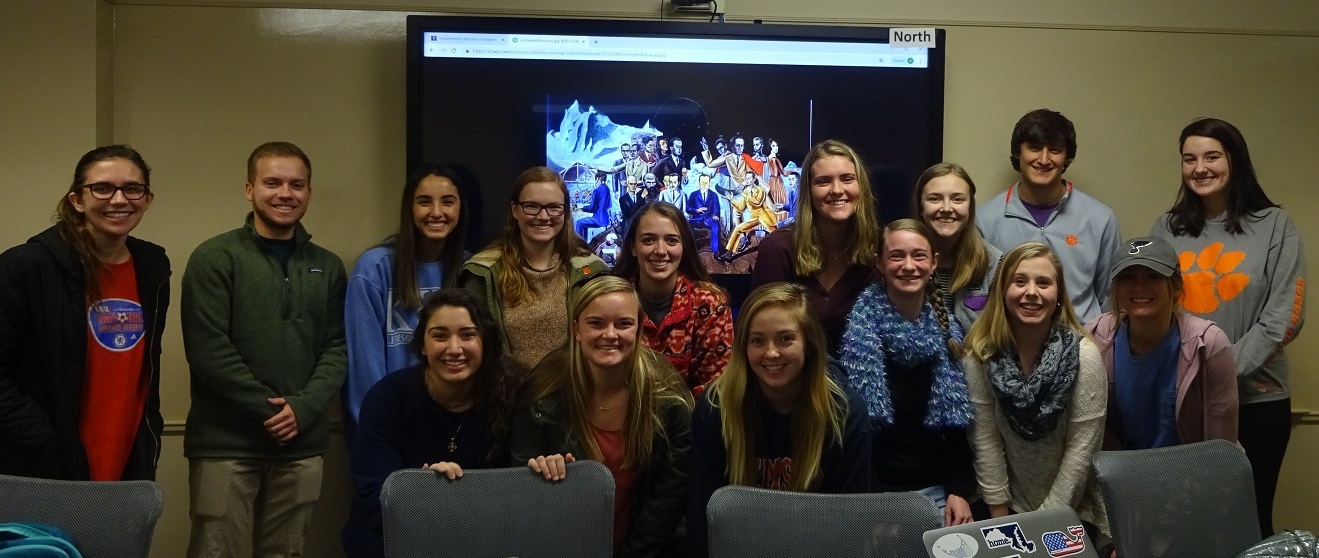
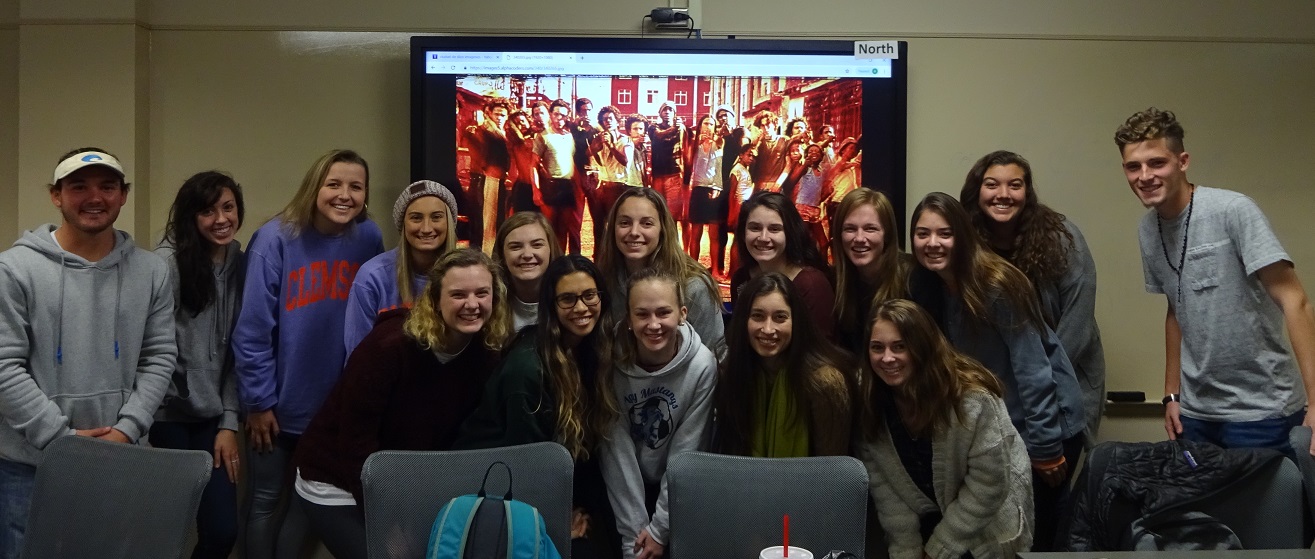
SPAN 3040 students. (Photo courtesy of Graciela Tissera.)

SPAN 3040 students Elisabeth Amini, Erin Clark, Anna Corontzes, Kara Donovan, Courtney Grayson, Madison Herin, Sarah Mcerlean, Allie Mchugh, Melissa Pratt, Hannah Reach, Maegan Reed, Keasler Rothemich, Bryson Rudolph, Mary Elizabeth Schaible, and Jacob Stackelhouse presented their research in the course ‘Introduction to Hispanic Literary Forms’ offered by Dr. Graciela Tissera. Students analyzed works by Jorge Luis Borges, Ana María Matute, Mario Vargas Llosa, José Martí, Rubén Darío, and Federico García Lorca to research transcendental themes and distinctive techniques related to narrative, poetry, and drama.

SPAN 3050 students. (Photo courtesy of Graciela Tissera.)

The following students in Tissera’s SPAN 3050 class also presented their research: Ryan Beale, Peyton Bramlett, Anna Clare Eckrich, Meredith Franchi, Laura Issel, Rachel Kral, Michelle Logan, Jamie Plummer, Hunter Rivers, Van Robertson, Emily Rowe, Courtney Sciarro, Hannah Shaffer, Heather Sloan, Cassidy Tom, and Natalie Ward. The presentations focused on controversial topics and on the analysis of the film City of God (Fernando Meirelles & Kátia Lund, 2002). Students explored themes such as diversity and gender, the psychology of willpower, the circle of poverty, personal and community identity, hope and survival, and the social impact of the arts.

In memoriam: Margit Sinka, professor emerita

Margit SinkaThe Department of Languages mourns the passing of Margit Sinka, professor emerita of German, who passed away on October 28, 2018 at the age of 76.

Margit was born during World War II in Hungary. She and her parents moved to Vienna, Austria, before immigrating to the U.S. and settling in a Hungarian neighborhood in Cleveland, Ohio. Margit was trilingual in Hungarian, German, and English; she also developed some fluency in Spanish. She earned her Ph.D. in German at the University of North Carolina at Chapel Hill.

Margit was a member of the Clemson faculty for 33 years. She taught intermediate and advanced German language and literature courses and served as the head of the department’s German section. Her research focused on Medieval German Literature, Modernism (German prose and drama), Contemporary Fiction, Contemporary Culture with an emphasis on Berlin Studies, Holocaust Memory and Representation, and German Cinema. During her career at Clemson, Margit held several important national and regional positions in the field of German, and in 2008, she received the Merit Award from the national American Association of German Teachers and the New York Goethe Institute. After retiring in 2007, she continued to work part-time and conducted five-week Clemson University summer study abroad programs on Holocaust Remembrance in Brussels and Berlin.

Assistant professor of German Gabi Stoicea recalled Margit as “energetic, jovial, and very enthusiastic about Clemson and about our department in particular.”

Margit’s memorial service will take place at 2 p.m. on December 1, 2018 at the Unitarian Universalist Fellowship of Clemson, 226 Pendleton Road, Clemson.

Click here to read the Inside Clemson obituary.

Department hosts 46th Annual Declamation Contest

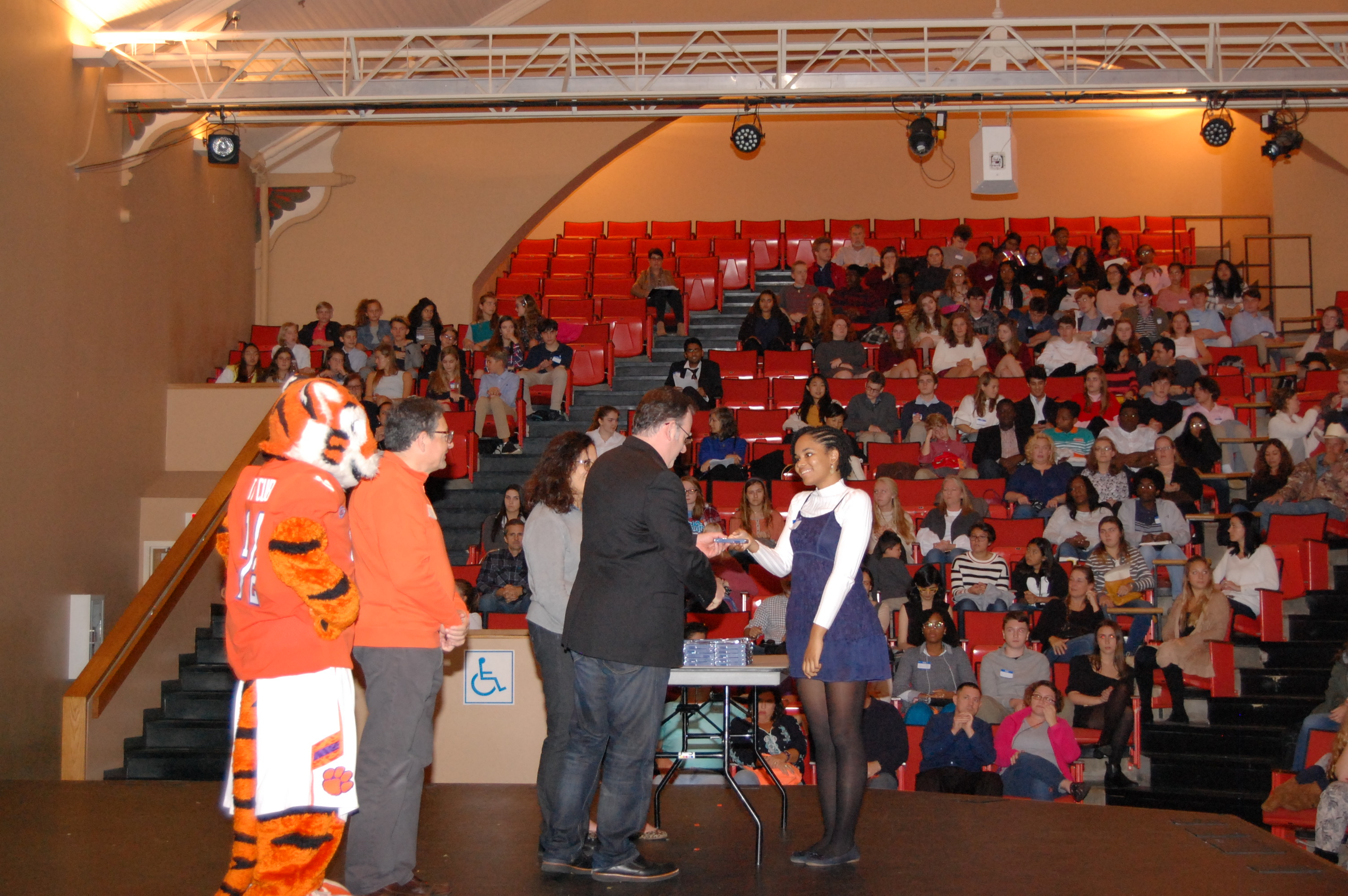
The Declamation awards ceremony in Tillman Hall. (Photo courtesy of Clemson University.)

On October 27, 2018, the Department of Languages hosted the 46th Annual Declamation Contest. This poetry recitation contest brings together middle- and high-school students from the region, who come to the Clemson campus for the day to show off their language skills. This year, 485 students from 31 middle and high schools in South Carolina, Georgia, and North Carolina registered to compete in ASL, Chinese, French, German, Italian, Japanese, Latin, Russian and Spanish. Clemson students also volunteered to set up, help with registration and parking, supervise contest rooms in Daniel Hall, and lead campus tours. The campus tours were a new offering this year, with approximately 80 contestants and their families participating.

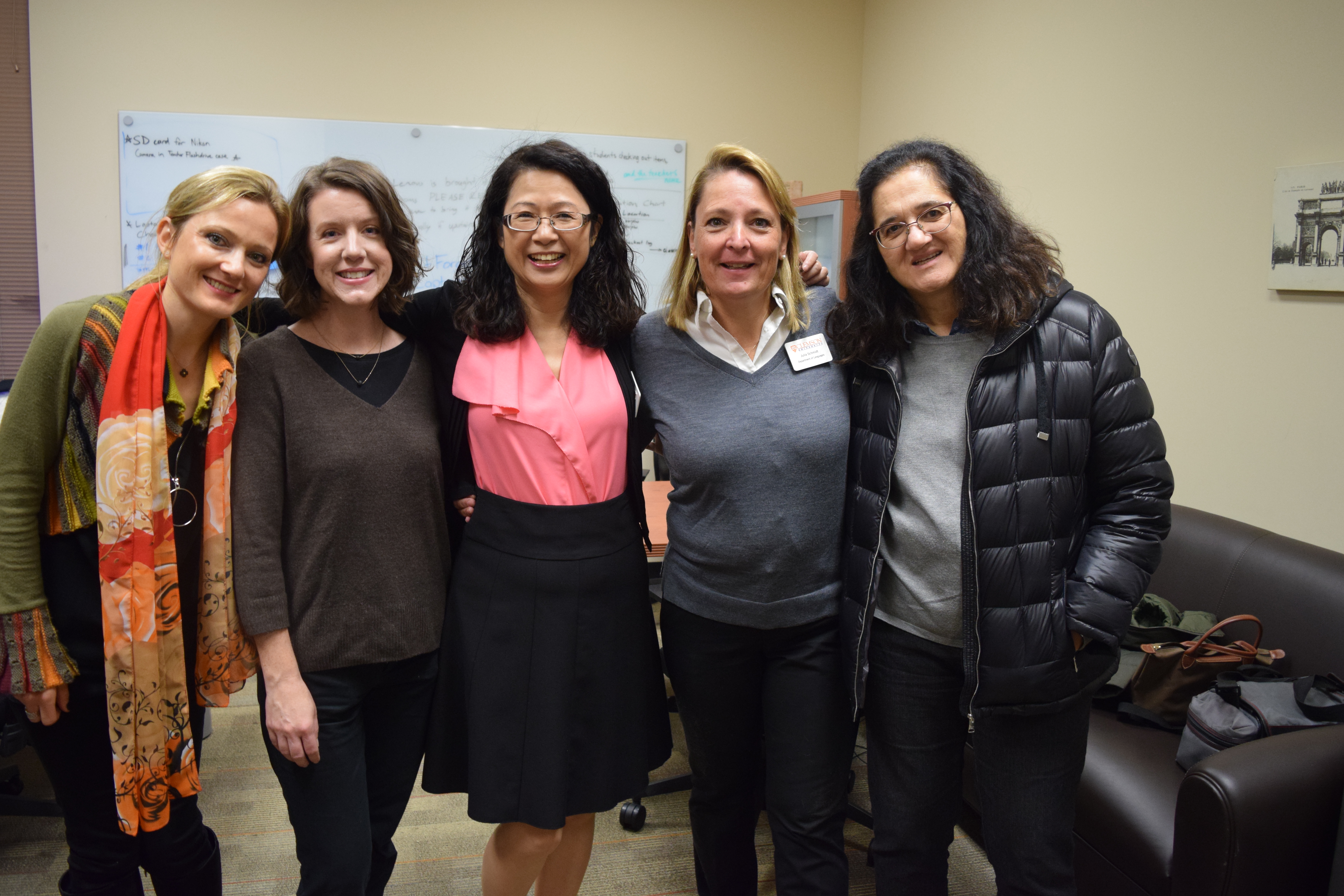
Some members of the Declamation Committee. From L-R, Anne Salces y Nedeo, Amy Sawyer, Su-I Chen, Julia Schmidt, and Dolores Martín. (Photo courtesy of Clemson University.)

Competitors recited two poems, a mandatory selection and a second selection. They were evaluated by 64 judges, who included Clemson faculty and staff and members of the community. After the judging was complete, students and their families attended an awards ceremony in Tillman Hall. The event also gave participants a chance to explore the campus, eat in a dining hall, and learn more about the school by joining a tour. Past Declamation participants have attended or are now attending Clemson to study foreign languages.

The contest’s continued success is due to the hard work of the Department’s faculty and staff, all of whom volunteer at the event, especially the Declamation Committee of Su-I Chen, Melva Persico, Doroles Martín, Anne Salces y Nedeo, Amy Sawyer, and Julia Schmidt. The Department is grateful for the continued support of donors Dr. Rob Roy McGregor, Jr. and Dr. Ralph Rynes; the volunteer judges; and the Dean’s Office of the College of Architecture, Arts and Humanities.