Clemson Extension Upstate District

Forged In 4-H in Union County

Forged In 4-H

Mark Cathcart
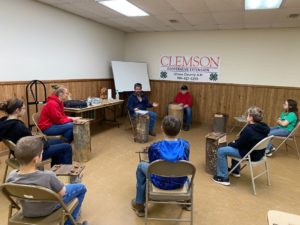
Forged in 4-H classroom
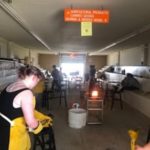
Union County, Forged In 4-H classroom time.

Being a 4-H agent is the most rewarding, frustrating, difficult, and easiest job I have ever had.  4-H agents do everything at once while everyone thinks you are doing nothing or just playing with kids.  On top of that, we must figure out how to pay for it all. It is often difficult to obtain proper funding to conduct programs at the desired level. Every now and then an opportunity comes along that can help with funding our programs.  The Extension Innovation Award is one of these opportunities.

As a blacksmith, I have a desire to pass the love of this trade on to a younger generation. The blacksmithing “tools of the trade” are always two things, heavy and expensive.  With that in mind, I piloted a blacksmithing program with a homeschool group with “makeshift” equipment and some of my own personal tools to see what would happen.  The enthusiasm was overwhelming!  At this point I realized that with a dedicated set of equipment their learning curve would steepen, and the love of this trade would deepen.  Now I had a new problem, MONEY.  After receiving the Extension Innovation Award, I was able to leverage the City of Union to give some more money to buy the proper equipment.  This equipment has allowed me to accelerate the home school group’s knowledge and technique as well as conduct two summer day camps.  We even gave the program a name, “Forged In 4-H”.

“Forged In 4-H” is designed to teach metallurgy and blacksmithing skills, as well as provide school enrichment through demonstrations, in a safe manner, with the use of chemistry, geometry, physics, math, and hands on projects. This program and equipment are being used to teach 4-H youth of all ages and any student through school enrichment including homeschool groups. The equipment will be housed in Union County, where the principal teaching location will be. The equipment will be kept mobile so that it can be moved to any county in the state to conduct short term projects, demonstrations, day camps, and school enrichment.

The use of hands-on learning techniques will allow students to experience and learn the trade of blacksmithing. With a resurgence of interest in blacksmithing, this is a need that begs to be met. This program is innovative for several reasons. First, we are leading the way in offering blacksmithing in 4-H. Only a few counties in the nation offer a 4-H program similar to this one. This may be due to lack of agents and volunteers who do not have the knowledge or funding. The interest in just my county has been overwhelming. Second, blacksmithing is an ancient art, but we will be teaching it in a new, modern, and exciting way. We will be teaching the life skills of blacksmithing to the younger generation, instilling an appreciation for an ancient art form, and preserving skills that we do not need to lose as a society. Third, we will be providing hands on knowledge and skills in a field that may become a career for some 4-H’ers. Forging, welding, metal working, and fabricating are not going away any time soon. In a world filled with technology, all too often we do not teach youth how to make something real and tangible. With young people spending an exorbitant amount of time on computers and cell phones, real world skills fall to the wayside. Putting simple math and geometry skills to work, seeing chemistry and physics in action, and developing simple hand eye coordination can easily be overlooked.

As youth development agents, it is our job to help young people choose a life path. If we can help these 4-H’ers become productive citizens, then we have done our job.
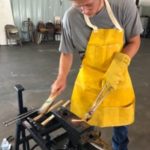
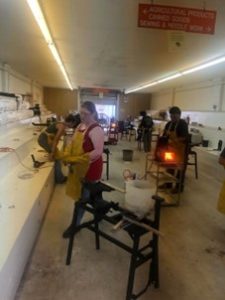
forging studentforging students workingforging students workinghot forge

Area Forestry and Natural Resources Report

Area Forestry and Natural Resources Report

Jeff Fellers

Summer is nearing an end and now is the time to get ready to make our way into the fall and winter.  We have had a busy summer in Extension as operations have returned to normal after the Covid outbreak.  This summer I have hosted two forestry association meetings, hosted a Hardwood Regeneration Workshop, wrapped up Master Tree Farmer with three different field tours across the state and made numerous direct contacts through field visits, office visits, and phone calls.

In May, I hosted a Hardwood Regeneration Workshop in McConnells, South Carolina.  In a state where pine is the number one timber crop, many times our hardwood stands get ignored.  This program was geared towards both landowners and professionals.  The program offered continuing education credits for professional foresters and those that needed pesticide credits.  This was an eight-hour program that went in-depth about how to convert an existing hardwood stand into a hardwood stand with favorable species for timber and wildlife.  The program had a classroom session and field tour that occurred at a demonstration site at Draper Wildlife Management Area.  Participants learned about herbicide prescriptions to control and kill existing timber, the basal area that needed to be left to maintain an existing canopy, and planting techniques for species that would be desirable in this situation.  We had 16 people attend this program, which included both landowners and professionals.  We had seven surveys completed on the program.  Of those seven, five were professionals and two were landowners.  The survey participants represented 903 acres owned and 131,000 acres managed.   Dr. Stephen Peairs (Clemson) and Dr. David Clabo (Georgia) provided the presentation based off of Dr. Peairs research and demonstration on the Draper WMA.  This workshop provided a good example of how research from Clemson University can help our local landowners better manage their hardwood stands.

May was a busy month, as I also hosted a meeting for the Newberry Forestry Association and the Laurens Forest Landowners Association.  The Newberry Forestry Association met for the first time since the Covid outbreak.  We had 29 people in attendance and had a program on Chronic Wasting Disease in Deer presented by Charles Ruth from SC Department of Natural Resources.  The Laurens Forest Landowners Association had 35 people in attendance and had a program on cost share available to landowners.  This program was presented by Chisolm Beckham with the SC Forestry Commission and Lisa Good with the Natural Resource Conservation Service.

Both of these Association also met in August.  The Newberry Forestry Association had 33 in attendance, and the Laurens Forest Landowners Association had 36 in attendance.  Carla Carlos from the SC Forestry Commission presented at both of these meeting on pine genetics.  These groups meet on a quarterly basis with their meetings typically being held in February, May, August, and November.  If you would be interested in attending any of these meetings, please contact me, at fellers@clemson.edu.

Master Tree Farmer was offered this year as a hybrid course.  The majority of the course was virtual with presentations online for participants.  Field tours at the end of the course were optional. We had 180 participants take the class, and roughly 130 participants took part in the field tours.  Field tours were hosted in the Upstate, Midlands, and Coastal area to help reduce travel for the participants.  Field tours were held on private lands where property owners were actively managing their timber.  The property owners provided details on how they managed their property, mistakes they had made, and things that they had done right to help better educate participants in timber management.

I also serve on the Indian Creek Quail Restoration Committee.  This committee puts out two newsletters a year.  One was published in March, and the next will be published in September.  These newsletters are great tools to get more information on managing for Quail.  This committee also hosts two workshops a year.  Our previous workshop was hosted in May, at the Belfast plantation owned by the SC Department of Natural Resources.  Attendees were able to see how the staff at the Belfast Plantation manages the property for Quail.  Participants visited sites that demonstrated timber thinning, beneficial native plant species, prescribed burn areas, and chemically treated areas to benefit habitat for Quail.

Lastly, I always enjoy the one-on-one site visits, phone calls, and office visits.   One-on-one visits provide a personal education experience where landowners learn how to better manage their specific property or natural resources.  This summer I have had 82 direct contacts that touched on subjects from timber management, wildlife management, invasive weed control, pond management and general horticultural/garden questions just to name a few.  Through these methods of direct contact, I have reached at least 100 people and 725 acres of owned property.

It has been a busy summer, with many programs offered for forestry and natural resource education.  If you would like more information on programs available for forestry and natural resource, please contact me, at fellers@clemson.edu.

It’s An Exciting Time For 4-H

It’s An Exciting Time For 4-H

Mark Cathcart
4-H Youth Development Agent
     It is time for Union County 4-H to get back to in person meeting.  It has not happened in a while and 4-H has found different methods of providing programming. However, nothing replaces in-person meetings and activities.  With the new year, comes new opportunities for 4-H to be a positive influence on the children and youth in our community.
     As we begin to build speed on the familiar road of 4-H clubs and projects, some things will look the same.  Because of their past success and popularity, clubs like Shooting Sports, Baking Buddies, Recycling Club, and Woodsrunners are back to monthly meetings.  Other things will look different as we constantly strive to keep young people interested and engaged.
     School enrichment is another aspect of 4-H that is getting back on track.  School enrichment is in-class support and reinforcement of lessons and school standards already being taught.  Classroom visits usually consist of a lesson, a demonstration, and an activity.  Currently, 4-H offers school enrichment in embryology, electricity, erosion & environmental protection, rocket science, and will soon have lessons on natural resources & wildlife.  Teachers can contact the Union County Clemson Extension office to set up a lesson and schedule a time.
     If you are interested in becoming a 4-H member, contact the Union County Extension office for information and instruction on how to do that.  Also, if you are an adult with a special interest or knowledge on a particular topic and would like to become a 4-H volunteer, please feel free to contact us.  This is a great way to be a positive influence on the young people of Union County. Contact us at 864-427-6259.
Club Meeting Schedule:
Woodsrunners — 1st Thursday @ 7pm
Shooting Sports — 2nd Thursday (BB) and 4th Thursday (archery) @ 7pm
Poultry Club — 3rd Thursday @ 7pm
Baking Buddies — 2nd Tuesday @ 3:30 pm
Recycling Club — 4th Tuesday @ 3:30 pm