South Carolina Hardwood Pulpwood Prices Continue Decline
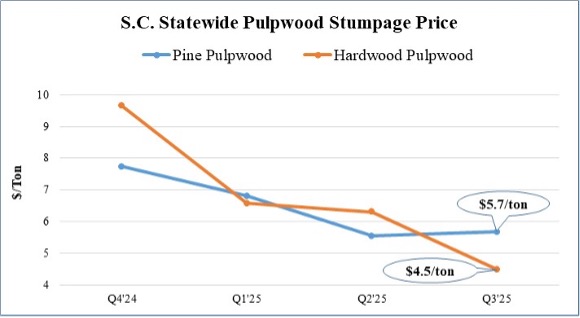
In the third quarter of 2025, the average statewide prices for pine and hardwood pulpwood in South Carolina were $5.70 per ton and $4.50 per ton, respectively. Compared to the first quarter of 2025, pine pulpwood prices have dropped by approximately 16%, while hardwood pulpwood prices have seen a more significant decline of about 32%. Both pine and hardwood pulpwood prices have been steadily falling since the third quarter of 2024, with hardwood prices experiencing a much sharper decrease. Meanwhile, pine pulpwood prices have remained relatively stable over the last two quarters. Interestingly, while hardwood pulpwood prices were higher than pine in the previous quarter, this trend has reversed in the latest update. Notably, both pine and hardwood pulpwood prices have fallen below $6 per ton in both the Lowcountry and Upstate regions of South Carolina.
South Carolina Sawtimber Prices Show Mixed Trends in Q3 2025

In the third quarter of 2025, the statewide average prices for pine and hardwood sawtimber in South Carolina were $22.80 per ton and $16.00 per ton, respectively. Compared to the previous quarter, pine sawtimber prices increased by about $1.00 per ton, while hardwood prices saw a slight decline of approximately 25 cents per ton. Over the past two years, the changes in pine stumpage prices have been less significant than those for hardwood stumpage.
Pine stumpage prices have dropped by roughly 2%, with hardwood prices seeing a much steeper decline of around 37% compared to the same period last year. Notably, hardwood prices have fallen more sharply in the Upstate region than in the Lowcountry, although both regions have experienced declines. This trend signals a challenging market environment for hardwood stumpage sellers across the state. Additionally, hardwood sawtimber has consistently sold for less than pine, and the price gap has continued to widen in this latest quarter. This growing disparity highlights the ongoing difficulties faced by hardwood producers in South Carolina.
Wood Market is Local
Stumpage prices for both sawtimber and pulpwood in your local markets could vary significantly as compared to the above statewide averages depending on: size and species composition, quality of timber, total acres and volume, logging operability, distance from nearby mills, and overall market condition.
Data credit: The sawtimber and pulpwood price data included in this newsletter are published with permission from TimberMart-South Athens, GA 30605 email tmart@timbermart-south.com.
Clemson Forestry Research Updates
Impact of Forest Product Manufacturers on Forestland Attributes Across SC (Awasthi et al., 2025)
Between 2011 and 2021, the forest product manufacturing landscape in South Carolina showed significant shifts. The number of biomass industries grew dramatically, while the number of pulp and paper mills stayed the same. Biomass production capacity increased across the state, particularly in the Piedmont region, while paper mill capacity saw mixed trends. Despite overall growth in timber resources, harvest volumes and live tree density decreased in some regions, particularly in the Coastal Plains. The distribution of mills also shifted, with clusters moving closer to urban areas, likely due to lower land costs and easier access to skilled labor. Interestingly, areas with higher aboveground carbon tended to have more mature forests, whereas regions with higher harvest volumes showed declining tree densities. The expansion of biomass mills, in particular, contributed to higher harvest volumes, which may impact long-term carbon storage potential. Despite these changes, biomass mills appeared to have a larger influence on forest attributes than other types of mills, highlighting the growing role of the biomass industry. These findings suggest a complex balancing act between increasing forest product demands and the need for sustainable forest management practices that support both carbon sequestration and timber production.
Understanding the Drivers of Deer-vehicle Collisions in SC (Sharma et al. 2025)
This study analyzed deer-vehicle collision data in South Carolina from 2018 to 2021 and identified key factors that contribute to these accidents. The highest number of collisions occurred in October, especially between 8:00 PM to 10:00 PM and 6:00 AM to 8:00 AM, when deer are most active. Collisions were more common on main roads and in areas with developed land or cultivated spaces, which are habitats that deer frequent. The study also found that counties with denser road networks, like Charleston and Greenville, had more DVCs. Using machine learning, a model was developed to predict DVCs based on factors like proximity to developed areas, water sources, and land cover types. The model showed that developed areas and traffic flow are significant contributors to DVCs, suggesting that managing traffic speeds, adding barriers, or adjusting road designs around high-risk areas could help reduce accidents. This study provides valuable insights for future strategies to prevent DVCs, particularly in high-risk areas during peak times.
Forest Industry Update (Source: Newsletter, NASAF Forest Market Committee)
Blog Summary – Growing the Future: Celebrating the Impact of Southern Forest Products
National Forest Products Week (October 19-25, 2025) celebrated the vital role southern forests play in the U.S. economy, with the region producing over half of the nation’s sustainable timber and generating more than $251 billion annually. Southern forests are known as the world’s wood basket, supplying timber for common products like paper, lumber, furniture, and flooring. However, they also provide lesser-known materials used in a variety of industries. For example, cellulose derived from wood is used in pharmaceuticals for tablet stability, in textiles like rayon for clothing and bedding, and even in bioplastics for food packaging and medical products. Additionally, terpenes extracted from wood are used in fragrances and flavors for a wide range of consumer products.
The South also leads in renewable energy production through forest biomass, with materials like tree trimmings, sawdust, and wood chips being converted into energy resources like wood pellets, syngas, and biogas. These renewable energy sources help reduce carbon emissions and support cleaner energy alternatives. The region’s forests are primarily owned by private landowners who practice sustainable forestry, ensuring the long-term viability of these valuable resources. By balancing resource use with ecological preservation, southern forests support over 1.1 million jobs and continue to contribute to both the economy and environmental health.
Author
Puskar Khanal, Cooperative Extension, Forestry and Wildlife Specialist
This information is supplied with the understanding that no discrimination is intended and no endorsement of brand names or registered trademarks by the Clemson University Cooperative Extension Service is implied, nor is any discrimination intended by the exclusion of products or manufacturers not named. All recommendations are for South Carolina conditions and may not apply to other areas.
Clemson University Cooperative Extension Service offers its programs to people of all ages, regardless of race, color, gender, religion, national origin, disability, political beliefs, sexual orientation, gender identity, marital or family status and is an equal opportunity employer.
