Physics and Astronomy Blog

Prof. Kaeppler’s sounding rocket experiment INCAA featured in popular German podcast

German radio journalist Kristian Thees and German actress and entertainer Anke Engelke, talk about the NASA sounding rocket experiment INCAA and the image of tracer releases in Alaska submitted by listener Prof. Gerald Lehmacher, who was co-investigator for the experiment. Prof. Steve Kaeppler and Prof. Miguel Larsen were principal investigator and co-investigator, respectively. The photo taken by Danute Paukstys from Wasilla, Alaska is featured in the podcast’s blog and discussed (in German) in the episode of May 26, 2022 (starting at about 8:50 min). Two sounding rockets were successfully launched on April 7, 2022 from Poker Flat, Alaska to study ion-neutral coupling under active aurora. The payloads carried experiments from the University of California Berkeley, the University of Calgary and Clemson University.

INCAA
INCAA tracer releases over Alaska (Photo: Danute Paukstys)

Clemson CI students present their rocket research at ESA symposium

Clemson undergraduates Austin Smith and James Hutchinson presented the student rocket experiments carried out under the supervision of Prof. Steve Kaeppler and graduate student Alvaro Guerra over the last two semesters at the 25th ESA Symposium for European Rocket and Balloon Programmes and Related Research in held on May 1-5, 2022 in Biarritz, France.  Their oral presentation entitled “Clemson University Student Space Program: Educating Students in the Field of Space Physics” was given in the “Rockets & Balloons in Space Education” session and received broad attention and feedback from scientists and students in the audience.

presentation
James Hutchinson and Austin Smith give their conference presentation at the Casino Municipal auditorium
participants
Austin Smith, James Hutchinson, Prof. Gerald Lehmacher (Clemson University)
sunset
Group photo of student participants at the 25th ESA symposium

Yang Yang Awarded Harvard-SAO Predoctoral Fellowship

Please join me in congratulating Yang Yang for being awarded a Harvard-SAO Predoctoral Fellowship. Over the past few years, several PhD students from our department have had the opportunity to work at other research institutions as part of their graduate education. Yang Yang is the fourth student in recent years (joining Amy Gall, Xiuriu Zhao, and Jordan Eagle) to be awarded this prestigious fellowship. Kudos to Prof. Takacs for the mentorship and support he has provided to help Ms. Yang achieve this opportunity. At the SAO she will use their electron beam ion trap to generate laboratory astrophysics atomic data for AtomDB, the databased maintained by SAO for the analysis of astrophysical spectra. She works closely with one of our alums, Dr. Gall, and is involved in collaborative work with the University of Georgia and Auburn University funded by NASA. This is a very exciting achievement for Ms. Yang!

An X-ray of a Kilonova

August 17, 2017 was a watershed moment for multimessenger astronomy when the gravitational waves and photons from a kilonova were detected for the first time. And GW170817 continues to surprise. A kilonova results from the merger of neutron stars and is thought to be the source of heavy elements such as gold.

Our colleague, Prof. Jon Zrake, was part of team that has monitored the evolution of X-rays from this source. Initially the source was fading, but in 2020 the fading stopped and has remained relatively constant since. This provides intriguing insight to the physics of neutron star mergers and the subsequent explosion. The behavior of the X-rays is somewhat puzzling, and this team has proffered two explanations to account for the behavior – one possibility is that we are seeing the afterglow of the kilonova. Another possibility is that we seeing the accretion signature of material falling into a blackhole formed by the merger of these neutron stars. If the constant brightness is due to an afterglow, we should see the source brighten again. If the result is due to accretion into the black hole, then the source should remain constant or fade away over the next few years. Either result will provide valuable insight to the physics of kilonova. This work was published in the Astrophysical Journal Letters and can be accessed here.

Clemson Students Win SCBio Competition

Alan Rowland, a first year Physics Ph.D. student, and Dylan Carroll, a genetics major, were finished second and third respective in SCBIO’s “Challenge Accepted” video competition. They developed videos highlighting their work in Dr. Podila’s lab. They described their work developing COVID-19 and tuberculosis sensors using smartphones. This work will increase access to such tests for people around the world. Read more about their fascinating work here.


In Memoriam: Jian He, professor of physics

I am sorry to announce that our friend and colleague professor Jian He has passed away. Jian was a prolific scholar, caring teacher, conscientious academic Professor Jian He and his research group.citizen and most importantly a good friend.
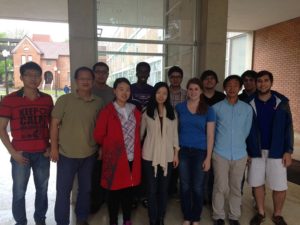
Jian earned his Ph.D. from the University of Tennessee and came to Clemson as a postdoc in 2004. In 2008, he joined the faculty of the Department of Physics and Astronomy as an assistant professor and climbed the ranks to full professor in 2021. Jian was a prolific scholar who published more than 257 peer-reviewed papers on a variety of topics in condensed matter physics. The esteem in which he was held by his colleagues is reflected by the large number of invited talks he has presented at conferences around the world. His collaborators spanned North America, Europe and Asia. He was also selected as a member of the board of reviewing editors for the journal Science. He mentored countless numbers of students in his lab and had a particular passion for undergraduate research. Condolences have been pouring in from students and colleagues around the world.

In addition to his excellence as a scholar, he was a caring mentor to his graduate and undergraduate students. His students have been recognized with numerous awards and honors from the Barry M. Goldwater Scholarship, the Astronaut Scholarship Foundation and the NSF Graduate Research Fellowship Program. Jian went above and beyond in providing the signature Clemson Experience for students.

We physicists have a reputation for having a bit of an ego, and Jian certainly earned the right to one. But perhaps no other scientist I’ve ever known has done more to shatter that stereotype. Jian was kind, helpful and unfailingly gracious. A few years ago, I hurt my ankle and Jian happened upon me while I was limping to my car. He told me to wait where I was, and he would be right back. He ran back to Kinard and a few minutes later came back with a pair of crutches. He told me he kept a set in his office for times when he sprains his ankle playing soccer (his other passion). This is just one of many stories we could tell that exemplify his kindness.

Jian will be missed but not forgotten. His example will serve as motivation to pursue excellence in our scholarly and teaching efforts as well as in showing kindness to those around us. To honor this passion for student engagement, we have established the Jian He Memorial Fund to provide support to undergraduate research in our department. Gifts can be sent to the Clemson University Foundation, P.O. Box 1889, Clemson SC 29633-1889 or call 864-656-5896. Online gifts can be made here.

Prof. Emil Alexov Awarded the Dr. Wallace R. Roy Distinguished Professorship

Prof. Emil Alexov has been awarded the Dr. Wallace R. Roy Professorship. This Professorship recognizes a high degree of collaboration with Prisma Health, success in health research funding and scholarship, evidence of leadership for multidisciplinary health research teams and mentoring of graduate students. Dr. Alexov is entering his 17th year as a member of the faculty of Physics & Astronomy. During this time, he has developed into one of the leaders of our department in all capacities.  He was instrumental in leading the efforts to build our current biophysics program that now includes three other outstanding faculty. He is now leading our search for the Dr. Waenard L. Miller, Jr. ’69 and Sheila M. Miller Endowed Chair in Medical Biophysics. Additionally, he has taken the lead on forming our new M.S. and Ph.D. programs in Medical biophysics. To accomplish this task, he has brought together 35 faculty across 10 departments at Clemson as well a three doctors from Prisma Health. This program will provide outstanding opportunities for students who will be prepared to apply fundamental physical principles to clinically relevant biophysical problems.

He has served as a CUSHR fellow and developed productive collaborations with clinicians at Prisma Health thus demonstrating to translating the insights that have emerged from his fundamental scientific work to application in a clinical environment. His research has garnered $4.3M in support and resulted in over 170 peer-reviewed publications. He maintains a software package, DelPhi, for analysis of macro-biomolecules that has been downloaded over 7000 times from users in 137 different countries. His research is integrated with education as well. To date, Dr. Alexov has graduated 9 Ph.D. students, 3 M.S. students, and 9 undergraduate students. He has also mentored 9 postdocs. His current group is comprised fo 3 postdoctoral researchers, 2 PhD students, 1 MS student, and 1 undergraduate student.

Please join me in congratulating Dr. Alexov for his excellence in transformative research and mentorship.


Sumanta Tewari comments on the status of Majorana fermions

In 2018 a group of researchers in the Netherlands reported the discovery of a Majorana fermion – an important candidate for comprising the qubits in topological quantum computing. Unfortunately the paper had to be retracted. In the news reports on this retraction, our very own Sumanta Tewari (who was not involved in the retracted study) was asked to comment. Read more about the study, its retraction, and Sumanta’s comments here.

Graduate Student, Lea Marcotulli, Awarded NASA Hubble Fellowship

Please join me in congratulating Lea Marcotulli for earning a NASA Hubble Fellowship. Open to astrophysicists around the world within three years of earning their PhD, this is among the most prestigious prize fellowships available to young astrophysicists. This year, there were 24 fellowships awarded, and Lea will be taking hers to work at Yale. Her scholarship is focused on the study of Active Galactic Nuclei. Using observational tools spanning the electromagnetic spectrum, she studies the accreting supermassive blackholes at the center of these galaxies. This is a great honor for Lea and a testament to her hard work, talent, and creativity.

Dr. Amy Pope Awarded the Jerry G. Gaff Faculty Award for Outstanding Teacher

Please join me in congratulating Dr. Amy Pope for being awarded the Jerry G. Gaff Faculty Award for Outstanding Teacher. This recognition is awarded annually by the Association for General and Liberal Studies to recognize a significant record of outstanding teaching and/or course development in general education programs, core curricula, or liberal studies. Founded in 1960, the Association for General and Liberal Studies is a community of practitioner-scholars that provides strategic, effective and innovative support for peers engaged in the day-to-day work of general and liberal learning in 21st century higher education. Dr. Pope is a beloved instructor who continues to find innovative ways to engage her students – especially those who enter their first physics course with more than a little trepidation. She tirelessly works to find new ways to communicate the relevance of physics to students from all backgrounds. Indeed, her most recent work at finding a way to reach students with Physics has been the development of a new course, “The Physics of Sports”. This award is well deserved recognition for her contributions to the mission of the Department of Physics & Astronomy.
