Clemson Extension Upstate District

2024 Saluda County Livestock and Forages Updates

Travis Mitchell
Livestock and Forages Agent for Newberry and Saluda Counties
Director for The South Carolina Cattlemen’s Association

 
Livestock and Forage producers around South Carolina are certainly ready for spring.  The spring bull and replacement heifer sales are in full swing, as this always seems to be a very busy time of the year.  As we move into 2024, input costs in every agriculture sector continue to rise.  Producers will face many challenges this year as they manage their budgets to navigate the rise in input costs.
The South Carolina Cattlemen’s Association held its annual meeting and convention on February 2 at the T.Ed. Garrison Arena in Clemson.  The educational components of the meeting focused on the beef cattle market outlook and investment strategies during market peaks.  Scholarships and state awards of excellence were also presented.  The South Carolina Cattlemen’s Foundation awarded four scholarships to deserving college students.
The Saluda County Cattlemen’s Association will hold its 32nd Annual Replacement Heifer Sale on Saturday, February 24.  Over 85 bred and open heifers will be auctioned from Saluda County cattlemen.
The Saluda County Cattlemen’s Association met on February 6.  Participants listened to an excellent presentation from Mr. Matthew Fischer, Clemson Extension Ag Economist.  Mr. Fischer gave producers a look into market expectations as we move through 2024.
The Saluda County Extension Service will offer a CAMM Recertification course on March 6 at the Hollywood Ruritan.  Participants interested in attending can call the office for further details on how to register.  2024 marks the end of the recertification block for producers holding a Private Pesticide Applicator license.  License holders are required to obtain five recertification credits by December 31, 2024.  A recertification course will be offered on March 6 at the Hollywood Ruritan Building.  Please call the Saluda County Extension office at 864-803-1123 to register.
 

Saluda County 4-H Spring 2024 and Upcoming Events

Lauren Venegas Black

4H Agent for Saluda County

As we enter the New Year, we have been busy with numerous activities, competitions, and events. Our monthly clubs have been meeting and doing multiple activities.

 For the month of January:

  • Our after school Clubs made Valentine’s posters for our Nursing Home patients.
  • Our cooking clubs learned how to make taco bites.
  • Our Sewing Club started working on a reading pillow.
  • Our Livestock Club learned about Horses.

School Enrichment:

  • We are still partnering with Saluda Primary Elementary School to provide art to kindergarten – 5th grade once a month.
  • We partnered with Hollywood Elementary School 4th grade to provide lessons on electricity and circuits through our Snap Circuits.

State Events and Competitions:

  • Congratulations to Sarah Ann Crawford for being selected to compete in the State 4-H Presentation Contest.
  • Congratulations to Makiyah Glymph on being selected as our Junior Poultry Record book Winner. She is now competing in the State Junior Poultry Record Book Contest.
  • Congratulations to Sarah Ann Crawford on being selected as our Junior Wildlife Food Plot Record Book Winner. She is now competing in the State Junior Wildlife Food Plot Record Book Contest.
  • We had several Juniors attend Junior Teen Weekend in February at Camp Long. Sarah Ann Crawford, Myla Long, Corley Jean Herlong, Caroline Berry, and Gillian O’Gorman. Mya Chapman also attended as a leader with the State Teen Council.

Upcoming Events and Projects:

South Carolina 4-H Engineering Challenge Overview
The event will be held at the South Carolina State Fairgrounds in Columbia, SC, on Wednesday, April 24, 2024, from 9 AM to 3:30 PM for youth ages 9-18 *. The SC 4-H Engineering Challenge began in 2012 and has grown annually to approximately 250 youth competitors! Youth who participated in this event reported increased confidence and knowledge in science skills. In addition to STEM-based
challenges for youth competition, there will be an interactive STEAM Expo from 11:00 AM – 3:00 PM.

4-H Poultry Project Offered
             It’s that time of year again to sign up for the 2024 4-H Poultry Project. It may be cool now, but Spring will be here before you know it, and the days will get warmer. With the current price of eggs, there is no better time to teach our youth the fun of raising and showing chickens. For the new or veteran chicken grower, this 4-H project offers youth the opportunity to learn valuable lessons in caring for and maintaining a flock in a fun and engaging atmosphere.
Raising baby chicks from day one to egg-laying age can be a rewarding experience for our 4-H youth across South Carolina. The 4-H Poultry Projects are open to all youth ages five to eighteen. Each county Clemson Extension office and 4-H Program will have registration information. Contact Steve Huck, Region Poultry Project Coordinator (chucks@clemson.edu), or Saluda County 4-H Agent at lblack4@clemson.edu.
             The 4-H Pullet Chain has been one of our most popular projects, and other than feed and shelter, it does not require an abundance of time or expense. Registration is open through March 3, 2024. Youth can order chicks in quantities of twelve ($45) or twenty-five ($85) to raise over the summer. Chicks will arrive in early May. This year’s breeds of chicks are Golden Comet, Rhode Island Red, and Barred Plymouth Rock. Each breed is a reliable layer. We encourage families to research before deciding which breed will be best for their 4-H project and as their backyard flock.
              Successful completion of the Pullet Chain project requires record keeping, showing at least one show, and returning a portion of the birds at the end of the project for auction. If you order 12 birds, you will return three birds to 4-H. If you order 25 birds, you will return five birds to a final 4-H Pullet Chain Auction, typically held after show season. Once the above is complete, the youth’s registration deposit is returned, and the remaining birds are theirs to keep for free. Proceeds from the auction help offset the cost of offering the project and all prizes/awards given throughout the year. Youth will also have opportunities to exhibit their poultry knowledge or showcase their 4-H project experience by participating in various educational opportunities leading up to the final show.
Also offered this year is the 4-H Laying Flock Project. The Laying Flock Project is for the youth who already have chickens at home and are not interested in ordering chicks from 4-H this year or they acquire them on their own by May 1, 2024. Participants have the same opportunities to show as those in the Pullet Chain. Participating in the Laying Flock Project costs $10 for 4-H members, and registration is open through May 1, 2024.
Youth registering for the SC 4-H Poultry Projects must also register and pay for their SC 4-H Membership at www.v2.4honline.com. The membership allows youth to participate in other 4-H projects offered for the year, including clubs, projects, and summer camps. The Clemson University Cooperative Extension Service offers programs to people of all ages, regardless of race, color, sexual orientation, religion, national origin, disability, political beliefs, gender identity, marital or family status, and is an equal opportunity employer.
             The 4-H Poultry Project, like our other animal projects, is a rewarding experience for young people. They learn responsibility and a vast array of life skills that will help them grow into versatile, well-rounded adults. 4-H animal projects, such as the 4-H Poultry Project, encourage the process of “discovery” of knowledge and solutions and build competence and confidence.
Youth must complete the poultry registration online to participate in the 4-H poultry projects. Assistance is available through local Clemson Extension Offices or online at https://www.clemson.edu/extension/4h/programs/ag-animals/livestock/poultry.html.

South Carolina 4-H Dairy Judging Contest
This event is open to South Carolina 4-H youth (5-18 years old as of January 1, 2024). Current 4-H membership is required for participation in this event. This evaluation contest will be held on Friday, March 22, at the T. Ed Garrison Arena, Pendleton, SC (1101 West Queen Street, Pendleton, SC, 29670). Please review the provided contest information below.
General Information
1. The contest check-in will be at 11:30 am, orientation is at 12:00 noon, and the contest will begin at 12:30 pm.
2. The awards program will be held after the contest.
3. All entries must be completed online by March 8, 2024. No late entries will be accepted. Corrections and substitutions will be accepted on the day of the contest. Refunds are available up to seven days before the event.
4. There will be a $15 registration fee for each individual or $45 per team (minimum of three, maximum of four team members.) Registration must be made online with a credit/debit card.
5. Any additional communication for the event will be made through the email address provided in the registration.
6. This event does not assume custodial care of youth in attendance. Parents, guardians, or chaperones must be present to supervise participants. Coaches will be responsible for providing meals/snacks for their youth.
7. Each contestant must bring two (2) sharpened No. 2 pencils as their writing instrument(s) and a clipboard/blank steno/notepad.
8. Direct questions to Tina Horn (Contest Superintendent) at thorn@clemson.edu and Heather Shultz at hkshult@clemson.edu.

2024 SC 4-H Small Garden Project
The 2024 SC 4-H Small Garden Project is now open for South Carolina youth registration. This project is a hands-on, environmental education program and a competitive, independent-study project that allows youth ages 5 through 18 an opportunity to establish, maintain, and harvest a small garden. The purpose of the Small Garden Project is to educate the youth of South Carolina on where and how their food is grown using hands-on, in-the-garden experiences.

Youth will set goals and plan activities and strategies to achieve those outcomes, even facing challenges. They will reflect on their work by documenting their skill development and learning experiences. They will give back to their communities through educational and service activities. Participating in this project will teach youth valuable record-keeping, financial management, and communication skills. They will ultimately become good stewards of the environment and gain technical expertise that can promote beneficial practices.

The cost is $25 for current 4-H members (non-members will be expected to enroll in 4HOnline for the 2023-2024 club year). If you would like to participate but do not have available land, your local Extension office may be able to help you locate a landowner or public space that could be made available to you.

Once youth register, 4-H will supply participants with a garden starter kit and other educational materials. Participants must plant at least two other crops of their choice. Participants will receive a printed project record book and newsletters/informational resources to help along the way.

Hurry! The deadline to register is Friday, April 5, 2024.

Contact your local Clemson Extension County office or visit the SC 4-H Small Garden Project Website: https://www.clemson.edu/extension/4h/program-areas/natural-resources/small-garden-project.html for more information and online registration.

 Contact your 4-H agent for more information! Lblack4@clemson.edu


Cool-Season Forage Pointers

Reid Miller
Livestock & Forages Agent
Greenwood, Laurens, & McCormick Counties

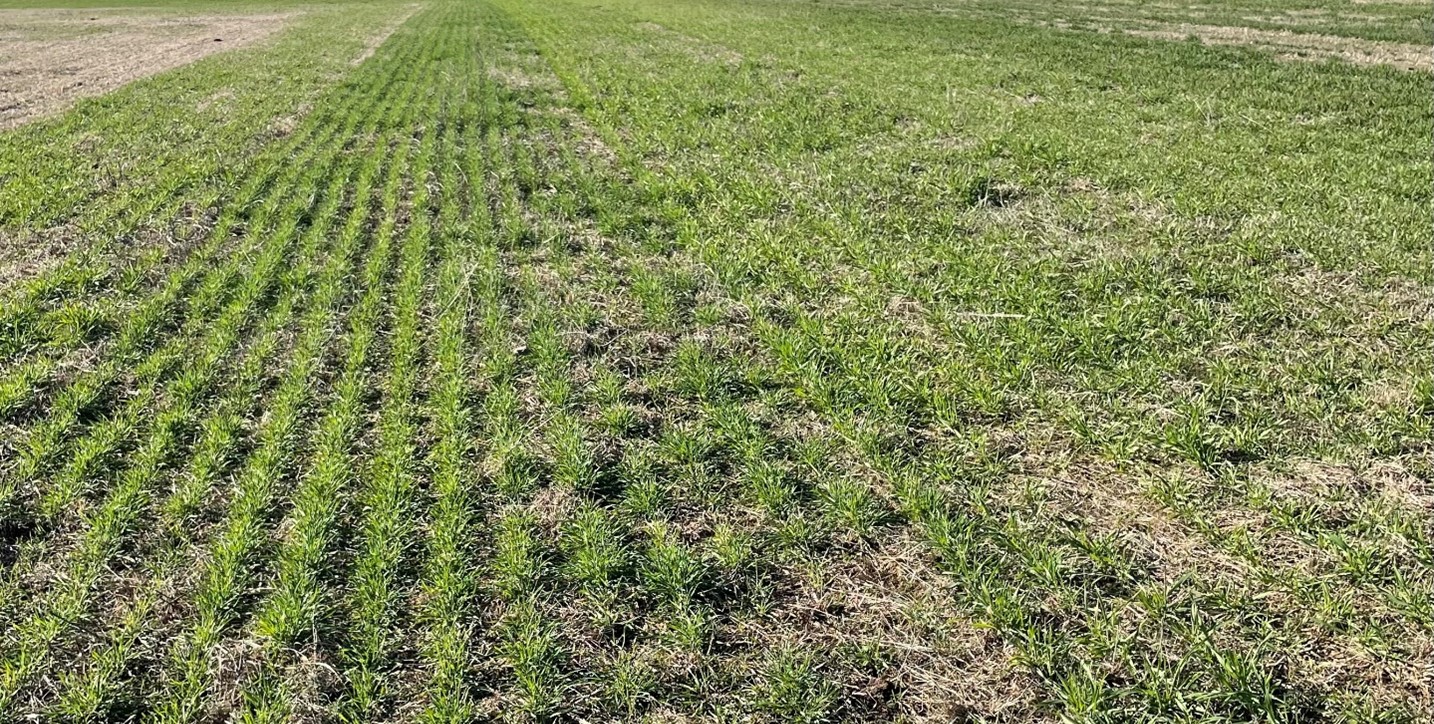
Pasture, picture taken January 2, 2024
Date taken: 1/2/24

While it is commonplace for producers in the upstate region of South Carolina to grow fescue as their primary forage crop, many producers utilize cool-season annuals to help get them through the winter. Cool season annuals are great for sodseeding into warm-season perennials like bermudagrass and for decreasing dependency on feeding hay. Cool-season annuals include a variety of small grains, ryegrasses, legumes, and some brassicas. In ideal conditions (adequate rainfall and extreme heat is gone), planting can begin in late September to early October. The earlier the planting the better your chances of being able to graze in the fall and early winter. Of course, the transition from summer to fall in this state can oftentimes be unpredictable with lingering heat and drought conditions. In the case of a late planting in early December, you may provide enough forage to carry cattle from spring to summer. Be sure to let forage grow to at least 6” in height before grazing, and do not graze below 2-3” in height. These parameters will allow the forage to develop a root system to promote drought tolerance and to sustain itself over the long term. The month of February is a great time to apply a second round of fertilizer regardless of whether you’re growing fescue or cool-season annuals. Remember to refer to your soil sample results when applying fertilizer. This is also a good time to evaluate the condition of your forage after the heavy frost events we received within the last month. The extent of the damage may determine whether it is worth fertilizing (regrowth must occur to justify fertilizer), replanting heavily damaged areas, or feeding hay until warm season grasses take over. To help our local clients gain some perspective on how cool-season annuals perform, we have a variety trial in place in Ninety-Six, South Carolina. We planted twenty-five different varieties including oats, wheat, ryegrasses, clovers, and other specialty forages. We hope to present the trial in the coming months if all goes well. Contact your local Clemson Extension office for more information.

Upcoming Events in Saluda, SC

Upcoming events sign


Saluda County Upcoming Events


February 24, 2024  Saluda County Cattlemens 32nd Annual Heifer Sale starts at 12:00, Noon

February 27, 2024 – Saluda 4-H Livestock Club Meeting here at the office at 4:00pm

March 3,2024 – Registration Deadline for the 4-H Pullet Chain Poultry Project

March 5, 2024 – State 4-H Legislative Day , Columbia SC

March 6, 2024  – Saluda County CAMM Training at Hollywood Ruritan for 10am to 12.
March 6, 2024 – Saluda County Private Applicators Recertification for Recert. Credits up to 3 Credits Meeting at 1 to 4pm at Hollywood Ruritan in Saluda, SC

March 8, 2024 –  Deadline to register for the 4H Dairy Judging Contest.

March 22, 2024–  4-H Dairy Judging Competition in Pendleton and Dairy Spring Show. Also, deadline to Register for the 4H Livestock Judging Competition.

April 5, 2024 – Deadline to Register For the 4-H Small Garden Project
April 5, 2024 – 4-H Livestock  Judging Competition in Pendleton

April 19-24 – Nation 4-H Conference in Washington, DC

Commercial Beef on Dairy Project for South Carolina Youth

With the demand for beef up, more dairy producers are crossbreeding heifers or less productive cows with beef.  With this shift and an increased interest in local grown beef, several livestock and 4-H agents are piloting a beef on dairy youth project to allow youth opportunities to grow and show these animals.
This project will allow youth who do not have beef or dairy cattle of their own or are looking for a shorter-term project than the current dairy heifer project an opportunity.  Milky Way farm is willing to provide animals needed for this project and share with us the list of individuals that currently buy these animals from them.  They do not currently raise enough steers to fill the orders for meat that they have requests for.

Youth who sign up for the project will need to have the ability to care for and raise an animal up to 1000 pounds. Application process will give priority to those who do not have cattle of their own. Youth will sign up and pay $500 for these animals that will be randomly drawn in May.  Youth will then feed, care for and show these animals for one year. These animals will be able to show at several local shows and the South Carolina State Fair during the dairy show.  This is a terminal project and all will be sold for beef in October of the following year.

This project will give more youth the opportunity to learn about animal agriculture and may be a bridge for these youth to the beef or dairy heifer project.  It may also provide more siblings to participate in a cattle project should a family reach the maximum of two youth per family if there is a shortage of dairy project heifers.

Contact:

TINA HORN
LIVESTOCK AND FORAGES AGENT
STATE DAIRY PROGRAM COORDINATOR
York County Cooperative Extension
Clemson University
120 North Congress St.
York, South Carolina 29745
w 803-944-2089
thorn@clemson.edu 

Silvopasture Systems in the Southeast

Silvopasture Systems in the Southeast

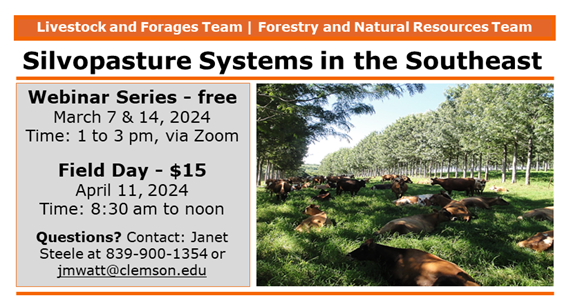
Discover the benefits of using Silvopasture Systems and register for the upcoming Webinar Series and Field Day.

Webinar Sessions

The two-part webinar series will address the establishment, management, and economics of implementing silvopasture systems.

Session 1 – March 7, 2024:

  • 1:00 PM – “Introduction to Silvopasture Production Systems” by Dr. John Fike, School of Plant and Environmental Sciences, Virginia Tech University.
  • 2:00 PM – “Animal Health and Environmental Benefits of Use of Silvopasture Systems” by Dr. Bruno Pedreira, Department of Plant Sciences, University of Tennessee.

Session 2 –  March 14, 2024:

  • 1:00 to 3:00 PM – A roundtable with agricultural professionals, producers and Extension personnel will discuss relevant topics and share experiences and challenges related to silvopasture systems in South Carolina and the Southeast region.

Field Day

You can also join Extension specialists and agents for a
Field Day on April 11, 2024 from 8:30 AM to Noon.

The field day will focus on topics about the establishment and management of woodlands and forage systems and the challenges and successes in using a silvopasture system for commercial livestock production. This event will be held at Varnville, SC.

Register for these events:

Is Your Farm a Hobby or a Business?

Christopher LeMaster, Jr.
Livestock & Forage Agent
Cherokee, Spartanburg, & Union Counties

Many may answer “Yes” to the above question, but nonetheless, that is an insightful question to ask yourself. Hopefully, you are intentional in your record-keeping, accounting, and tax preparation so that the IRS isn’t asking you the same question.  Whether you identify as a hobbyist or businessman, all will agree that it requires real work to answer this question successfully. Besides the work, there are fundamental business concepts that cannot be ignored if you wish to keep your farm around for future generations. A team of agribusiness agents and specialists and I have worked to develop the workshop series Farm Business Concepts. This course is designed to dive deep into the foundations of a well-run farm business. Participants will learn about business structures, labor forms, record keeping, accounting (managerial, tax), and tax management.  The workshop also includes a session on enterprise budgets and some case studies tailored to the cow/calf and hay producer. We are excited to help our farmers run their farms like businesses. There’s nothing wrong with being a hobby farmer, and truthfully, most of us would not endure the long hours and labor if we weren’t truly passionate about farming. We hope this program will help farmers identify ways to keep their farms profitable so that they may survive the ups and downs of the market and, most importantly, be around for another generation of farmers.

2023 Livestock and Forages Updates

Travis Mitchell
Livestock and Forages Agent for Newberry & Saluda Counties
Director for The South Carolina Cattlemen’s Association


Summer has been a very busy season in Saluda County.  The Saluda County Clemson Extension Livestock & Forages program has assisted many producers with questions concerning hay production, pasture weed control, and fall armyworm control in pastures and hayfields.  Producers were also assisted in commingling tractor-trailer load lots for marketing their calf crop.  These load lots enabled producers to receive value-added premiums for the calves they sold.

The Clemson Extension Livestock & Forages team, in conjunction with the South Carolina Cattlemen’s Association, hosted the South Carolina Cattlemen’s Association regional meetings from August 29th through the 31st.  Over 250 producers from across the state were in attendance during this three-day event.  Dr. Mark Alley with Zoetis gave an outstanding presentation on the importance of vaccines and how they add value to your calf crop.  Dr. Alley then joined Dr. Che Trejo with Merck Animal Health and Mr. Randy Fordham with Boehringer-Ingelheim for a panel discussion about the importance of vaccines.  These three gentlemen answered the producer’s questions and provided further insight on overall herd health.

The Saluda County 4-H Livestock shows were held September 20th and 21st at the Central Milk Producers Show & Sale Arena.  Many 4-H youths from across the state exhibited their prize animals.  Seeing so many young people enthusiastically involved in agriculture is always a great time.


South Carolina Youth Dairy Heifer Project

The South Carolina Dairy Heifer Project began in 1974 and is one of the oldest 4-H projects of its kind in the Nation. This project was designed to provide youth in South Carolina an opportunity to raise a dairy heifer and experience the dairy industry, and then sell their heifer at the South Carolina Dairy Heifer Project Bred Heifer Sale. Throughout the years, thousands of South Carolina youth have taken part in 4-H dairy work. These 4-H and Dairy Heifer Project alumni can be found in all “walks of life.” Many are outstanding farmers and leaders of the dairy industry, while others are doctors, veterinarians, and teachers. In nearly every case, these people look back on this 4-H dairy experience as an outstanding part of their youth.

As the dairy industry has changed and evolved over the years, so has the South Carolina Dairy Heifer Project. Due to COVID restrictions, the 2020 Bred Heifer Sale was held online for the first time with great success. Due to that success, the sale has been permanently moved to an online format and the event dates have been adjusted to better suit the needs of the dairy industry. Through all the changes, the South Carolina Dairy Heifer Project has continued to thrive and reach youth across the state. Thirty-seven heifers are currently in project and under the care of 4-H youth and eighteen of those youth are from York County.

The 4-H and FFA dairy project members exhibit their dairy project animals at fairs, shows, and events in nearly every region of the state. Millions of people have seen or learned about 4-H and FFA through these youth dairy exhibits at the many fairs and events in South Carolina. This offers a tremendous opportunity for 4-H, FFA, Clemson Cooperative Extension, and the dairy industry to educate and inform the public about the dairy industry and youth dairy programs. Many thanks go out to the industry for the support of the program. Heifers for the project come from project alumni and producers across the Southeast who have seen the impact the project has had and is continuing to have on our youth.

Pulling Together for Something Bigger

Christopher LeMaster
Livestock & Forage Agent
Cherokee, Spartanburg, & Union Counties

Cattle at LeMaster Grain & Cattle Co.

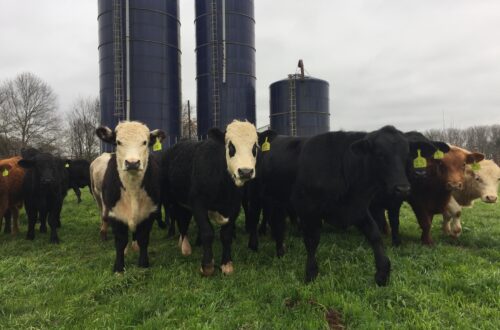
Like most industries, quality, uniformity, and volume rule the market. With over 7800 cattle farms in our state, marketing for uniformity can be challenging. This challenge is further compounded by the lack of scale caused by the State’s average herd size being around 25 head. Most cattlemen do not produce enough calves to take advantage of load-lot prices. In the economics of scale, cattle are traded on loads of 50,000 lbs. These loads can be comprised in many different ways but are often made up of groups of 60 to 80 calves. Many of our producers will not raise that many calves in 5 years. Clemson Extension, with numerous other organizations, have helped our producers pull together similar calves from different farms to take advantage of the higher prices for load lots. In addition to adding scale, most of these organizations will require some form of value-added marketing. This usually includes weaned, dehorned, castrated, vaccinated, dewormed, graded, and fed for at least 60 days. These practices make for much healthier cattle that will perform well in their next stage of life in the feed yard. Cattle buyers recognize this and gladly pay for it. In addition to the economic incentive, these programs have provided excellent educational opportunities for agents to help farmers prepare their cattle for these programs. Please contact me if you would like to discuss ways to add value to your calf crop. These opportunities are all over our state. 

Chris LeMaster
clemast@clemson.edu
864.649.8251