Clemson Extension Upstate District

The Future of Your Farm Program

Reid Miller

Area Livestock & Forages Agent

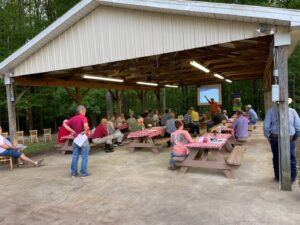
The future of your Farm Program attendees.

With help from the Greenwood Soil and Water Conservation District and the Upper Savannah Land Trust, our program titled “The Future of Your Farm” was held on April 20th, 2023, at the Connie Maxwell Oasis Farm in Greenwood, SC. This program was developed due to the current issues the agricultural community in South Carolina is facing. The number of farms has been decreasing and the average age of the farmer has been increasing for years. However, due to the current economic climate, housing developments and land prices have been increasing at a rapid pace in certain rural areas of the Piedmont Region consuming farmland in the process as heirs sell inherited land and assets from relatives who have passed on. The Future Of Your Farm had these goals in mind: informing farmers and landowners of the current climate in the real estate market, about land easements and other conservation programs, and about agricultural taxes and how to transition the land from one owner to the next. Our speakers Lonnie Gillespie (Greenwood Soil and Water Conservation District), Wade Harrison (Upper Savannah Land Trust), and Adam Kantrovich (Clemson Cooperative Extension) did a great job informing the audience of the current issues and how to protect their land and resources for future generations. We had a great turnout at our first meeting with twenty-eight people attending from five counties in South Carolina. Be on the lookout for the next meeting of this series coming later this year.

Area Livestock and Forages Agent Update

This past December, I had the opportunity through South Carolina Farm Bureau to travel to Washington DC with a few other Young Farmer and Ranchers from across our state to meet with our legislators, government ag agencies, and Farm Bureau staff. It was eye-opening and humbling to see how policy for our country is made. We had the privilege to sit down with policymakers and tell them exactly what we do as well as the challenges we face as farmers.  They were eager to listen and provide feedback on legislation that will keep Agriculture the number one industry in our state. Many of the discussions led back to farmland loss as we learned that South Carolina is 8th for the fastest loss of farmland. That was statistic was alarming. I work with many multi-generational farmers that have no succession plans. I also work with first-generation farms that are clawing to get access to land. Both are affected by the increased urban sprawl in our state. This trip was a reminder to help my producers to be able to tell their stories and communicate with people who don’t understand farming. Also, this sparked a renewed interest in promoting ways to keep the farm viable to keep farmers on their land. This past December, I hosted a workshop on Farm Successional Planning that presented information on how to strategically transfer the business and the land. We also discussed conservation easements and other strategies to keep farmland affordable for new farmers as well as veteran farmers. As we look forward to the Spring, we will continue with programs that focus on the business aspect of farming because we know that profitable farms with good succession plans don’t give way to strip malls and townhomes nearly as easily.

Back Yard Poultry Processing Grant Update:
We had a very successful first workshop with our mobile processing grant. Despite the hurricane-force wind and rain, we harvested 100 broilers. Participants were able to grow the birds for 7 weeks and then learned safe and humane practices for harvesting the chickens. We teamed up with the 4H and the Food Safety team to offer a day-long program on harvesting techniques, food safety, and the economics of raising boilers. Our next program is scheduled for May. We look forward to a productive Spring, thank you for continued support of our programs.

Chris LeMaster, Area Livestock and Forages Agent

Area Livestock Agent Assigned To Union County

A note from Chris LeMaster:

I’m happy to begin a new adventure serving the livestock and forage producers of Union County.  I’ve been the Livestock Agent in Cherokee, Spartanburg, and York since 2014. I live on my family’s farm in the Grassy Pond Community of Cherokee with my wife and son. Along with my family, we background calves as well as raise horses and hay. I look forward to meeting the farmers of Union County.                   clemast@clemson.edu

2023 Livestock Updates


Travis Mitchell
Livestock and Forages Agent for Newberry & Saluda Counties
Director for The South Carolina Cattlemen’s Association

The spring season is in full swing across the Carolina’s. It is a joy and relief to see pastures greening up and cattle grazing. Spring always brings optimism which was evident in the “beef cattle market outlook” presentation Dr. Andrew Griffith gave at the South Carolina Cattlemen’s Association Annual Meeting. Cattle producers from across the state met at the T. Ed Garrison Cattle Complex on February 3rd for this event. Dr. Griffith, an Extension Livestock Economist with the University of Tennessee, presented to the group a favorable market outlook report indicating higher cattle prices for the next two years. Producers also enjoyed a presentation from State veterinarian Dr. Michael Neault. Dr. Neault presented on the Asia Longhorn Tick, educating producers regarding control measures and identification strategies. The meeting concluded with a joint awards banquet with the Clemson Bull Test.

Be on the lookout in next month’s issue of the Carolina Cattle Connection for photos and awards of excellence winners. I want to thank each of our Prime, Choice, and Select members for putting on an outstanding trade show and for their financial support in making the 2023 Annual Meeting a huge success.

Advisory Council

Working Together to Offer Community Resources

The Fairfield County Clemson Extension Service advisory council met on January 12, 2023 to share available resources and discuss ideas for future collaboration.  Eight community members were in attendance representing Fairfield Behavioral Health Services, Love Never Fails, Fairfield Forward, Fairfield County Chamber of Commerce, Fairfield County School District, Fairfield County Council on Aging, and SLED. We thank these participants for sharing their perspective both as individuals and on behalf of their organizations.

Fairfield is covered by seven specialized extension agents: Agribusiness, Food Systems and Safety, Forestry and Wildlife, Livestock and Forages, Urban Horticulture and Specialty Crops, Water Resources, and 4-H. During the meeting, these agents highlighted programs offered both virtually and in-person including “Be Well Informed” (testing well water for quality and maintenance) and “Know Diabetes by Heart” (health education program). 

Visit the Cooperative Extension Service website and learn more about the Agents who serve Fairfield County. You can find more information about their upcoming events on the Extension Calendar and register. Residents of Fairfield can also access statewide programs from the Home and Garden Information Center and Rural Health team.

The advisory council’s main collaborative project suggestion was implementing more community gardens for Fairfield residents. These gardens could serve as a hosting site for programming including beginner and advanced gardening skills, student engagement with 4-H, as well as food storage and canning workshops. Partnership opportunities with groups such as the Fairfield Farmers and Artisans’ Market, Fairfield Forward, and the Fairfield Career and Technology Center’s horticulture class could also benefit from this community project.

Have suggestions for improvement or future collaborations with the Fairfield community? Clemson Extension welcomes your feedback, so please fill out our anonymous survey to meet the needs of Fairfield County utilizing Clemson Extension’s resources. To get involved with future advisory council meetings and share ideas or resources, contact Fairfield County’s Clemson Extension Service County Coordinator Stephanie Eidt: seidt@clemson.edu | 803-589-8977.  Thank you for your continued support!

Winter Livestock Updates

Christopher LeMaster
Livestock & Forage Agent
Cherokee, Spartanburg, & York Counties

This past December, I had the opportunity through South Carolina Farm Bureau to travel to Washington DC with a few other Young Farmer and Ranchers from across our state to meet with our legislators, government ag agencies, and Farm Bureau staff. It was eye-opening and humbling to see how policy for our country is made. We had the privilege to sit down with policymakers and tell them exactly what we do and the challenges we face as farmers. They were eager to listen and provide feedback on legislation that will keep Agriculture the number one industry in our state. Many of the discussions led back to farmland loss as we learned that South Carolina is 8th for the fastest loss of farmland. That statistic was alarming. I work with many multi-generational farmers that have no succession plans. I also work with first-generation farms that are clawing to get access to land. Both are affected by the increased urban sprawl in our state. This trip was a reminder to help my producers to be able to tell their stories and communicate with people who don’t understand farming. Also, this sparked a renewed interest in promoting ways to keep the farm viable to keep farmers on their land.

Also, I hosted a workshop on Farm Successional Planning that presented information on strategically transferring the business and the land. We also discussed conservation easements and other strategies to keep farmland affordable for new and veteran farmers. As we look forward to the Spring, we will continue with programs that focus on the business aspect of farming because we know that profitable farms with good succession plans don’t give way to strip malls and townhomes nearly as easily.

Mud Management

Reid Miller
Area Livestock & Forages Agent
muddy pastureRainfall has been a big topic of conversation over the last year. Six months ago, we would have taken any drop we could get. Now, it’s a much different story. With all this rain and feeding hay comes mud….and lots of it. Too much mud can drastically affect cattle performance and pasture conditions. A study from the University of Nebraska gives us a range for loss of gain due to mud from 7% at dewclaw deep to 35% at belly deep with shin deep coming in at 14%. So how do we manage against this?

There is no silver bullet, but here are some tips to help you mitigate mud accumulation on your operation:

  1. Choose your feeding areas wisely. Feed hay in pastures that are well drained (higher ground), and maybe a pasture that could use a fertility boost. Waste hay and manure can provide needed fertility for the upcoming growing season (mostly beneficial for summer grasses). Updated soil tests can help with proper feeding placement. This works best in a temporary situation where the animals are not there long enough to dismantle the soil structure. Some type of drag to help evenly distribute manure and hay can help as well.
  2. Rotate between multiple feeding or sacrifice areas if possible. If one area begins to have an excess of mud, give it a rest, and use a different area for a while. Temporary fencing can help for those with electric fence.
  3. Avoid feeding near streams, ponds, or other water sources to prevent contamination and added potential for a muddy situation. Also, while feeding on a slope or hill can assist with drainage, consider the effects of runoff.
  4. For high traffic or heavy use areas such as dirt roads, feed bunks, water troughs, and hay storage, it may be worth installing either concrete or packed gravel. Your local NRCS office should have information about their EQIP programs that can help with these issues.

York County Welcomes Livestock Agent Tina Horn

Tina Horn
Tina Horn

Clemson Extension York County is happy to announce that Clemson Extension Livestock Agent Tina Horn will now be the livestock and forages agent for York County.  Tina grew up on a dairy farm in VA and was very active in 4-H and FFA. She attended Virginia Tech, where she received a BS in Dairy Science with a focus on Nutrition and my Masters in Education. Tina worked as a dairy nutritionist for 10 years before taking a job with extension in VA. Tina moved to SC and began working for Clemson Extension in 2007 as a state dairy agent. Tina will continue in this statewide role but will take on the additional responsibility of serving as the livestock agent for York County.

What’s Going On In Saluda County, S.C.

Upcoming events sign

Saluda County Upcoming Events


February 24, 2024  Saluda County Cattlemens 32nd Annual Heifer Sale starts at 12:00, Noon

February 27, 2024 – Saluda 4-H Livestock Club Meeting here at the office at 4:00pm

March 3,2024 – Registration Deadline for the 4-H Pullet Chain Poultry Project

March 5, 2024 – State 4-H Legislative Day , Columbia SC

March 6, 2024  – Saluda County CAMM Training at Hollywood Ruritan for 10am to 12.
March 6, 2024 – Saluda County Private Applicators Recertification for Recert. Credits up to 3 Credits Meeting at 1 to 4pm at Hollywood Ruritan in Saluda, SC

March 8, 2024 –  Deadline to register for the 4H Dairy Judging Contest.

March 22, 2024–  4-H Dairy Judging Competition in Pendleton and Dairy Spring Show. Also, deadline to Register for the 4H Livestock Judging Competition.

April 5, 2024 – Deadline to Register For the 4-H Small Garden Project
April 5, 2024 – 4-H Livestock  Judging Competition in Pendleton

April 19-24 – Nation 4-H Conference in Washington, DC

“Meat-ing” a Need

Christopher LeMaster
Livestock and Forage Agent
Cherokee, Spartanburg, and York

Small scale poultry producers will get hands-on experience in processing their birds for meat.

Finding a facility to harvest and process your livestock is a challenge for producers of any scale. This challenge has been exasperated by labor shortages and increased local meat demand. Fortunately, an exemption for small-scale poultry producers allows them to harvest and sell their meat. Many South Carolinians bought poultry during the pandemic as a hobby and our call volume regarding poultry harvest and processing has certainly increased. To safely and humanely process chicken requires hands-on training. This can be a complex skill and is certainly not something you’d try to handle “virtually”.

Through an extension innovation grant, we have secured funding to put together a mobile processing unit. This consists of an enclosed trailer that houses the necessary equipment to teach producers on-farm the proper practices of processing. We are still outfitting the trailer but have planned its first two outings. We will use the mobile processing unit at a “train the trainer” meeting and then will offer a poultry processing workshop to the public on November 11th. The goal of the mobile processing unit is to educate producers of any size on humane harvest, efficient processing, safe food handling, good marketing practices, and even some good cooking recipes.

I anticipate a busy fall with livestock shows, cattlemen meetings, and our extension workshops. Thank you for your support of Clemson Extension.