Clemson Extension Upstate District

“Meat-ing” a need

Finding a facility to harvest and process your livestock is a challenge for producers of any scale. This challenge has been exasperated by labor shortages and increased local meat demand. Fortunately, an exemption for small-scale poultry producers allows them to harvest and sell their meat.

Many South Carolinians bought poultry during the pandemic as a hobby and our call volume regarding poultry harvest and processing has certainly increased. To safely and humanely process chicken requires hands-on training. This can be a complex skill and is certainly not something you’d try to handle “virtually”.

Through an extension innovation grant, we have secured funding to put together a mobile processing unit. This consists of an enclosed trailer that houses the necessary equipment to teach producers on-farm the proper practices of processing. We are still outfitting the trailer but have planned its first two outings. We will use the mobile processing unit at a “train the trainer” meeting and then will offer a poultry processing workshop to the public on November 11th. The goal of the mobile processing unit is to educate producers of any size on humane harvest, efficient processing, safe food handling, good marketing practices, and even some good cooking recipes.

I anticipate a busy fall with livestock shows, cattlemen meetings, and our extension workshops. Thank you for your support of Clemson Extension.
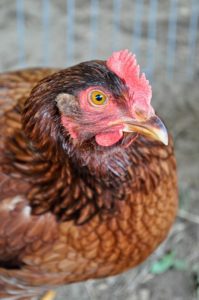
Small scale poultry producers will get hands-on experience in processing their birds for meat.

South Carolina to Issue Handy New Card for Ag Sales Tax Exemptions : SCATE will Debut February 1,2022

South Carolina to Issue Handy New Card for Ag Sales Tax Exemptions

SCATE Will Debut February 1, 2022

By Eva Moore, South Carolina Department of Agriculture


In 2022, the South Carolina Department of Agriculture is rolling out a handy new card for farmers to use for agricultural sales tax exemptions.

South Carolina state law offers several sales tax exemptions for items used in agricultural production. For many years, farmers have had to fill out a paper form, the ST-8F, to receive these exemptions.

But after April 1, 2022, farmers must instead show their SCATE (South Carolina Agricultural Tax Exemption) card to retailers to demonstrate they are eligible for these exemptions.

The program is similar to Georgia’s GATE card, but unlike in Georgia, South Carolina users do not need to meet a minimum farm income threshold to be eligible.

It’s important to understand that state law is not changing. Farmers will still be able to receive the same exemptions as before.

A SCATE card costs $24 and is good for three years.

You can apply for your SCATE card starting Feb. 1, 2022, using the online portal at scatecard.com or call 1-803-734-2210 Option 1 Debbie. You must apply and pay online or pay over the phone; there is no paper application.

You’ll need the following information in order to apply:

  • Taxpayer ID Number – personal [SSN] or business [FEIN]
  • Valid email address
  • Credit card or bank account number

Questions about SCATE? Contact the South Carolina Department of Agriculture at scate@scda.sc.gov or 803-734-2210 Option 1 Debbie . For questions specifically about tax exemptions, you can email the South Carolina Department of Revenue at FarmExemption@dor.sc.gov. You can also read the FAQs at scatecard.com.

Travis Mitchell – Area Livestock & Forages

         Livestock and Forage producers around South Carolina are certainly ready for spring. The spring bull sales and replacement heifer sales are in full swing as this always seems to be a hectic time of the year. As we move into 2022, input costs in every sector of agriculture continue to rise. Producers will face many challenges this year as they manage their budgets to navigate the rise in input costs.

        The South Carolina Cattlemen’s Association held its annual meeting and convention on February 4th at the T.E.D. Garrison Arena in Clemson. The educational components of the meeting focused on managing input costs during these challenging times. Scholarships and state awards of excellence were also presented. The South Carolina Cattlemen’s Foundation awarded six scholarships to deserving college students.

       The Saluda County Cattlemen’s Association will hold its 30th Annual Replacement Heifer Sale on Saturday, February 26th. Over 100 bred and open heifers will sale at auction from Saluda county cattlemen.

       The Saluda County Cattlemen’s Association met on February 10th. Participants listened to an excellent presentation from Corteva about maximizing the return on investment for weed control.


SCATE Card Update

South Carolina Agricultural Tax Exemption Card

As some of you may have heard, South Carolina Department of Agriculture has implemented the new SCATE (South Carolina Agricultural Tax Exemption) program. This SCATE card will be used in place of SCDOR’s Agriculture Exemption Certificate (ST-8F). The application is available to the public at: https://agriculture.sc.gov/scate/. The card costs $24 for a 3 year term which boils down to $8/year. The last day retailers will accept the ST-8F paper document is April 1st, 2022. The sales tax laws for South Carolina have not changed. The only thing that has changed is the way buyers demonstrate they are eligible for certain agriculture tax exemptions. The state also does not require producers to generate a certain level of income from agriculture to qualify for sales tax exemptions unlike similar programs. For those with limited or no computer access, public libraries throughout the state provide free computer access. Contact your local library for more information on public computer access for applying for the SCATE Card.

For more specific information on the SCATE program, contact your local Clemson Extension office, call the SCDA direct at 803-734-2210, or visit https://agriculture.sc.gov/faq/scate/.

For producers wanting specific information on what products qualify for tax exemption, please email farmexemption@dor.sc.com.


Hands-On and In-Person

Chris LeMaster
Livestock & Forages Agent
Cherokee, Spartanburg, & York Counties

Who would have thought that would be the headline of an Extension program? Over the past two years, we’ve seen significant technology adoption by all of our clients as we adapted to COVID protocols. While this provided some unique opportunities to bring in outside speakers and an “anywhere and anytime” form of Extension, there has also been burnout of on-demand and online learning opportunities. While we seek to find a balance, we’ve realized the personal face-to-face aspect of our workshops and farm visits cannot be replicated or replaced by virtual learning.

Participants learn fencing techniques first-hand

This fall, I worked to provide opportunities for both learning styles. The online Fall Fescue Workshop was well-attended due to the convenience of logging on via smartphone during lunch. However, the hands-on, in-person Fence Construction Workshop was my favorite. Producers from across the state attended a day-long workshop with class time and hands-on demonstrations to learn the newest and most cost-effective fencing methods. The focus of the workshop was planning and laying out the most efficient fenceline to maximize pasture and minimize efforts for gathering animals, watering, grazing, and distributing nutrients. Participants left the workshop knowing how to properly construct a brace, tie hi-tensile knots, post and select wire, and much more. This program was a success from the generous help of industry sponsorship.

Participants enjoyed the hands-on approach

This winter, I plan to keep this balance of virtual and in-person programs through the Backyard Poultry Workshop, Equine Forage, Online Forage Focus, Cattlemen meetings, and the partnership with 4H in the Down on the Farm Day and the Cherokee County Spring Livestock Show. Our livestock team continues to generate numerous learning opportunities that can be found on the Clemson Extension Livestock and Forages Facebook page. As always, be sure to check Clemson’s Land Grant Press for peer-reviewed articles on various livestock topics. I hope to see you this winter, whether virtually or in-person, at a workshop or farm visit.

Tri-County Feeder Cattle Sale Evaluation

Brian Beer
Area Livestock Agent

Feeder calves transportation

Cattle producers always try to maximize the value of the calves they market. Group marketing efforts, like the Tri-County Feeder Cattle Sale, provide opportunities for farmers to improve market prices. Clemson Extension coordinated the off-farm feeder cattle sale for cattlemen in the region. Twelve area farmers sold 886 head of feeder calves (10 loads, 2 partial loads) using this alternative marketing option.  Marketing feeder calves off-farm resulted in a $0.20 per pound higher price when compared to traditional auction markets. The price increase resulted in $134 per head of additional revenue to area farmers. Marketing feeder calves using this alternative generated a total of $118,724 increase in revenue, an average of $9,834 per farm.

Farmers Don’t Take Snow Days

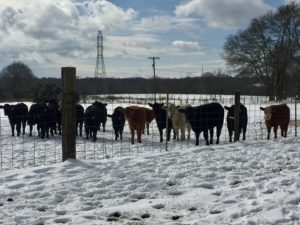
The pandemonium at the bread and milk aisle must mean we are due for some wintry weather and milk sandwiches. At the time of this blog, forecasts call for snow, ice, and long periods of sub-freezing temps. While this is not uncommon for our area, we have a few more precautions than your average homeowner as livestock producers. The biggest concerns for our livestock in wintry weather are hypothermia and dehydration. Shelter and added calories are the best defense for hypothermia. Water is always a challenge in winter but pay close attention to ice-over and monitor animal intake as we approach Sunday.

Calves stand waiting for feed
Cows still have to eat on snow days.

Animals burn considerably more calories with windchill and a wet coat. Ruminants and horses (hind-gut) generate heat when they ferment forages. For this reason, consider feeding in the late afternoon to help provide max heat during overnight lows. Ice will make grass more inaccessible than snow, so be prepared to put out hay early and often. In addition, rolling out hay to provide warm, dry bedding can be a relief to younger animals. Ensure you have adequate room to lessen the chance of young animals getting stepped on. Shelter is often not feasible for our cattle herds but encourage animals to bed in windbreaks by hay placement.

Winter weather in the south means ice. Besides the loss of traction, power loss is usually imminent in an ice storm. Temporary fences will fall to the added weight of the ice and may require a battery power source. Before the weather, top off feeders that are hard to access or need electricity (augers). If you are on well water, consider putting out extra troughs in case we lose power. Make sure your machinery is ready by checking fluids, adding weights, and don’t forget your small engines (ATV, chainsaw, generator).

Although the list of preparations is long, farmers are ever-ready and solid. They are the first called to pull a neighbor out of a ditch or cut a tree off a driveway. So while you’re trudging in snow caring for your livestock, please take a second to enjoy the views and know it too will pass soon.

Initial Private Applicator Training and Exam

Initial Private Pesticide Applicator Training and Licensing Exam  

Wednesday, December 8 at 9:00am to 12:30pm

Private applicator licenses are intended for agricultural producers who must purchase, use, or supervise the use of restricted-use pesticides on their operations.

NOTE: This certification is not for homeowners, commercial applicators, or pest control operators.

LEARN MORE