First Fridays York County Master Gardeners host garden talks that are presented on the first Friday of every month at Glencairn Garden Learning Center in Rock Hill from 11 am to noon. The 2023 topics are available here: https://www.yorkmg.org/programs/first-friday
First Fridays in the Garden Expands Starting February 3rd, the talks will also be offered at the Clover Library from 2:00 to 3:00 pm.
Woody Plant Identification Class
Woody Plant Identification is a 12-week class from April 12th through June 28th at Bartlett Tree Research Lab arboretum. It will be on Wednesday evenings from 6:00 to 8:00 pm. This class is for the commercial horticulture industry to prepare them for a Certified Nursery Professional exam administered by the SC Green Industry Association. We will cover approximately 25 plants per week as we walk the property. Contact Paul Thompson at (803) 639-9101 for more information.
2023 Master Gardener Class
The 2023 class starts August 2 and ends November 8. It will be held at the Glencairn Garden Learning Center at 825 Edgemont Avenue in Rock Hill. Classes are each Wednesday from 9:00 am to 12:30 pm.
Contact Paul Thompson via email at pthmpsn@clemson.edu for an application that needs to be remitted by June 1, 2023.
Clemson Extension York County is happy to announce that Clemson Extension Livestock Agent Tina Horn will now be the livestock and forages agent for York County. Tina grew up on a dairy farm in VA and was very active in 4-H and FFA. She attended Virginia Tech, where she received a BS in Dairy Science with a focus on Nutrition and my Masters in Education. Tina worked as a dairy nutritionist for 10 years before taking a job with extension in VA. Tina moved to SC and began working for Clemson Extension in 2007 as a state dairy agent. Tina will continue in this statewide role but will take on the additional responsibility of serving as the livestock agent for York County.
Please help us welcome Mrs. Kristin Kunde as our new 4-H Agent. Kristin taught high school mathematics in York County for 6 years and then spent a little time teaching middle school. Growing up, she was a 4-Her in Lancaster County and participated in teen council, horse clubs, pullet showmanship, and many summer camps. She is married to a Fort Mill Police Officer and has three children (ages 5, 3, and 2). Her hobbies include playing guitar, riding horses, raising chickens, and spending time outdoors. She also LOVES bluegrass music.
For over 120 years, 4-H Youth Development has engaged youth with high-quality developmental settings with an emphasis on academic motivation and success, social competence, high personal standards, connection, personal responsibility, and contribution to others through leadership and civic engagement. The 4-H Thriving Model is the theory of change for positive youth development in 4-H. The model illustrates the process of positive youth development in 4-H programs by connecting high-quality program settings to the promotion of youth thriving.
The Regional 4-H PYD Champion Network consists of 4-H professionals from Land-Grant Universities (LGUs) across the five Extension Regions. Clemson University Cooperative Extension is proud to support Patricia Whitener as a champion for SC 4-H and part of the southeastern regional working group. Her focus as a thrive champion is on capacity-building efforts for 4-H professionals and volunteers with both Clemson University and SC State. Her focus is on promoting a consistent, correct, and complete understanding of positive youth development throughout the state and region.
Patricia has received $25,000 through a competitive distribution of Extension Innovation funding to further the implementation and adoption of the 4-H Thrive model. This will be accomplished through PYD capacity building with 4-H professionals and volunteers, leading to improved PYD programming, and stronger and clearer program impact. Ultimately the aim of the thrive sessions is to educate and empower 4-H professionals and to secure the position of SC 4-H as a regional leader in positive youth development programming through delivering professional development, developing effective professional development evaluation, and supporting quality program implementation standards. The impact of the initiative is widespread. Research demonstrates youth programs must be done well if they are to make a positive difference in the lives of youth. Long-term outcomes of quality Developmental Context (i.e., 4-H programs) are academic or vocational success, civic engagement, employability and economic stability, happiness, and wellbeing.
Food Systems and Safety Agent Alex Thompson Hosts a Canning Demonstration
Food Systems and Safety Agent Alex Ryan Thompson is helping to educate Upstate South Carolina residents on a range of food safety topics. As a part of the Food Systems and Safety program team with Clemson Cooperative Extension, Alex Ryan Thompson hosts home canning workshops covering all forms of canning. Types of canning boiling water bath, pickling, jams and jellies, and pressure canning. These workshops are hands-on experiences where participants will learn about the process of canning, the scientific principles behind canning, and how to identify research-based canning recipes. Canning workshops are hosted by Alex across the Upstate. No previous canning knowledge is required to attend these workshops. For the most current schedule of upcoming workshops and to register, visit the Food Systems and Safety team page here:
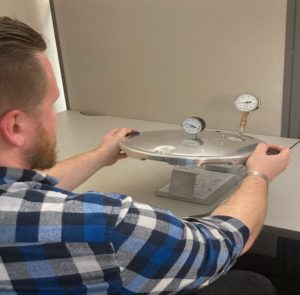
Testing a pressure canner gauge. Photo Credit: Misty Galloway
Upstate South Carolina residents who own pressure canners can also reach out to Clemson Cooperative Extension to have their pressure canners inspected and their dial gauges tested for accuracy. The Food Systems and Safety team recommends having pressure canners inspected and dial gauges tested annually to ensure safe pressure canning. Contact your local Extension office to schedule an appointment to have your pressure canner checked.
Furthermore, the Food Systems and Safety Team hosts ServSafe Food Handler and Manager trainings and can proctor ServSafe examinations for Upstate South Carolina residents. If you or someone you know needs ServSafe training, contact your local Extension office to schedule training or an examination.
Whether you want to know if your leftovers in the refrigerator are safe to eat or want to start a food business, the Food Systems and Safety team with Clemson Cooperative Extension is here to help!
Contact: Alex Ryan Thompson Food Systems and Safety Agent Clemson Cooperative Extension 352 Halton Rd Suite 302
Small-scale poultry producers will get hands-on experience in processing their birds for meat.
Finding a facility to harvest and process your livestock is a challenge for producers of any scale. This challenge has been exasperated by labor shortages and increased local meat demand. Fortunately, an exemption for small-scale poultry producers allows them to harvest and sell their meat.
Many South Carolinians bought poultry during the pandemic as a hobby and our call volume regarding poultry harvest and processing has certainly increased. To safely and humanely process chicken requires hands-on training. This can be a complex skill and is certainly not something you’d try to handle “virtually”.
Through an extension innovation grant, we have secured funding to put together a mobile processing unit. This consists of an enclosed trailer that houses the necessary equipment to teach producers on-farm the proper practices of processing. We are still outfitting the trailer but have planned its first two outings. We will use the mobile processing unit at a “train the trainer” meeting and then will offer a poultry processing workshop to the public on November 11th. The goal of the mobile processing unit is to educate producers of any size on humane harvest, efficient processing, safe food handling, good marketing practices, and even some good cooking recipes.
I anticipate a busy fall with livestock shows, cattlemen meetings, and our extension workshops. Thank you for your support of Clemson Extension.
An On-Farm planting located at a cooperating farm has established new experimental grape varieties and new muscadine cultivars. Fruit harvest began two weeks ago with ‘Rhazzmatazz,’ a novel seedless hybrid muscadine-vinifera hybrid grape developed by Gardens Alive plant breeder Jeff Bloodworth.
The next grape I just started harvesting is ‘Oh My,’ another seedless cultivar from the same company. Muscadine plants we are evaluating but have not started picking are ‘Paulk’ and ‘Ruby Crisp.’ These are University of Georgia cultivars donated by Dr. Patrick Conner. Other experimental varieties will not begin fruiting till next year as plants were planted one year after initial planting. Yield and quality data on these varieties are being collected for direct farm application. Information from this planting and the demonstration grape farm at Clemson’s Musser Farm assists several new muscadine farmers in the upstate.
Five farmers from several counties toured the Musser Farm to observe small fruit production. Three farmers recently accompanied me to Gardens Alive Farm in Kings Mountain to consider newer varieties.
Grapes fit well into fall production programs, especially for anyone growing pumpkins and doing Fall field days. We know what works now, but many new varieties are being cultivated. We will be ready for what is coming next with the information we gather from these trials.
Clemson Cooperative Extension’s Rural Health and Nutrition Team offers a fantastic resource for those living with diabetes in Greenville County through the Health Extension for Diabetes (HED) program. The Health Extension for Diabetes program is an American Diabetes Association recognized practice-tested diabetes support program for people with either type 1 or type 2 diabetes. The purpose of the program is to provide you with the knowledge and skills you need, along with the necessary support, to prevent complications associated with diabetes. The program is delivered through a series of 16 online group education and support sessions over 4 months.
Each session lasts an hour and incorporates education as well as support group components. The goal of the program is to help provide participants with the education, resources, and support they need to better manage diabetes. Session topics include healthy eating, physical activity, managing stress, medications and monitoring, and more. You must be 18 years old to participate and have a diagnosis of type 1 or type 2 diabetes.




 For over 120 years, 4-H Youth Development has engaged youth with high-quality developmental settings with an emphasis on academic motivation and success, social competence, high personal
 standards, connection, personal responsibility, and contribution to others through leadership and civic engagement. The 4-H Thriving Model is the theory of change for positive youth development in 4-H. The model illustrates the process of positive youth development in 4-H programs by connecting high-quality program settings to the promotion of youth thriving.

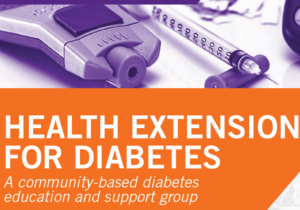 Clemson Cooperative Extension’s Rural Health and Nutrition Team offers a fantastic resource for those living with diabetes in Greenville County through the Health Extension for Diabetes (HED) program. The Health Extension for Diabetes program is an American Diabetes Association recognized practice-tested diabetes support program for people with either type 1 or type 2 diabetes. The purpose of the program is to provide you with the knowledge and skills you need, along with the necessary support, to prevent complications associated with diabetes. The program is delivered through a series of 16 online group education and support sessions over 4 months.
