Silvopasture is an interactive system that integrates forage, livestock, and trees into one system where the components are intentionally selected to enhance each other. It is also intensive, requiring more frequent implementation of management practices. Silvopasture is an old practice that has been gaining popularity due to its potential to enhance land use and production, diversify income and deliver ecosystem services. These benefits include, but are not limited to, increased biodiversity, soil health responses, livestock performance and welfare, and enhanced aesthetics.

Silvopasture can be created by thinning existing timber stands or planting trees in existing pasture or newly established areas. In this context, the choice of forage should be considered based on local climate and topography conditions, soil type, and operational goals. Establishing a silvopasture system requires proper planning and understanding of the needs and requirements of each system component (forage, livestock, tree) and their interrelationships with the ecosystem.
The Tree Component
In addition to providing a source of income from timber production, the tree component in the silvopasture provides several essential functions. The shade provided by the trees in an established system helps reduce the heat stress on livestock during the hot months, which can support the performance of young categories. Forages grown under trees can retain a higher moisture content during dry conditions and mature more slowly, making them more palatable and digestible. Finally, the trees can absorb and utilize the nutrients from the livestock waste and reduce runoff.
The forestry component of silvopasture can be established through two methods: planting a new stand or managing an existing stand. New stand establishment can occur on fallow agricultural land, hayfields or pastures, and cutover timberland. The site’s type and amount of vegetation will depend on its land use history. Pastures and hayfields may contain dense, rhizomatous forage species such as bermudagrass that will compete aggressively with young trees. At the same time, fallow agricultural fields may include a wide variety of leafy weeds that can also outcompete newly planted seedlings. Site preparation treatments before tree planting are crucial and can be conducted through mechanical practices, chemical applications, or a combination of both. These practices aim to give the tree seedlings at least one year of limited pressure from competing vegetation so they can become established and start initiating root and shoot growth. Required practices may include:
- Pastures and Hayfields – Scalping of improved forage grasses
- Agricultural Fields – Ripping or subsoiling of the plow pan/hardpan
- All Sites – Herbicide applications to control competition (grasses, broadleaf weeds, and woody and shrubby vegetation on cutovers)
Another pre-establishment consideration is soil pH, which may need adjustment for the selected tree species. Finally, residual chemicals used for crop production may require that an agricultural site be laid out up to 1 year before planting tree seedlings.
Most silvopastures in the southeast utilize pine species. In South Carolina, this is most often longleaf or loblolly pine. The branching habit of longleaf pine and its ability to self-prune make it a good choice for the tree component in silvopasture. It is the preferred species on droughty soil sites and can grow well on wetter sites when competition is adequately controlled. However, it is more prone to planting failure since the time it spends in the grass stage after planting makes it more susceptible to the impacts of heavy competition in areas with inadequate site preparation. Loblolly pine is a fast-growing species that does well on various soil types. But, the number and size of limbs in its crown require more frequent pruning than in slash or longleaf stands to provide adequate sunlight to the forages on a site. Hardwood trees are more challenging to establish by planting than the pine species and require additional protection from the impacts of livestock and wildlife during establishment. Pecan trees can produce a commercial nut crop and be suitable for silvopasture if the seedlings and saplings can be adequately protected from animal damage.
The planting design can be done using two methods. The first is a double row of trees with a forage alley between rows. Tree seedlings are planted at 8′ to 10′ between rows and 4′ to 8′ between trees within rows, with a 40 to 60-foot alley between the sets of rows. This design results in 200 to 400 trees per acre. Planting in an east-west direction maximizes sunlight on forage strips.

A wide block planting can also be used [ex. 12′ by 12′ spacing to establish 300 trees per acre], but, this design limits the producer’s ability to harvest hay. Genetically improved tree seedlings developed for fewer limbs and improved stem form should be considered for this planting option. Livestock should be excluded from new stands for the first 3 to 6 years. The terminal buds need to be above browsing height, and the trees sturdy enough to withstand rubbing and trampling before animals are introduced.
Another method for establishing the tree component is to transition an existing timber stand to silvopasture through thinning. Reducing the stand to a desired tree density will be based on the sunlight needed for successful forage establishment and production. If the stand is being thinned for the first time, this is traditionally a 3rd or 4th row thinning, with additional removals within the residual rows. A professional forester should mark subsequent thinnings to ensure residual crop trees with the best timber quality will be left while meeting the stand density requirements. Depending on the producer’s selected forage, a residual basal area of 40-60 ft2/acre is usually recommended.
Landowners and managers need to know that managing the tree component in a silvopasture system is more intensive than on sites managed strictly for timber production. Competition control will significantly affect tree seedling survival rates for the first two years after planting loblolly pines and until longleaf pine seedlings grow out of the grass stage. When trees are planted into established pastures, mowing between the rows of trees to control competition from grasses is recommended when feasible. Grasses, broad-leafed weeds, and woody species that mowing cannot control will require herbicide treatment. A variety of herbicide options are available for pre-emergent and post-emergent treatments. The selected herbicide and the application rate will vary with the date of application, the species of tree planted, and the species of competition present. In addition to improving tree seedling survival and growth rate, herbaceous weed control will also enhance forage production by reducing competing species. Again, producers can contact their local Extension agent for assistance with plant species identification and herbicide application recommendations.
Prescribed burning to reduce hazardous fuels, improve forages for livestock and wildlife species, and prune lower limbs can also be implemented. Mechanical pruning is a labor-intensive management activity required to maintain stem quality on crop trees and create knot-free wood. Widely spaced trees and those sides of trees exposed to sunlight will develop more and larger limbs, which can reduce timber value. Pruning also raises the canopy to allow more sunlight to reach the forages. Finally, herbaceous weed control is often required in the understory thinned stands to enhance forage production.
The Forage Component
Forage crop selection is a crucial step and shade-adapted species should be selected, such as tall fescue, bahiagrass or native warm-season grasses. Also, site selection is important for successful forage establishment and management. Suitable sites for establishing silvopasture should be determined based on topography, soil type, drainage, sunlight, availability of water for livestock, existing fencing, nutrient levels, soil pH, and other resources required for tree and forage growth, and livestock management. Then, forage species must be adapted to the climate and soil conditions of the specific area to succeed. Producers should also consider the level of investment and management needed and their skill sets before committing to using a silvopasture for their livestock, as it is a management-intensive system.
Soil sampling is required before implementation. Soil samples should be collected and sent for analysis to the Clemson Agricultural Services Laboratory (https://www.clemson.edu/public/regulatory/ag-srvc-lab/soil-testing/). The recommendation is to sample around 5 acres per composite sample to obtain an initial assessment of the soil’s chemical characteristics. In addition to determining fertilizer rates and types, the soil test results will also provide the soil pH. Most areas will have a lower pH, ranging from 4.5 to 5.2. The optimal pH range for perennial grasses is 5.6-5.8, and for legumes is over 6. Agricultural lime can take up to 8 months to react in the soil and raise the soil pH so that soil nutrients become available for plant growth.

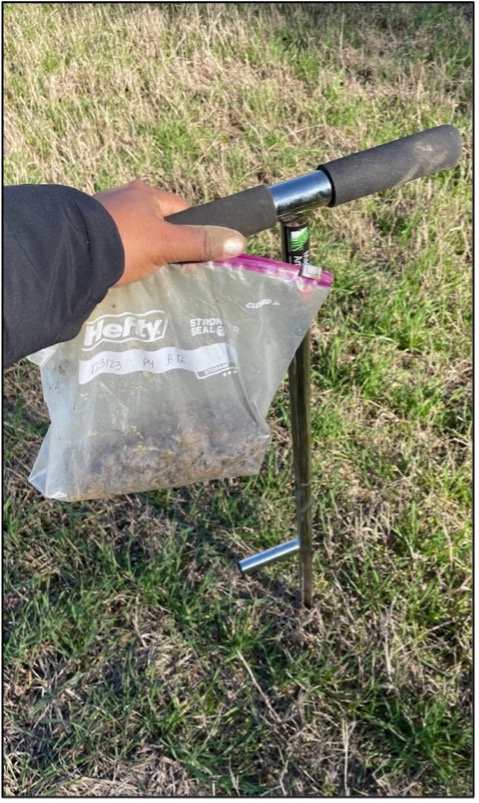
Proper land preparation before planting is key. If a prescribed burn is needed to remove thicker layers of dead material and vegetation standing in the field, it should be conducted by the end of February. Disking or plowing will also be required. Unfortunately, all these land preparation steps can activate the seedbank and result in weed seed germination. The seedbed must be clean to limit weed competition in early establishment. For pre-establishment, non-selective herbicides can be used to kill all weeds and promote control before sowing seeds.
Before sowing the selected forage species, the planting site must be firm and smooth to ensure proper seed-soil contact. Equipment calibration is crucial and should be conducted before planting any crops to ensure an appropriate seed depth, seed-soil contact and seeding rates. After sowing, fertilizer should be applied according to recommendations obtained from the soil test. Lack of adequate land preparation, weed control, and improperly calibrated equipment are some of the most common reasons for the failure of establishment in any crop.
Establishing a perennial grass stand takes 2 to 3 years, and it should not be overseeded until it is properly established. Annual forages such as ryegrass and oats can eventually be overseeded into established silvopasture to extend or prolong the grazing season in early spring and late fall. Leaf fodder from a forage crop, such as legumes, can add nutritional value to livestock diets. Studies have found up to 51% higher yields in cool-season forages in a silvopasture system versus a traditional system.
A post-emergence weed control plan must be developed as the forage becomes established and weed competition is evaluated. The local Livestock and Forages Extension Agents are sources for information related to weed identification, herbicide selection, and determination of application rates. The local agents can be found at https://www.clemson.edu/extension/co/.
The Livestock Component
A silvopasture system provides forage but also offers microclimate benefits for livestock. The ideal temperature range for cattle is 41°F to 77°F, depending on where they are located, breed, nutritional condition, body score, etc. The summer months in the southeast can far exceed this range. Heat stress directly impacts animal production (e.g., milk, weight gains, etc.) and can reduce reproductive responses. Elevated body temperature in cows and heifers increases the chances of failure to become pregnant after insemination and can cause sperm production issues in bulls (morphology and motility). There can also be survival issues related to heat in embryo transfer. The trees can also provide shelter during the winter months in colder climates.
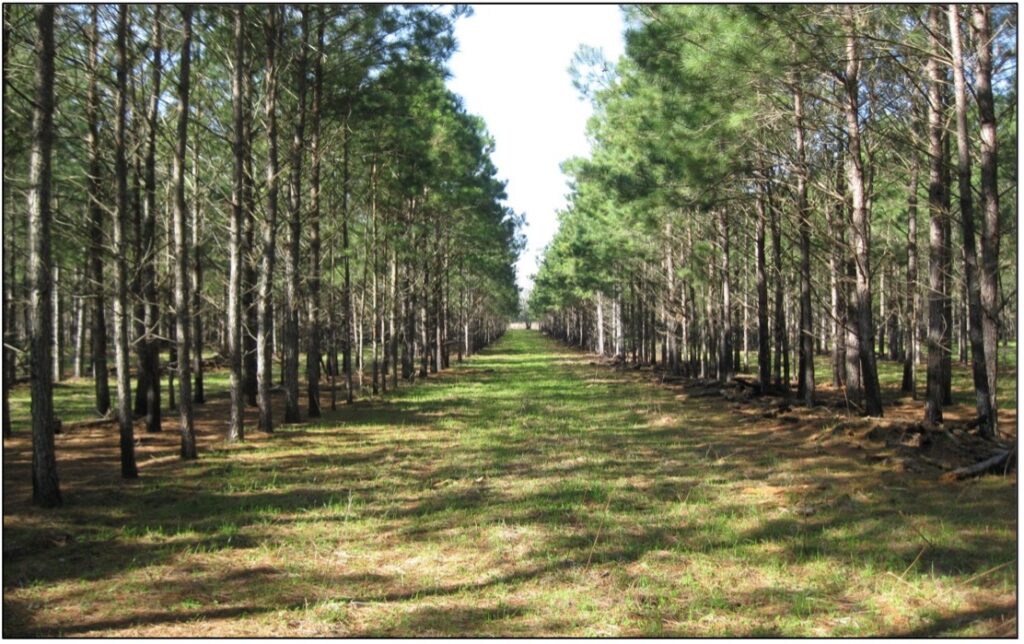
Livestock will start grazing in year 2 or later, depending on what forages are established and the age of the trees. Small ruminant production can also benefit and thrive in these ecosystems, so multi-species grazing can be another option. The maximum value will be obtained from the forages when livestock is divided into paddocks based on nutritional needs. A rotational grazing strategy will often need to be implemented to maintain forage productivity and prevent overgrazing. Additional costs for fencing and watering systems to facilitate moving animals from one area to another are important considerations before implementing a silvopasture.
A new guidebook on the establishment and management of silvopasture in South Carolina is now available
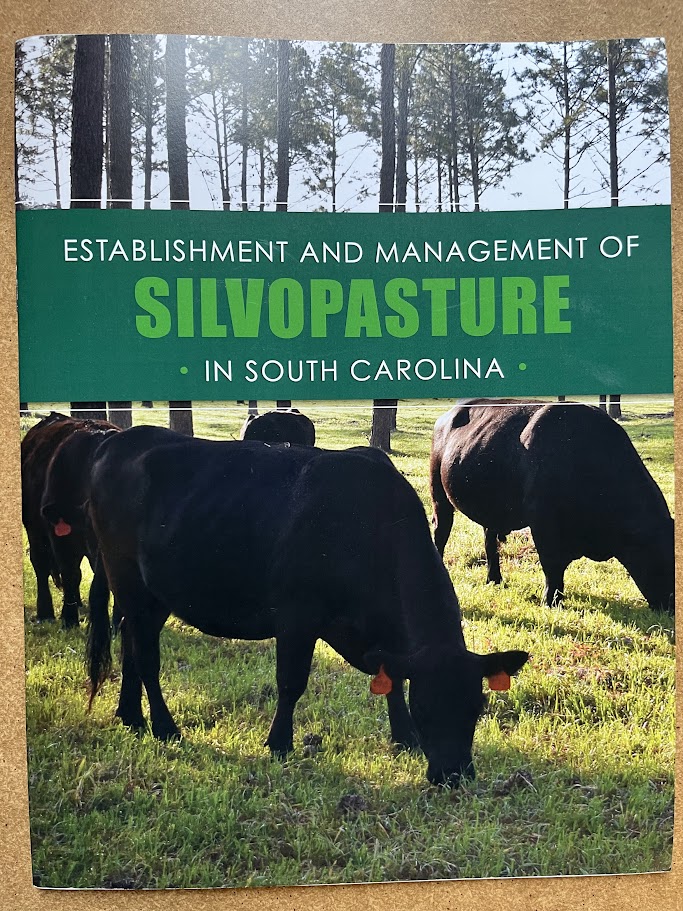
We are excited to announce the release of this new educational handbook: “Establishment and management of silvopasture systems in South Carolina”. This is a great multidisciplinary collaboration among 12 specialists and graduate students to discuss aspects related to the establishment and management of silvopasture. This handbook provides concepts and research-based information on the establishment and management of silvopasture for Extension and agricultural educators, producers, students, and the public in South Carolina. The goal is to provide a practical resource that any producer can understand and use, regardless of their background or scientific training. This handbook encompasses topics related to trees, forages and livestock management, water quality, ecosystem services, economic considerations to adopt silvopasture, and more.
Author(s)
Janet Steele, Cooperative Extension, Forestry and Wildlife Agent
Liliane Silva, Clemson University, Forage-Livestock Systems Assistant Professor, Extension Specialist
This information is supplied with the understanding that no discrimination is intended and no endorsement of brand names or registered trademarks by the Clemson University Cooperative Extension Service is implied, nor is any discrimination intended by the exclusion of products or manufacturers not named. All recommendations are for South Carolina conditions and may not apply to other areas. Use pesticides only according to the directions on the label. All recommendations for pesticide use are for South Carolina only and were legal at the time of publication, but the status of registration and use patterns are subject to change by action of state and federal regulatory agencies. Follow all directions, precautions and restrictions that are listed.
Clemson University Cooperative Extension Service offers its programs to people of all ages, regardless of race, color, gender, religion, national origin, disability, political beliefs, sexual orientation, gender identity, marital or family status and is an equal opportunity employer.
