You don’t even know it is there. It lurks in the dark of your yard, searching for prey while its venom drips off its iron-red teeth. It is a formidable hunter, consuming more than its weight in food daily. It has probably walked by you when you are outside in the dark, camouflaged by its dark pelt. Fortunately, you are not on the menu. It is the one-ounce short-tailed shrew, one of the few venomous animals.
There are two short-tailed shrew species in South Carolina: Blarina brevicauda (northern short-tailed shrew) and Blarina carolinensis (southern short-tailed shrew). Northern short-tailed shrew can be found in the foothills and mountains of SC, while southern short-tailed shrew can be found statewide except for the mountains. They are both 2 to 4 inches long, with a tail about one-third the length of the body. The southern short-tailed shrew is slightly smaller. The dense pelage is dark gray with some silver specks, which separates them from shrews in the Sorex and Cryptotis genera, which have brown pelage and longer tails. Northern and southern short-tailed shrews are difficult to distinguish without analyzing the skull, teeth, and DNA. At first sight, shrews can be mistaken for mice, but they have a wedge-shaped face with an elongated movable nose and tiny ears and eyes covered by hair. They are nearly blind and likely only detect light. They do not need to see well because they spend most of their time underground or under leaf litter. Their elongated nose, along with the strong front legs, helps them to burrow through soft soil and leaf litter. They are rarely seen alive due to their fossorial, underground lifestyle.
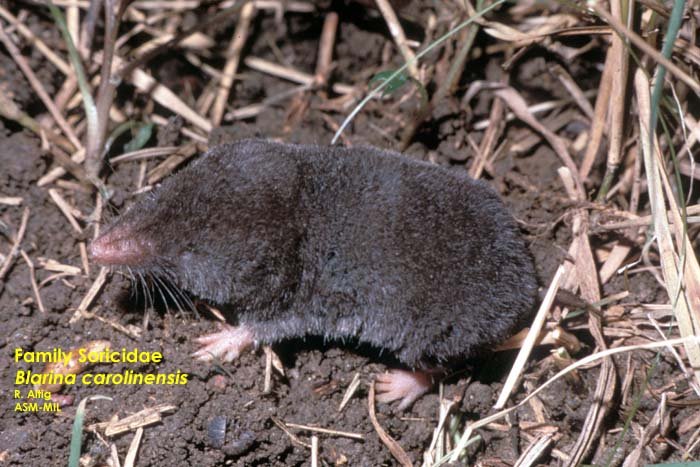
Short-tailed shrews hunt invertebrates such as grubs, insects, spiders, snails, and worms and sometimes capture lizards, amphibians, mice, and ground-nesting birds. They occasionally consume plant material, especially in the winter. Due to their preference for insects and snails, shrews contribute to controlling pests. The neurotoxins produced by a gland at the base of the incisor teeth paralyze or kills their prey. The toxins are secreted into the saliva and are chewed into the prey. Some paralyzed prey is taken back to their nest and stored for several days before being consumed. Shrew saliva also contains enzymes that help break down muscle tissue. For a human, the bite can be painful but only causes bruising.
Shrews have a voracious appetite and often consume up to 100% to 150% of their body weight in a day. With a heart rate over 800 beats per minute, going a few hours without food can lead to starvation. This appetite is due to their active nature, high metabolism, and small size. Small animals have a greater ratio of surface to volume, so a greater proportion of their skin is exposed to the environment. Therefore, it is easier for them to lose heat to the environment. They ingest a large number of calories to maintain their metabolism and normal body temperature, especially in the winter. As an adaptation to their high caloric needs, they store some energy in specialized brown fat that is also found in human babies and bears.
Shrews begin mating in early spring and may have several litters per year. They typically have 2 to 6 blind, helpless offspring in an underground nest of grass and leaves deeper in their burrows. They can produce a large number of offspring per year, but many do not survive the first year. The average shrew’s lifespan is two years.
Shrews can inhabit a variety of habitats, but they prefer moist, yet not saturated, soils. They often have a surface burrow system in leaf litter and a deeper burrow system. It is not unusual for several individuals to share burrow systems, but they hunt alone. Shrews are more abundant in areas with high plant diversity because plant diversity supports a diversity of insects and small animals. They especially like ecotones because they support a greater diversity of prey. An ecotone is where two habitats meet, such as the border of a forest and a field. Decaying logs and brush piles are also utilized. Prescribed burns reduce habitat quality for shrews by reducing the amount of leaf litter. Home range size depends on prey density and varies from 1 to 2.5 acres. Home ranges are marked by scent glands on the belly and vigorously defended, although they often overlap. The gland also produces an odor similar to a skunk that deters predators.
With poor vision and sense of smell, shrews must use other tricks to navigate. One trick is vibrissae, whiskers, to detect surroundings and prey. The most impressive trick is echolocation. They produce ultrasonic clicks and then interpret the echo to understand their surroundings. They produce other noises, such as chirping for courtship and interacting with competitors.
References
Best, T.L. and J.L. Dusi. 2014. Mammals of Alabama. University of Alabama Press.
National Park Service. (n.d.). Species spotlight: Short-tailed shrew. U.S. Department of the Interior. https://www.nps.gov/articles/netn-species-spotlight-short-tailed-shrew.htm
Maryland Department of Natural Resources. (n.d.). Northern short-tailed shrew. https://dnr.maryland.gov/wildlife/pages/plants_wildlife/northern_short-tailed-shrew.aspx
Outdoor Alabama. (n.d.). Northern short-tailed shrew. Alabama Department of Conservation and Natural Resources. https://www.outdooralabama.com/insectivores/northern-short-tailed-shrew
Outdoor Alabama. (n.d.). Southern short-tailed shrew. Alabama Department of Conservation and Natural Resources. https://www.outdooralabama.com/insectivores/southern-short-tailed-shrew
Laerm, J., & Ford, W. M. (2007). Northern short-tailed shrew. U.S. Department of Agriculture, Forest Service, Northern Research Station. https://www.nrs.fs.usda.gov/pubs/jrnl/2007/nrs_2007_laerm_001.pdf
Laerm, J., & Ford, W. M. (2007). Southern short-tailed shrew. U.S. Department of Agriculture, Forest Service, Northern Research Station. https://www.nrs.fs.usda.gov/pubs/jrnl/2007/nrs_2007_laerm_002.pdf
Altig, R. (n.d.). Blarina carolinensis [Photograph]. American Society of Mammalogists Image Library. https://www.mammalsociety.org/image-library/blarina-carolinensis-20
Author
Robert Carter, Cooperative Extension, Area Forestry and Wildlife Agent
Clemson University Cooperative Extension Service offers its programs to people of all ages, regardless of race, color, gender, religion, national origin, disability, political beliefs, sexual orientation, gender identity, marital or family status and is an equal opportunity employer.
