It’s time for our annual update on invasive tree pests in South Carolina! We all know that South Carolina’s forests have their share of pests – most of which are native and typically only impact stressed or injured trees. However, several invasive species are established in our state or in neighboring states.
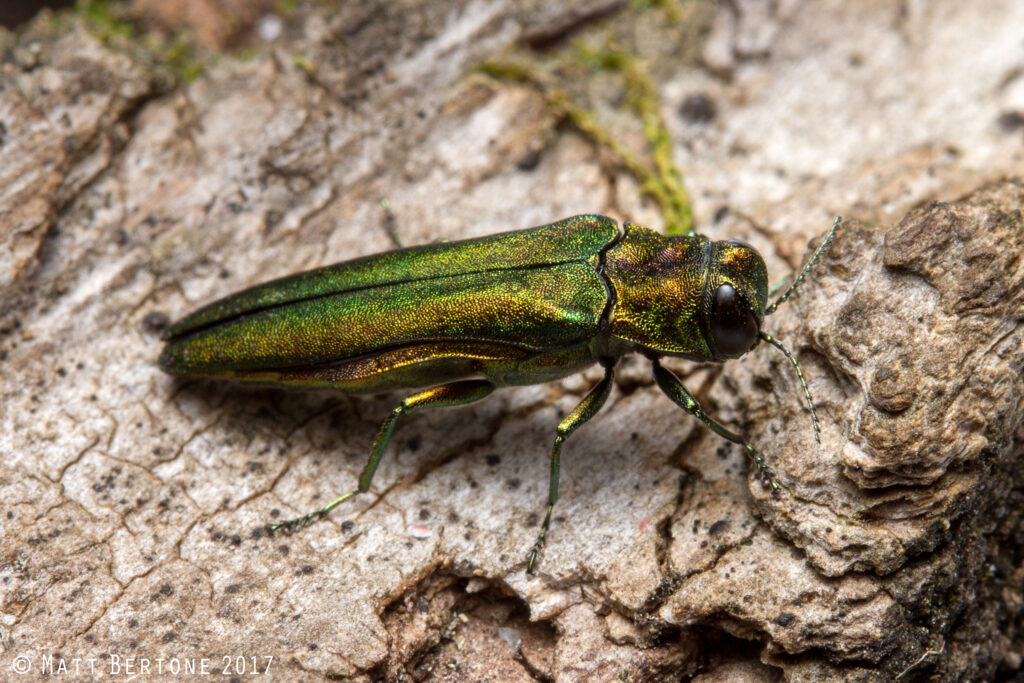
Dr. Matt Bertone, ©2017, NC State University
Emerald ash borer
The emerald ash borer is still present in Pickens, Oconee, Anderson, Greenville, Spartanburg and York counties. This beetle’s adults are bright green and the whitish larvae feed on the tree’s phloem (just under the bark). Larval feeding can kill mature trees in just a few months, as their winding feeding galleries cut off nutrient transport within the tree and essentially cause starvation. Little can be done to manage emerald ash borer populations in natural areas, though there are several biological control agents that have been shown to help reduce beetle populations. These beetles only impact ash (Fraxinus), so if you have dying ash, it’s worth checking it out and notifying your local Extension agent or SC Forestry Commission forester.
Laurel wilt
Laurel wilt is a devastating disease spread by the redbay ambrosia beetle that affects all species in the family Lauraceae, which includes redbay and sassafras. This disease is present in 22 counties in South Carolina’s Piedmont and Coastal Plain regions. The beetles attack healthy trees and introduce a fungus, which quickly grows and clogs the tree’s water-conducting tissues – and this nearly always results in tree death. You can track the spread of laurel wilt here.
Asian longhorned beetle
While neither the emerald ash borer nor laurel wilt have significantly expanded their ranges in the last couple of years, the same cannot be said for some other invasive tree pests in South Carolina. The Asian longhorned beetle is under federal and state regulation and is now present in Mount Pleasant as well as in the original area where it was first found, around Hollywood and Ravenel (in Charleston and Dorchester counties). This large black and white beetle primarily attacks maple (Acer), but can also use poplar (Populus), willow (Salix), birch (Betula), sycamore (Platanus), and elm (Ulmus) as hosts. Larvae can grow up to nearly 2” long and feed on the wood, causing branches and stems to break. While this pest can be eradicated, total host removal is necessary, which means removing and grinding the infested tree and stump.
Species to be on the lookout for:
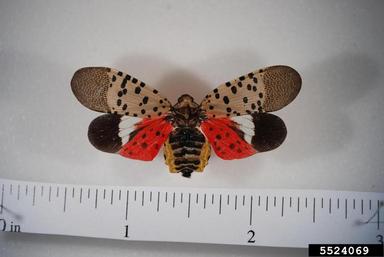
Spotted lanternfly
The spotted lanternfly is an insect that feeds on over 100 different host plants, including several smooth-barked hardwoods, like maples and young walnuts (Juglans). This pest was first found in Greenville and then Oconee counties in summer 2025. Spotted lanternfly is unlikely to be a forest pest but feeding by this insect can negatively impact tree growth and health. We are asking anyone who sees this pest to report it immediately, as the impacts of this pest are both known and significant.
Elm zigzag sawfly
The elm zigzag sawfly isn’t known to be present in South Carolina yet, though it is present in both North Carolina and Tennessee. This pest is capable of defoliating any species of elm and is fairly distinctive in appearance – elm zigzag sawfly larvae make characteristic feeding patterns in leaves, and can quickly defoliate entire trees. We also have a great fact sheet on the elm zigzag sawfly- https://hgic.clemson.edu/factsheet/elm-zigzag-sawfly/.
If you see either any of these pests, please let your local Clemson Extension agent or SC Forestry Commission forester know right away. Find out more about these pests from the South Carolina Forestry Commission (https://www.scfc.gov/protection/forest-health/) or at our state regulatory page (https://www.clemson.edu/public/regulatory/plant-industry/invasive/index.html) and report them if you see them!
Author
Dave Coyle, Cooperative Extension, Forestry and Wildlife Specialist
Clemson University Cooperative Extension Service offers its programs to people of all ages, regardless of race, color, religion, national origin, disability, political beliefs, sex, marital or family status and is an equal opportunity employer.
