If you have ever owned a small woodlot, you know firsthand the challenges that come with it. Oftentimes, it seems impossible to get any kind of forestry management activity performed on such a tract, short of you having to do it yourself. In this article, I want to discuss the many things to consider and/or options one might not have considered. Just remember to always plan for a desired outcome (a goal), and you achieve these goals through objectives (actions taken). Your goals should ultimately reflect why you own the land.
Keep Making Money: Harvest with a Neighbor.

In 2025, for most parts of the state of South Carolina, it has become increasingly difficult to harvest tracts of less than 20 acres. Sometimes, the only way to get these tracts harvested is to partner with a neighbor who also owns timber, in hopes that between the two owners, the total acreage of timber is over the 20-acre threshold to make it financially feasible for a logger. A ‘Timber Contact’ will be written to each landowner separately before any wood is harvested (for more information about Timber Contracts, please see here). Usually, the logger will set up on one property, harvest the timber on that tract, finish all activity on that tract, and then begin harvesting the neighbor’s timber while dragging it to, and loading it from, the original tract loading spot (aka a loading deck). This is to cut down on moving expenses that the logger would incur, save time, and keep truckloads separate to identify where the wood came from. Load ticket identification is imperative, so the correct landowner is paid for their wood in its entirety. Sometimes a single load of wood to the mill will be identified as a ‘split load’, meaning part of the wood is from the first tract and part from the second tract to make a full log truck. At this point, the landowners must trust their logger as a professional, as some split loads might be 25%/75%. This is where open communication is imperative for all parties involved. After harvesting is over, the small woodlot owner can resume normal forestry practices on their land, such as reforestation if clearcut, knowing that they can move future wood growth, to maintain a healthy forest, through partnering with the neighbor when it is time to harvest again.
This is for the Birds: Managing for Open Woodlots.

Often, the best outcome for small woodlots is to reduce the remaining stems to a Basal Area of 40-60. (For more information on How to Measure Basal Area please see here). This will allow the woodlot to seem wooded while opening it up to a more park-like savannah that most find attractive. Most people associate this look with the stereotypical quail woods habitat look. Justly so, as this usually promotes many different forms of wildlife. If the woodlot is pine, this will significantly reduce the likelihood of pine beetle (southern pine beetle, IPS beetle, turpentine beetle) attacks. This style of woodlot can easily be managed with prescribed fire. Prescribed fire is a highly desirable management tool due to the plant community response you get afterward (which wildlife depend on), while reducing the wildfire risk through fuel reduction. However, if you are in a smoke-sensitive area, then the use of herbicides on undesirable plants, light winter discing, or mechanical mowing is an option as well. Once woodlots of mature timber are reduced to 40-60 basal areas, typically, harvesting timber is not needed. The property is maintained in this state for as long as the timber lives until natural mortality takes them. These openings from dead trees can either be maintained as openings for plant diversity or replanted with desirable tree species, depending on the landowner’s objectives. If you are receiving property tax breaks through Agricultural Exemption, make sure you do not lose your exemption status.
A Holistic Approach: Clearcut and Repurpose.
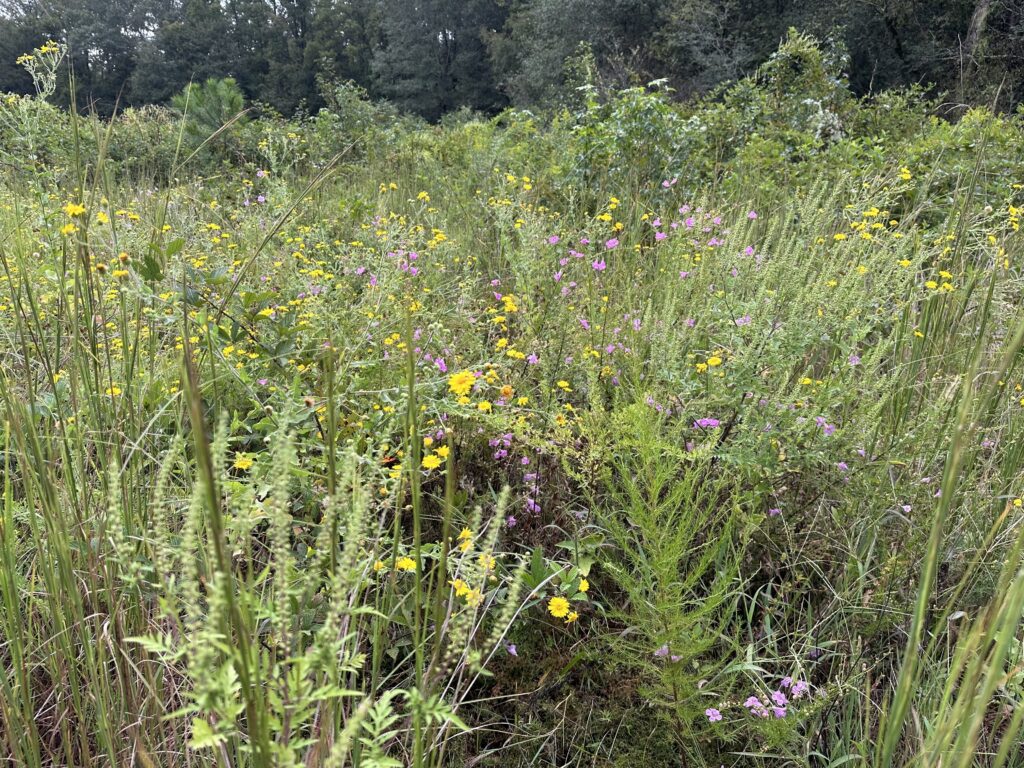
Sometimes, the only way to make a small woodlot attractive for harvest is to clearcut it due to the needed volume to make it financially feasible. That might sound great if you were looking for a financial gain, but when you replant it (plantation pines or hardwoods), how are you going to get that timber thinned when it comes time for a first thinning since the volume of wood from that same size acreage will be significantly less in a first or second thinning versus a clearcut. Not to mention, with pines, the lack of timely harvests sets you up for stressed trees, which typically spells pine beetle problems. This is when we must decide if repurposing the land is the best option. Converting land to pasture and/or farmland is one option. Still, it is expensive due to stumping and possibly having to regrade areas afterward, not to mention pasture grass establishment, fencing, etc. This is when converting land to more of an open meadow to favor wildlife and/or pollinator habitat usage is simpler and less expensive. When planning for this habitat conversion, keep in mind the necessities for a given wildlife species: food, water, shelter, and space. Also, keep in mind that many of the native grass and/or plant species that make great wildlife and pollinator habitats naturally occur. Many of these species have seeds already sitting in the seed bank, just waiting for soil disturbance and sunlight to cause them to germinate. You can also supplement native grass/plant habitat by planting these species through the purchase of seeds from companies that specialize in native plants. Specific species of trees and shrubs can also be planted based on the wildlife needs that you are planning for, while undesirable plants can be controlled with herbicides. Oftentimes, these herbicide applications will be target-specific, thus utilizing methods like tree injections, cut-stump applications, hack-n-squirt, or, at a minimum, foliar applications with herbicides that are species-specific. Again, check on maintaining the Agriculture Exemption, if you are currently receiving it, due to the practice change.
Time to Fold’em: The Last Option.
As one who has spent his entire life around forestry and surrounded by like-minded individuals, it pains me to type the following, but sometimes it is a landowner’s only option. Sometimes the best option for a woodlot owner is to sell it. Oftentimes, neighboring tracts are interested in adjoining tracts, thus solving the management issue due to overall acreage. There is also the option of selling it to someone looking to build a home. Either way, in the end, the current owner realizes that they cannot meet the goals they have for owning the property. Either the objectives are too hard to perform to reach the goals, or the tract simply does not lend itself to being achievable. This could be due to geographic location, timber market conditions, proximity to neighboring houses, wrong soil type, liability reasons, and/or the owner’s age or physical limitations.
Here to Help: Clemson Extension.
Above are just some of the most common options given for most landowners. It in no way is a one-size-fits-all. When faced with these decisions, it always helps to talk to a forester and/or wildlife biologist to help assess what you want to do and/or need done. Remember that Clemson Extension’s Forestry and Natural Resource Team has an Agent ready to help in every county in South Carolina.
Author
Stephen Pohlman, Cooperative Extension, Area Forestry and Wildlife Agent
This information is supplied with the understanding that no discrimination is intended and no endorsement of brand names or registered trademarks by the Clemson University Cooperative Extension Service is implied, nor is any discrimination intended by the exclusion of products or manufacturers not named. All recommendations are for South Carolina conditions and may not apply to other areas.
Clemson University Cooperative Extension Service offers its programs to people of all ages, regardless of race, color, gender, religion, national origin, disability, political beliefs, sexual orientation, gender identity, marital or family status and is an equal opportunity employer.
