Most forest landowners and agricultural producers, as well as many homeowners, own a chainsaw for use on their property. Chainsaws can make quick work of clearing land, removing downed trees or limbs, and cutting firewood. However, chainsaws are inherently dangerous tools, and when injuries occur, they can be very severe and even fatal. The improper use of chainsaws, often due to a lack of training and experience, and the absence of personal protective equipment (PPE) result in thousands of injuries each year. Combined Occupational Safety and Health Administration (OSHA) and hospital emergency room admissions for chainsaw-related injuries totaled 128,000 over the 5-year span from 2018 to 2022, or an average of 25,600 injuries per year during that time. The Centers for Disease Control and Prevention (CDC) has an even higher annual estimate of 36,000 chainsaw-related injuries that require a hospital visit. The majority of these injuries occur among non-occupational chainsaw users, as OSHA reported that 202 occupational chainsaw-related injuries requiring hospital admission happened during this time period.
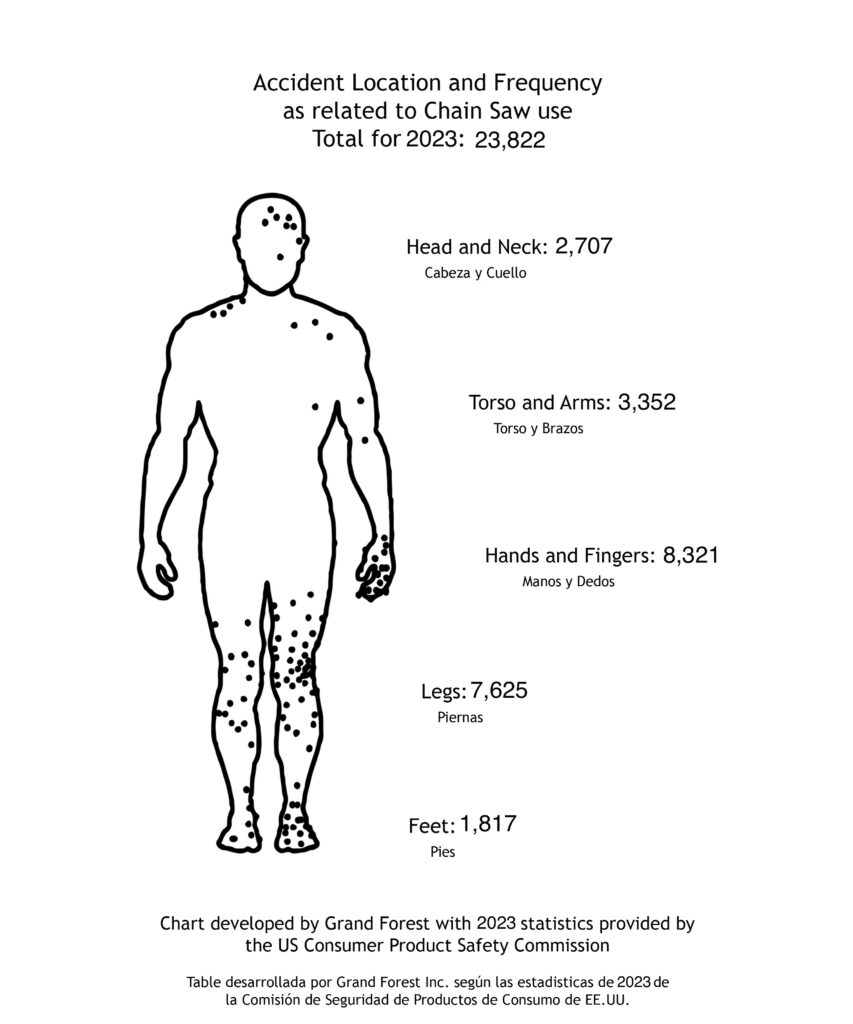
Grand Forest, located in Summerville, SC, produces chainsaw protective apparel, including chainsaw chaps. Their most recent “dot man”, which illustrates the frequency of lacerations caused by chainsaws on different areas of the body, showed a total of 23,822 such injuries reported for 2023 by the US Consumer Product Safety Commission. Overall, the statistics for chainsaw-related injuries should prompt any chainsaw user to consider how well-trained and prepared they feel to operate a chainsaw.
Chainsaw facts and statistics
- Chainsaw chains revolve at 55-60 MPH
- Chainsaw teeth are designed to rip and pull apart wood fibers, not making a clean cut like a knife
- Chainsaw lacerations usually are jagged and deep, requiring, on average, 110 stitches
- For lacerations requiring a hospital visit, which is about 76% of all chainsaw injuries, they occur primarily on the left side of the body above the waist and about equally on either side of the body below the waist
- 11% of injuries were to the head and neck – these injuries are usually caused by kickback and can be fatal due to major veins and arteries located in the neck, and the risk of brain injury
- 14% of injuries to the torso and arms
- 35% to the hands and fingers
- 40% to the legs and feet
- About 7% of chainsaw injuries are fractures, and about 5% are soft tissue injuries
- 6% of hospital visits require admission, particularly for pain management and IV antibiotics, or when severe cuts involve joints or amputations
- 50% of the hospital admissions are due to lacerations
- 25% of the hospital admissions are due to fractures
- The remainder are due to burns and amputations
- The number of annual fatal chainsaw accidents has been reported as high as 250; non-occupational deaths may go unreported; OSHA reported 57 deaths related to occupations for the 5 years from 2018 to 2022
- Falling trees and tree limbs, or “struck by” accidents, account for the majority of the fatal injuries
For anyone considering purchasing a chainsaw or who already owns one and has not evaluated its safety features or considered proper PPE for operating a chainsaw, two great articles are already available on the Clemson Extension Forestry and Wildlife website. These articles, written by Patrick Hiesl, Ph.D., Associate Professor of Forest Operations in the Department of Forestry and Environmental Conservation, can be found at these links:
“The Safety Features of a Modern Chainsaw” https://blogs.clemson.edu/fnr/2023/09/05/the-safety-features-of-a-modern-chainsaw/
“Personal Protective Equipment for Chainsaw Users” https://blogs.clemson.edu/fnr/2024/01/08/personal-protective-equipment-for-chainsaw-users/
Safety features on a chainsaw and proper PPE are critical for reducing the risk of chainsaw injury. However, the Clemson Extension Forestry and Wildlife team learned during a recent in-service training with Greg Helton, Chainsaw and Logging trainer with Forestry Mutual Insurance Company, that the best line of defense is proper training and the development of good habits when operating a chainsaw. To help reduce your risk of becoming a chainsaw-related injury statistic, best practices when operating a chainsaw include:

- Wear the appropriate clothing, including sturdy, closed footwear, preferably boots, and the proper PPE.
- Ensure that the safety features on your chainsaw are working correctly and that the saw is well-maintained.
- Evaluate the area you will be working in for overhead hazards, such as dead limbs, check for spring poles and other vegetation which could lead to “struck by” injuries, and consider any slope in the work area to make sure cut material will not roll downhill toward an operator.
- Evaluate the tension and compression in the woody material that is going to be cut and determine which side of the limb or log to start cutting on and how deep each cut can be made before the bar will become pinched. Tension and compression will change along the length of a limb or log as weight is removed and sections are no longer supported.
- Maintain a balanced stance without the risk of debris or other vegetation becoming tangled around your feet.
- Maintain a firm grip on the chainsaw, with the left thumb wrapped under the front handle and the right thumb wrapped around the rear handle.
- Stand to the side of where you are cutting, not directly over a rotating chain.
- Do not take your eyes off of what you are cutting and pay attention to shifts in the limb or log, particularly if it is starting to move towards you.
- Set the chain brake between cuts or when moving from one position to another.
- Do not remove either hand from the running saw to clear your work area or remove limbs without first setting the chain brake.
- Always be aware of where the “kickback” corner of the saw is when it is running.
- Never run a chainsaw above shoulder level. The weight of the saw will shift your center of gravity, and if kickback occurs, the face, neck, and upper body are at increased risk of injury.
- While having a second person on-site to serve as a spotter is a good practice, ensure that they are at least a full tree length away from any cutting area. Never use a second person to hold woody material while it is being cut, or to push or pull material as it is being cut.
No matter how experienced a sawyer, accidents can still happen. Be prepared by having a first aid kit, including a bleeding control kit, on the site where you will be operating your chainsaw. If you are working alone, let a friend or family member know your location and when they can expect to hear from you.

Since the fall of 2021, the Clemson Extension Forestry and Wildlife Program Team has been offering chainsaw workshops around the state. The lead instructor is Patrick Hiesl, Ph.D., who relied on years of experience as a professional logger in his home country of Germany when developing a curriculum designed for non-professional chainsaw users. The Chainsaw Safety and Handling course covers the basics of chainsaw operations, with an emphasis on the importance of using Personal Protective Equipment (PPE) and selecting chainsaws that feature the most up-to-date and functional safety features. In the hands-on portion of this course, participants learn the primary cutting techniques for handling stems already on the ground. Upon completing that course, participants can then take the Tree Felling course. This course teaches directional felling using the open-face felling method and techniques to maintain control while felling trees, thereby reducing the risk of injuries and damage to residual trees or structures. So why should you consider taking one or both of these courses? Because the best protection against injury from chainsaws begins with knowing how to handle the saw properly, learn the combination of cuts that can be used to safely limb, buck, or fell a tree, and most importantly, do not place yourself in a position that puts you at an added risk of injury. And then like any other skill, practice, practice and practice!
Author(s)
Janet Steele, Cooperative Extension, Forestry and Wildlife Agent
Clemson University Cooperative Extension Service offers its programs to people of all ages, regardless of race, color, religion, national origin, disability, political beliefs, sex, marital or family status and is an equal opportunity employer.
