A new school year means new learning opportunities! This
year, Cherokee County 4-H wants to enrich schools with positive agricultural
learning experiences.
We will offer our popular Caterpillar to
Butterfly Project to all kindergarten teachers! Students make predictions and
observations during this project and love seeing the physical changes made each
day.
For first
grade teachers, we will offer a series of healthy lifestyles lessons where
students will learn where their food comes from and what components are in that
food that make it healthy. And let’s not forget the best part… taste tests!
Cherokee County second graders attending Down on the Farm Day
Second graders will take part in Down
on the Farm Day. Our partnership with the Institute of Innovation allows
students to take a field trip to us where they will rotate through six
different stations and experience a different aspect of farming at each one.
Third grade teachers! We have an
awesome opportunity for you! Please contact me to learn how you can sign up to
get South Carolina Farm Bureau’s Ag. Learning Lab in route to you this school
year!
Fourth graders will be offered a
series of agriculture lessons taught by me, your 4-H agent!
AgMags are wonderful resources to
teach your students about agriculture. Fifth grade teachers can receive a class
set of AgMags each month beginning in November on a variety of topics. Think,
“How It’s Made”, agriculture style.
Last but certainly not least,
embryology! Chick embryology is a fan favorite! Students enjoy incubating and
hatching chicken eggs and caring for the chicks after hatching. Along with this
hands-on experience, teachers will also receive very detailed curriculum to
guide them through each day of the process with their students, making this an
awesome learning experience for all! This program will be offered to any school
librarian in Cherokee County (elementary, middle, and high school).
Aside from school enrichment,
Cherokee County 4-H has many other opportunities to get involved in such as
community cubs, independent projects, statewide events, and livestock shows.
Please contact me if you are interested in getting your youth involved!
New Online Course! Seasonal Pond Management If you own or manage a freshwater pond, the Seasonal Pond Managementcourse is for you! For $15, you’ll receive on-demand access to course materials for 365 days. The course focuses on actions throughout the year that can help maintain a healthy pond.
Water Chats
We are wrapping up another successful season of the Water Chats program with final sessions in September and a student-focused session in October. This partnership between Clemson Extension, S Sea Grant Consortium, and the SC Water Resources Center, has helped educate professionals across the state on a range of water quality issues and solutions.
Missed a webinar that you you wanted to see? Let us know (nix4@clemson.edu) and we’ll provide access to the recordings, when available.
Chris LeMaster Livestock & Forages Agent Cherokee, Spartanburg, & Union Counties
Safety data (2019) by the U.S. Bureau of Labor Statistics indicates that the agriculture sector continues to be the most dangerous in America with 573 fatalities, or an equivalent of 23.1 deaths per 100,000 workers. Even in Cherokee County, we have had two ag-related fatalities less than a year apart. As we prepare for the busyness of fall hay harvest, a reminder about farm safety is much needed.
On August 1st we held a farm safety workshop tailored for cattle and hay producers. Typically, safety talks bring about a glazed and yawning audience. However, our speaker, Marion Barnes, used many real-life examples from around our state. He shared startling facts about the dangers of youth around farms. One point that shapes the deadly youth statistics is that on most farms, there is no separation between the barnyard and the children’s play area . This leads to complacency around dangerous equipment for both the youth and the parents.
Aside from the loss of limb or life, accidents on the farm are very costly and, in many cases, can bankrupt a farm. If you want to see your farm passed down another generation, you had better make good decisions on your “calculated” risks around equipment and livestock.
After the presentation, many stories were shared with the audience about ag-related deaths and injuries in our county from the past couple of decades. I received several calls after the workshop from farmers stating they appreciated the safety talk and planned to implement changes in their operations.
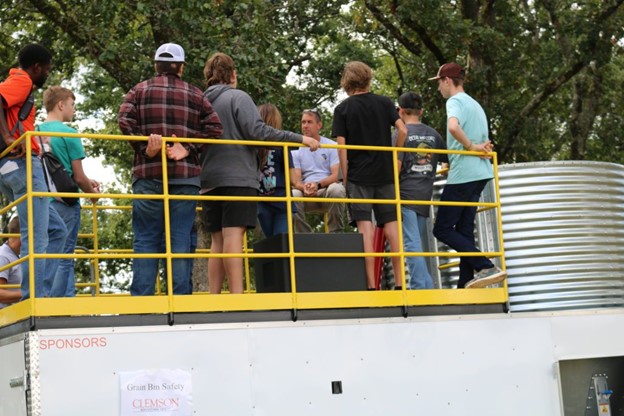
Grain Bin Safety Trailer
This program stemmed from an in-service training held on June 3rd at the Sandhills Experiment Station. Agents and specialists from across the state received presentations and demonstrations on farm safety topics. The demonstrations included legally transporting equipment, Rollover protection systems, and grain bin rescue. The grain bin rescue simulator was the most impressive demonstration. It was designed and constructed by the Ag Mechanization department to fit a small grain bin on top of an enclosed trailer that houses specialized equipment for the extraction demonstration. This trailer has been all over the state to help rescue teams train for grain bin entrapment. We plan to have this trailer visit some local fire departments in our farming communities.
Farmers are hard to replace, and so many people count on us. Please slow down and think about any avoidable risks. We need our farmers, and your families need you. For more information on farm safety and mental health for farmers, visit the links below:
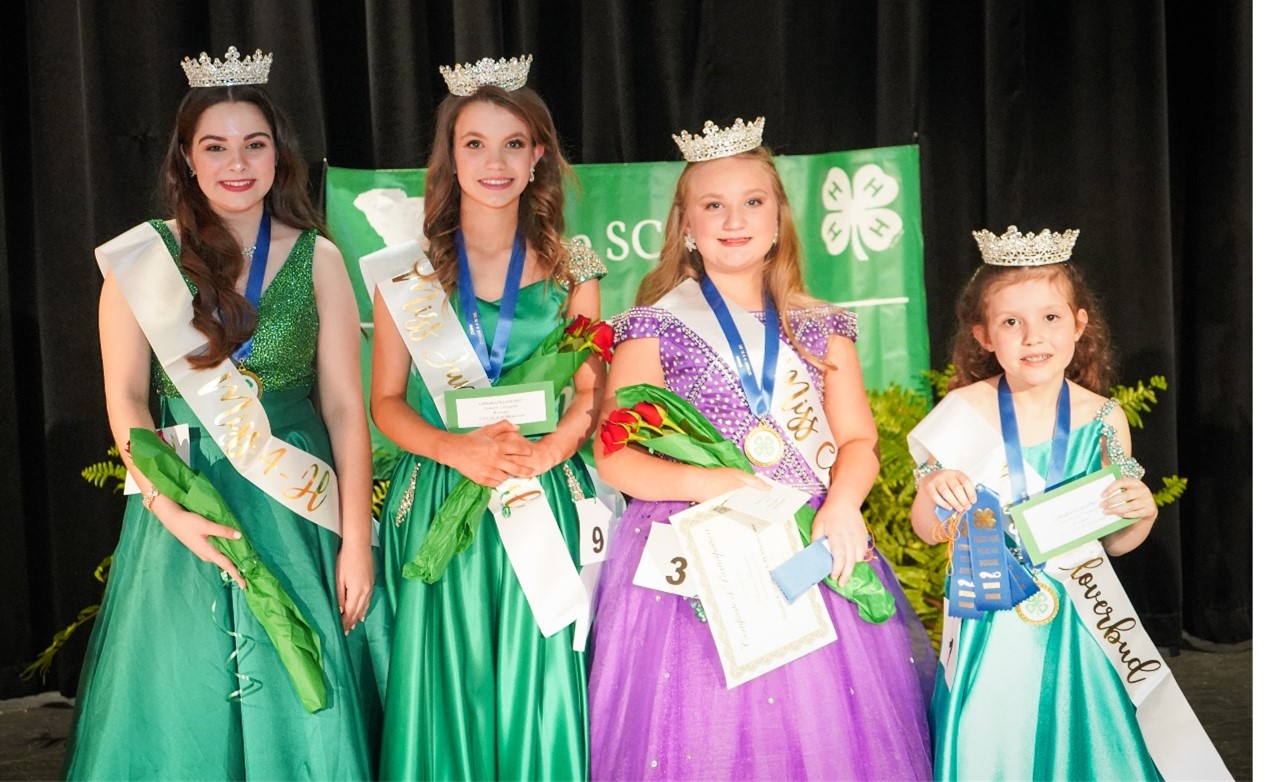
Winners of the 2024 SC 4-H Showcase: Miss 4-H Hennelly Gavin, Miss Junior 4-H Brooklyn New, Miss Cloverleaf Dixon Freeman, and Miss Cloverbud Hannah Dye.
On Saturday,
January 13th the Laurens County 4-H volunteers presented the 2024 SC
4-H Showcase at the Gilliam Center for Performing Arts on the campus of
Thornwell Charter School. The 4-H Showcase is a unique fundraising event that
is meant to highlight the achievements of 4-H’ers across South Carolina. This
is accomplished while building confidence, improving public speaking skills,
and instilling a sense of pride in the hard work of our contestants.
Our 16 contestants competed in three onstage divisions:
business wear, 4-H project wear, and formal wear. In addition, our Junior and
Senior contestants participated in an interview with the judges earlier in the
day. This was a great opportunity for them to gain self-confidence.
We were pleased to welcome three outstanding judges for
the event:
Erica Eadicicco – former Laurens County 4-H’er, Presidential
Tray recipient, and native of Kinards, SC.
Courtney Stonell – Keep Laurens County Beautiful
affiliate coordinator with the Laurens County Chamber of Commerce.
Haleigh Tomlin – former Greenville County 4-H’er and the
current Miss Newberry.
Matthew Brownlee of Laurens served as our Master of
Ceremonies. This was the fifteenth year that Laurens County has presented this
program, so in honor of that occasion we were pleased to welcome the very first
Miss 4-H, Mrs. Anna Crowder, ag teacher at Laurens District 55 High School, to
assist in the crowning of our winners.
The winners will go on to represent 4-H in their local
communities and at various state events during the year. The winners of the 2024
SC 4-H Showcase were:
Miss Cloverbud – Hannah Dye of Chester County
Miss Cloverleaf – Dixon Freeman of York County
Miss Junior 4-H – Brooklyn New of Laurens County
Miss 4-H – Hennelly Gavin of Lexington County
Congratulations to all our winners and participants in
this year’s 4-H Showcase. Thank you to our dedicated volunteers without whom
this event would not be possible and thank you to our sponsors, the Laurens
County Water and Sewer Commission, Piedmont Rural Telephone Cooperative, and
the Laurens/Greenville 4-H Dairy Club. Also, a special thanks to Thornwell for
allowing us the use of their facilities.
While it is commonplace for producers in the upstate region of
South Carolina to grow fescue as their primary forage crop, many producers
utilize cool-season annuals to help get them through the winter. Cool season
annuals are great for sodseeding into warm-season perennials like bermudagrass
and for decreasing dependency on feeding hay. Cool-season annuals include a
variety of small grains, ryegrasses, legumes, and some brassicas. In ideal
conditions (adequate rainfall and extreme heat is gone), planting can begin in
late September to early October. The earlier the planting the better your
chances of being able to graze in the fall and early winter. Of course, the
transition from summer to fall in this state can oftentimes be unpredictable
with lingering heat and drought conditions. In the case of a late planting in early
December, you may provide enough forage to carry cattle from spring to summer. Be
sure to let forage grow to at least 6” in height before grazing, and do not
graze below 2-3” in height. These parameters will allow the forage to develop a
root system to promote drought tolerance and to sustain itself over the long
term. The month of February is a great time to apply a second round of fertilizer
regardless of whether you’re growing fescue or cool-season annuals. Remember to
refer to your soil sample results when applying fertilizer. This is also a good
time to evaluate the condition of your forage after the heavy frost events we
received within the last month. The extent of the damage may determine whether
it is worth fertilizing (regrowth must occur to justify fertilizer), replanting
heavily damaged areas, or feeding hay until warm season grasses take over. To
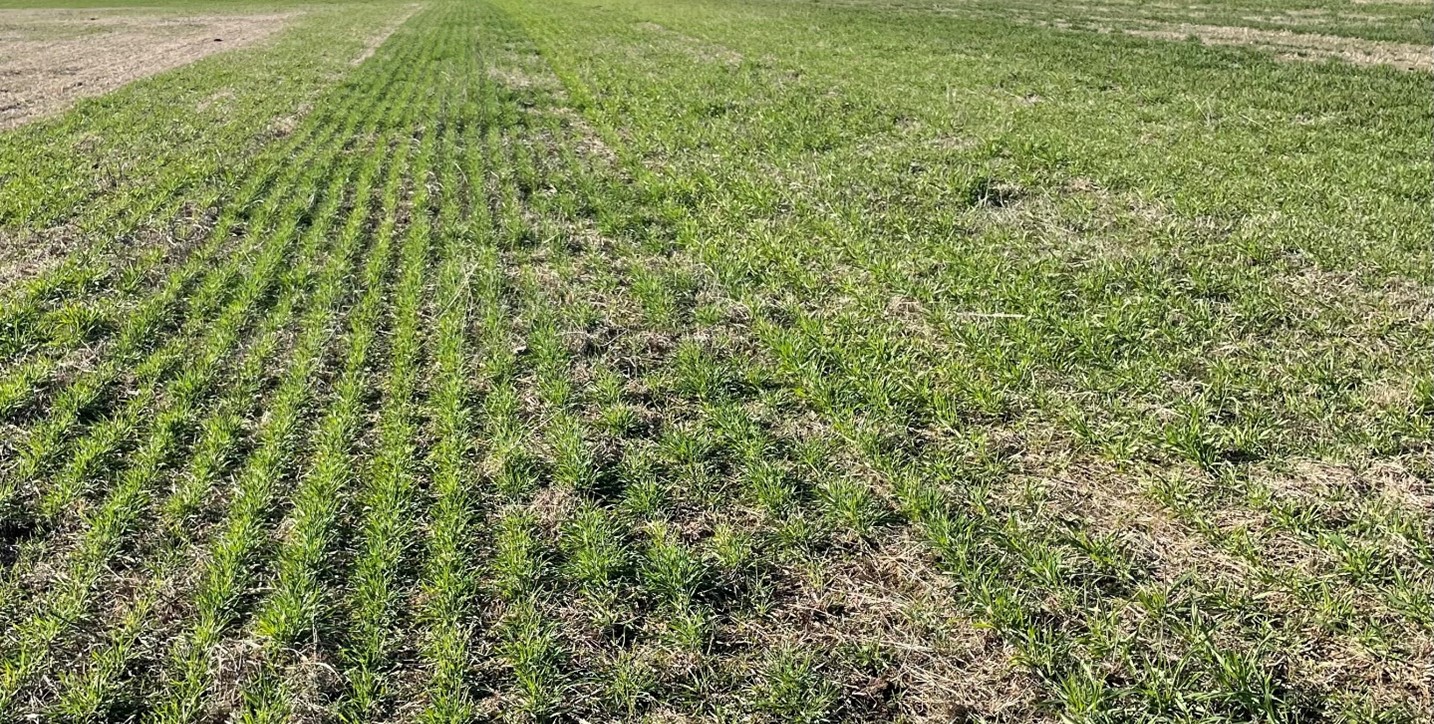
help our local clients gain some perspective on how cool-season annuals
perform, we have a variety trial in place in Ninety-Six, South Carolina. We
planted twenty-five different varieties including oats, wheat, ryegrasses,
clovers, and other specialty forages. We hope to present the trial in the
coming months if all goes well. Contact your local Clemson Extension office for
more information.
Jeff Fellers Area Forestry & Natural Resource Agent Chester, Laurens, Newberry, Union, & York
One thing I love about working for Clemson Extension is the
diversity of work throughout the seasons.
Rarely do we have the same tasks day after day. It often changes with the season. The fall
and winter seasons bring about fairs and festivals, along with our normal
activities.
Union County Agricultural Fair October is all about the fair in Union County. The Union County Extension Office is heavily
involved in managing the livestock, poultry, agricultural products, and home
economics sections. We also operate the
Union County 4-H Shooting Sports Trailer throughout the week of the fair. On Thursday of the fair, we also host a 5K
day where all the Union County public schools bring their kindergarten classes
to the fair to learn about livestock and agriculture. I always enjoy presenting on the crops
section for this field trip. If you have
never visited the Union County Agricultural Fair I highly recommend coming by
and seeing us.
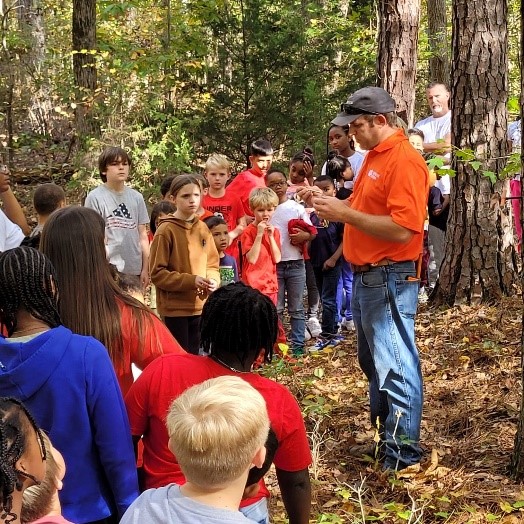
Kids in the Parks Track Trail I
had the opportunity to lead a trail hike for the Newberry County
Recreation Department for their grand opening of the Kids in the Parks
Track Trail. This trail is located at Lynches Woods in Newberry
County. I really enjoyed spending the afternoon with the children and
helping them identify some trees and shrubs, along with learning about
growth rings on pine trees. The Newberry County Recreation Department
has a nice kiosk with brochures that help educate those who take the
hike.
Wood Magic Forest Fair Wood Magic Forest Fair is a free field trip for fourth graders, hosted by
the South Carolina Forestry Commission.
The program provides a learning experience about the forest industry in
South Carolina that meet fourth grade school standards. Volunteers from around the forest industry
come together to teach fourth graders all about forestry. This year I had the opportunity to teach the
Gifts of the Forest station at the Harbison State Forest location. For more information on Wood Magic visit: https://www.scfc.gov/education/wood-magic/.
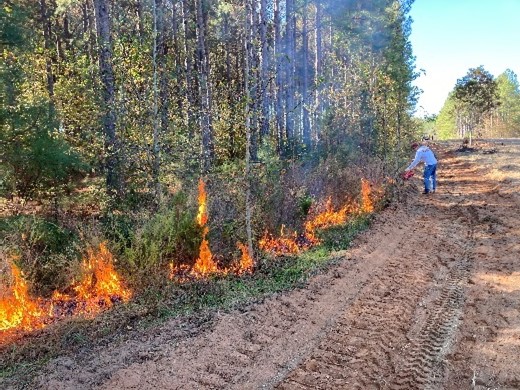
Learn to Burn In November, I had the opportunity to assist with a Learn to Burn program in Union County. This program was hosted by the Piedmont Prescribed Fire Cooperative at a private landowner’s property. Participants were able to actively participate in a burn on a mature pine stand. They were able to see the process from planning, preparation, execution, and mop up. Learn To Burn provides a great educational experience to landowners that are wanting to learn how to implement prescribe fire on their property.
Newberry Forestry Association The Newberry Forestry Association had their last quarterly meeting in 2023
on November 14. We met at Mt. Pleasant
UMC. Eddie Reese, with NRCS, presented
on forestry cost share programs. Our
next meeting will be February 13, 2024, and our topic will be estate
planning.
Laurens Forest Landowners Association
The Laurens Forest Landowners Association had their last quarterly meeting in
2023 on November 28. We met at the
Laurens County Farm Bureau Office. Chris
Gordy, from West Fraser, presented on local and statewide mill updates. Our next meeting will be February 27, 2024.
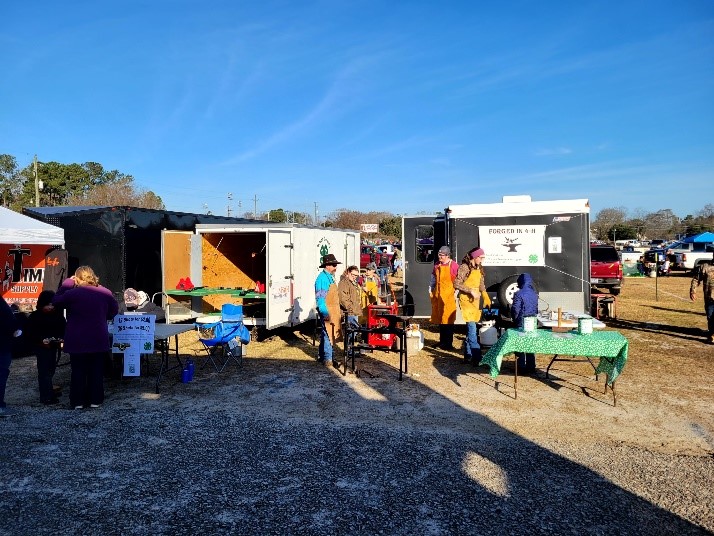
Grand American This was the first year that we took the Union County 4-H Shooting Sports Trailer down to the Grand American in Orangeburg, SC. Along with Forged In 4-H, we set up a display to help raise funds for the two programs. Just like at the Union County Agricultural Fair, the trailer is set up for participants to have fun shooting air rifles. For those less experienced shooters, we spend a little extra time helping them learn the basics of shooting. Forged In 4-H also provided forging demonstrations, while selling some of the items that were made through the program. The Grand American provided an excellent venue to advertise our program and educate participants about what great programs we have to offer.
4-H Food Plots One of my favorite activities in this job is judging 4-H Food Plots. We typically do this in January, so the weather is normally not cooperative. This year however, we had a very nice day to be out in the woods. We judged 1 in Newberry County and 2 in Union County. For more information on the 4-H Food Plot Project visit the following link: https://www.clemson.edu/extension/4h/program-areas/natural-resources/wildlife-food-plot-project.html.
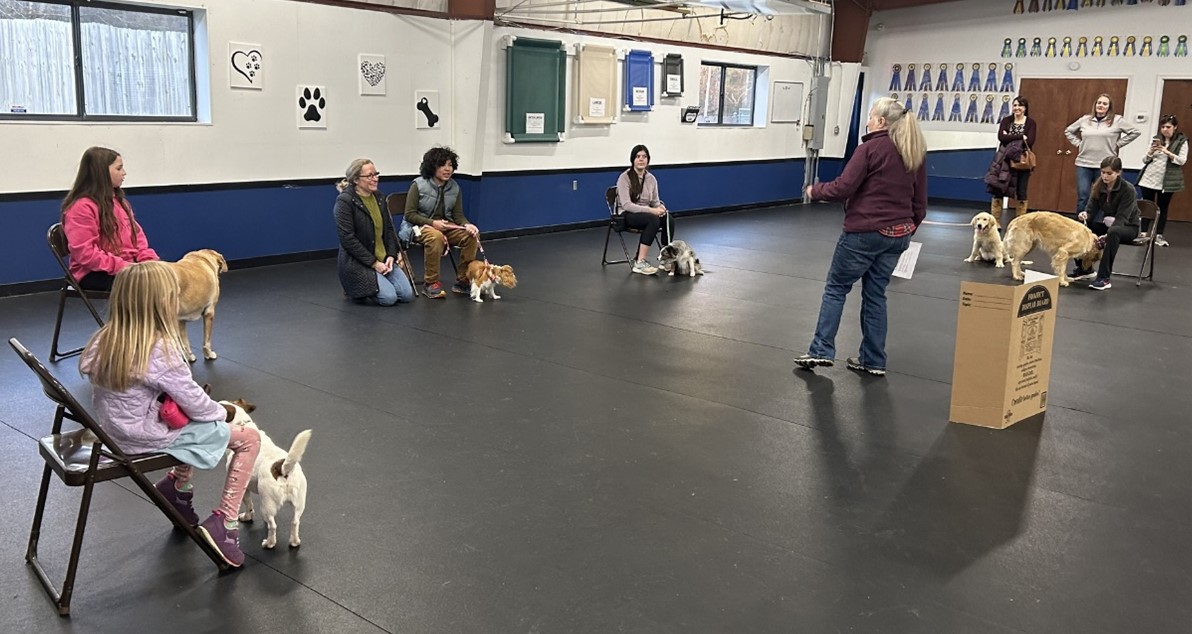
4-H’ers participating in the training classes presented by the Whiskers and Tails 4-H Dog Club. These classes are held weekly in Fountain Inn.
The Whiskers
and Tails 4-H Dog Club is a group of 4-H’ers from Laurens and Greenville
Counties who are interested in learning more about working with their furry
friends and showing them in competitive events.
For many
years, Laurens County 4-H has supported opportunities for youth related to
dogs. Each year through the Laurens County Dog Project, 4-H’ers are encouraged
to learn and keep records of training, health, grooming, and much more as it
relates to their pets. There have also been collaborations with the Greenville
Kennel Club as they have provided clinics and support over the years. They
assist each year in judging the annual dog show as part of the Laurens County
Junior Livestock Show.
Beginning in
August of 2023, the Whiskers and Tails 4-H Dog Club started offering weekly dog
training classes at the Dog Trainers Workshop in Fountain Inn. These classes
were for Canine Good Citizen certification, rally, and dog showmanship. They
concluded at the end of September with a final competition. Then, with growing
interest, it was decided to offer additional weekly classes in January of 2024
that will conclude at the end of February. These classes consist of Canine Good
Citizen certification and rally and were open for any 4-H member in Laurens or
Greenville Counties.
This club is
led by a great group of volunteers; Charity Blumer, DeAnn Karns, and Lisa
Stroup. Our 4-H’ers are also receiving quality lessons from qualified AKC instructors.
It’s been amazing to see the amount of knowledge and confidence gained by these
youth as they work with their animals. Thanks to Dog Trainer’s Workshop of
Fountain Inn for the use of their training facility. We look forward to
additional training classes throughout the year.
Stay posted for the opening
of registration for the 2024 Laurens County Dog Project in the spring. This
project is open to all interested 4-H’ers in surrounding counties as well.
Please contact Adam Petty at akpetty@clemson.edu or 864-705-1102 for more
information. Also, check out our Facebook page at https://www.facebook.com/4Hlaurenscounty
Julia Newsome Rural Health & Nutrition Agent Cherokee & Union Counties
“The first Health Extension for Diabetes (HED) cohort in Cherokee county was a community success! The cohort started in August 2023 and graduated in December 2023, with approximately a 90% graduation rate (adjusted)! We are recruiting for a second Health Extension for Diabetes cohort in partnership with the Cherokee County Family YMCA for HED in-person programing. Registration is open from 01/24/24-02/21/24, please contact me if you are interested in participating!
HED is a free diabetes support program recognized by the ADA as a practice-tested diabetes support program. The main goal of this program is to help participants better manage diabetes to prevent or delay complications. HED is 4 months long and includes a series of 8 education sessions and intermittent support sessions. Each session is designed to help participants learn more about diabetes and provide them with necessary skills and support to successfully self-manage diabetes. Participants will receive bi-weekly materials and weekly follow-up to help navigate resources and reach healthy lifestyle goals. A Type 1 or Type 2 diabetes diagnosis is required for enrollment.
February is American Heart Month; If there is an upcoming event or group meeting that you are looking for a guest speaker and a timely topic, I would love to attend and hold the Know Diabetes by Heart (KDBH) program. Please feel free to contact me if you have any opportunities or questions.
KDBH is sponsored by the American Diabetes Association (ADA) and American Heart Association (AHA). It is a free education session offered in-person or online. The program aims to help participants better understand the link between diabetes and heart disease. By participating in this one-hour session, you will learn more about risks related to diabetes and heart disease, how to take control of your risks, and learn about community and clinical resources.
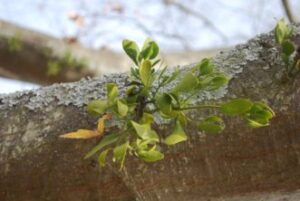
Now that deep winter is upon us, and the trees are bare of leaves, it is extremely easy to see the round, green balls of leaves scattered throughout the tree canopies. This is mistletoe.
Is it harmful to trees? Well, kind of. It is considered a parasite, a hemiparasite, to be exact. A hemiparasite makes some of its own food through photosynthesis but takes water and most of its nutrients from the host tree. American or Oak Mistletoe (Phoradendron serotinum) is commonly found on deciduous trees such as pecans, oaks, elms, hackberries, maples, and wild cherries. In the fall, it produces white berries that contain toxic chemicals poisonous to people and domestic animals.
Where did it come from? Birds are the most common culprit. They consume the sticky, white berries, and then transport the seeds to other trees where the seeds can germinate and begin their parasitic journey.
Mistletoe uses specialized roots called haustoria, which penetrate the host tree’s bark, allowing them to embed themselves in the vascular tissue. Through this connection, mistletoe siphons off nutrients from its host, sustaining itself.
What should you do if you have mistletoe? The primary method of management involves pruning out the infected branches. Prune the affected branch at least 18 inches beyond the point of attachment. Simply removing the mistletoe plant, without removal of the infected branch, will provide some protection from spreading. However, if you remove only the mistletoe, it will probably regrow.
For more extensive infestations higher in the tree, it’s advisable to enlist the services of a professional Certified Arborist. For some older, larger, heavily infested trees, it may not be feasible to remove such large portions of the canopy, and best just to let the tree live out its natural life or have it removed.
If you’d like to learn more about tree insects, diseases, and issues, or perhaps invite Carolyn Dawson, Clemson Extension Forestry Agent, to speak at your event, please contact her at dawson4@clemson.edu.
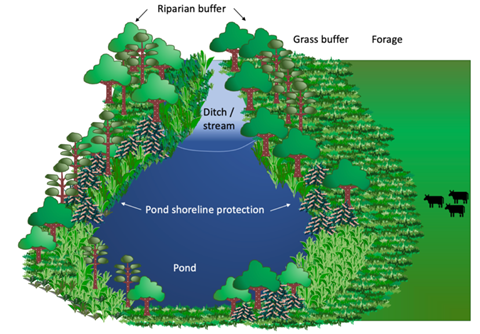
New Online Course! Be Well Informed If you rely on a private well to provide drinking water for your home, the Be Well Informed course is for you! There is no cost and it’s available anytime. Figure 1. Example of a healthy riparian buffer with livestock-safe plants. Image credit: Sarah White
Prepare your pond for spring!
The winter is a great time to start preparing for a healthier pond
when warm weather arrives! Here are some actions to consider.
Consider adding plants to the shoreline of
streams and ponds. Riparian buffers with healthy, native vegetation support
clean water and help prevent erosion along the shoreline. If the waterbody is
in a pasture, see our new Land Grant Press article on Livestock-Safe
Buffers!
When vegetation decays in ponds, the
nutrients from the plant tissue are returned to the water – and can spur future
plant growth. Remove decaying vegetation and compost in an upland area to help
reduce in-pond nutrients.
Consider installing an aerator in ponds that
stratify (or, to simplify, that develop layers of different temperature water)
and in areas with slow or stagnant water. Pumping air to the bottom of a pond
and letting it bubble to the service can increase dissolved oxygen levels and
support healthy fish populations.


 New Online Course! Seasonal Pond Management If you own or manage a freshwater pond, the