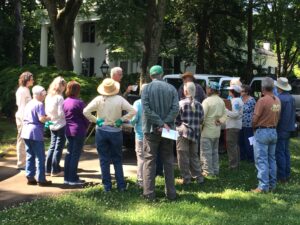
The Cherokee County 4-H Clovers in the Kitchen Club provides a program once a month for kids ages 9 to 18. We want to inspire the youth in our community to learn to cook healthy and nutritious meals for their families. The Clovers in the Kitchen Club has been cooking through the seasons since September. They have learned various valuable skills such as chopping, seasoning, baking, etc. In September, they learned to make nutritious items that can be packed in their lunch boxes. October was full of delicious tailgate food and of course November and December were Thanksgiving and Christmas inspired. We look forward to continuing the year and learning new skills to enhance our confidence in the kitchen. Other clubs that Cherokee County 4-H has to offer are Cloverbuds (ages 5-8), Bits and Pieces Horse Club (ages 9-18), Cherokee Charter Academy 4-H Club (students of Cherokee Charter Academy), and Teen Council (ages 14-18). In the months ahead we will have our Peach Country 4-H Livestock Show in March for any youth interested in showing beef, poultry, market hog, or rabbit and Down on the Farm Day in April for second grade classes across Cherokee County. Also, be on the lookout for 4-H summer day camps!
If any of the youth in your life would like to be a part of Cherokee County 4-H, please contact Haven Blackwell by email at daynab@clemson.edu or by phone at (864) 649-8252.
Christopher LeMaster, Jr. Livestock & Forage Agent Cherokee, Spartanburg, & Union Counties
Many may answer “Yes” to the above question, but nonetheless, that is an insightful question to ask yourself. Hopefully, you are intentional in your record-keeping, accounting, and tax preparation so that the IRS isn’t asking you the same question. Whether you identify as a hobbyist or businessman, all will agree that it requires real work to answer this question successfully. Besides the work, there are fundamental business concepts that cannot be ignored if you wish to keep your farm around for future generations. A team of agribusiness agents and specialists and I have worked to develop the workshop series Farm Business Concepts. This course is designed to dive deep into the foundations of a well-run farm business. Participants will learn about business structures, labor forms, record keeping, accounting (managerial, tax), and tax management. The workshop also includes a session on enterprise budgets and some case studies tailored to the cow/calf and hay producer. We are excited to help our farmers run their farms like businesses. There’s nothing wrong with being a hobby farmer, and truthfully, most of us would not endure the long hours and labor if we weren’t truly passionate about farming. We hope this program will help farmers identify ways to keep their farms profitable so that they may survive the ups and downs of the market and, most importantly, be around for another generation of farmers.
Alana West 4-H Youth Development Agent Newberry County
During the summer of 2023, Newberry County 4-H offered 8 opportunities for local youth to participate in. Some of these programs were on the local level and some were on the state level. In all, 66 Newberry County youth participated in these programs.
Our summer started with our Science of Art/Art of Science Day Camp where ten Newberry youth and one Fairfield youth explored the relationship between science and art. We studied constellations, moon phases, the color wheel, optical and sensory illusions, and more. We are grateful for the partnership with Fairfield County 4-H and the Jenkinsville Community Center.
Newberry County 4-H members learning to iron.
Next on the calendar was our Summer Engineers Day Camp. This camp took aim at recruiting youth to participate in our annual SC 4-H Engineering Challenge. The three-day camp allowed twelve youth to take a set of parameters and a list of materials and design a solution to a given problem. Participants built and tested bridges, paper airplanes, rockets, spaghetti towers, circuits, penny boats, Pringles rings, marshmallow catapults, and air boats.
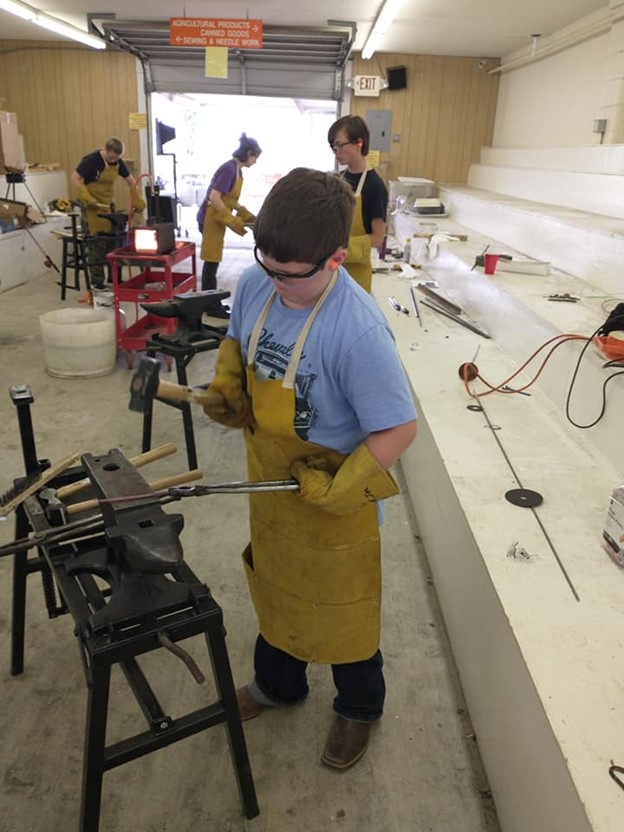
The next camp was a two-day venture into forging and blacksmithing. Seven youth from Newberry and two from Fairfield traveled to Union County to glean skills and knowledge from Union County 4-H Agent, Mark Cathcart. In addition to these skills and knowledge, youth took home S-hooks, mini swords, salt spoons, knives, and other trinkets they made.
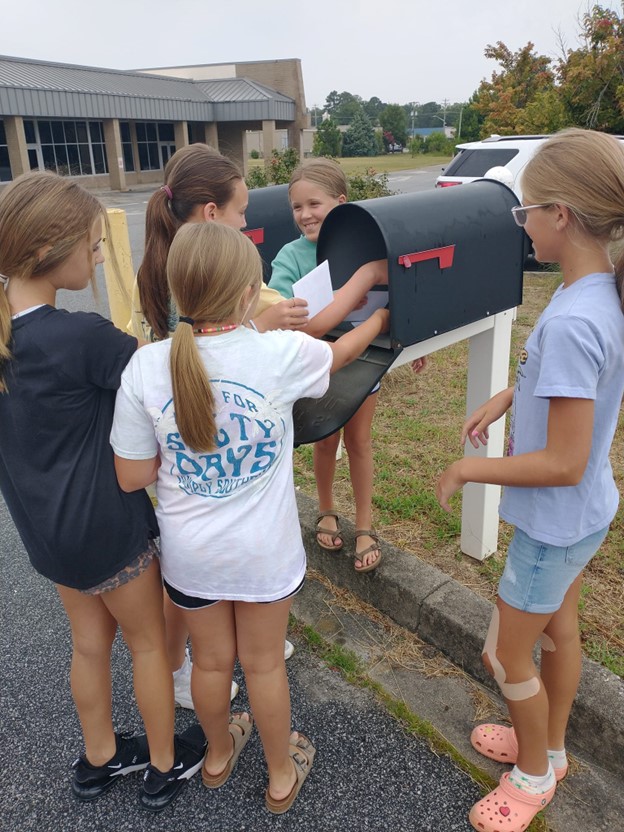
Newberry County 4-H members learning to write thank you notes and then properly address them for mail service.
In addition to these local camps, South Carolina 4-H held their annual Club Camp at Camp Long in Aiken in June. Youth in attendance were exposed to traditional summer camp activities including swimming, campfires, skits, and more.
To close out June, South Carolina 4-H held its annual 4-H State Congress, the pinnacle event for a 4-H member’s career. Three girls represented Newberry County. They attended workshops on self-defense, food safety and preservation, a makerspace, and etiquette as well as toured the Clemson dairy farm, experimental forest, cheese and ice cream labs, and planetarium. The week’s service project included packing 1,700 meals through Meals of Hope. The week was capped off with an awards banquet, with guest speaker, Newberry native Michael Mills and a dance with DJ Travis Gilliam, a Silverstreet native.
In July, we offered two rounds of our Magic in the Kitchen Day Camp, one for younger youth ages five through eight and another for older youth ages nine through fourteen. These camps were more about food science than cooking. We explored sinkers and floaters, astronaut ice cream, sugar substitutes, oil and water, popping corn, butter making, mixed drinks, dehydration, and tricked a lot of parents with our mock apple pie.
The final offering of the summer was for our older 4-Hers. A class on CPR was taught and four went home with new certifications.
Newberry County 4-H members learning to forge metal.
Throughout the summer, we also offered our first ever Summer Breakfast Club. Nine youth attended five meetings where they cooked their breakfast and then cleaned up their mess prior to learning a new life skill. Their breakfast menus included French toast roll-ups, chocolate chip pancakes, omelets, biscuits and gravy, and donuts, all homemade. They learned skills like ironing and folding laundry, checking tire pressure and plugging a tire, car maintenance, etiquette and table setting, grocery shopping skills, and how to write and mail a thank you letter.
In addition to our camps, we also had youth growing produce to compete in our Newberry County 4-H Tomato Project and our South Carolina 4-H Small Garden Project. Wrapping up the summer and kicking off the fall show season, we had one youth show his beef heifer at the Jr. Beef Round up in Clemson the first weekend of August. You may have also seen us representing at the South Carolina 4-H State Horse Show and Creative Contest in Clemson and Newberry County Soil and Water Conservation District’s Camp Conservation.
With fall livestock shows just around the corner and school busses now on the road, we look forward to starting our 2023-24 4-H club year, which runs September through August. School programs and clubs are now what’s on the calendar. Stay tuned for an update by checking our webpage: www.clemson.edu/extension/4h/county/newberry or following Newberry County 4-H on Facebook.
Melissa Bales Rural Health & Nutrition Extension Associate Statewide; Programs in Greenville & Laurens Counties
Melissa Bales, Extension Associate, and Mary Vargo, Urban Horticulture Agent, prepare for Growing Health in June.
Growing Health just wrapped its SIXTH class! Growing Health is a program that was developed by the Greenville County Rural Health and Nutrition and Urban Horticulture Agents to help beginner gardeners in Greenville learn to grow their own vegetables and incorporate these vegetables into a healthy diet. In order to help beginner gardeners learn about vegetables that can be grown throughout the year, Growing Health is presented in accordance to growing seasons – spring, summer, and fall. Those who participate in the program receive information and growing materials to take home.
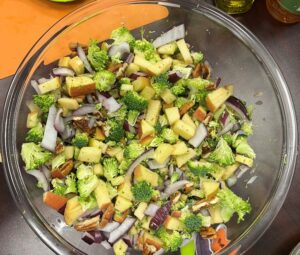
Participants in Growing Health in August got a taste test of Broccoli, Apple, Pecan Salad. Find the recipe at hgic.clemson.edu.
We are so excited to have had so many of you participate in the program so far. We would like to thank Clemson Extension’s Innovation Awards program for providing the initial funding for the development and pilot of the program. While the pilot of the program has concluded, we look forward to continuing to offer this program throughout the growing seasons and look forward to expanding the program outside of Greenville County.
We hope to see you in a future Growing Health class! Contact Rural Health and Nutrition Extension Associate Melissa Bales at 864-986-1047 or mbales@clemson.edu for more information or questions regarding the program.
Master Gardener Karen-La-Fleur Stewart Giving an Engaging Presentation on How To Improve Southern Soils.
Throughout the summer, the Greater Greenville Master Gardener Speakers Bureau and Clemson Extension – Horticulture joined hands to offer a series of invaluable and free gardening programs. These programs covered an extensive array of gardening topics and addressed issues that resonate with the community in Greenville County.
Commencing in April, this educational journey continued every other week until August, enriching the lives of gardening enthusiasts across the region.
The core mission of the Master Gardener program is to empower knowledgeable volunteers who serve as conduits of research-based information, bringing vital insights to our local community. These dedicated Master Gardeners are instrumental in disseminating public education on horticultural and gardening-related subjects.
The 2023 program series was a resounding success, featuring ten captivating topics and speakers that ranged from the beauty of summer bulbs to the challenges posed by invasive species, the art of growing herbs, and the creativity of container gardening, among others.
One of the highlights of this series was the spirited discussions that followed each session. After the informative talks, Mary Vargo moderated these discussions, addressing questions, and fostering a sense of community among participants.
The impact of this initiative was nothing short of remarkable. Not only did it provide a platform for individuals to expand their gardening knowledge, but it also created a vibrant community of gardeners who came together to learn, share, and grow.
The turnout for these free programs was overwhelming, and the response from participants was overwhelmingly positive. Throughout the summer, attendees acquired a wealth of new knowledge, and the bonds formed during these sessions will undoubtedly continue to flourish in the gardens and hearts of Greenville County residents.
Hannah McAntyre Administrative Assistant Spartanburg County
Hello Everyone!
My name is Hannah McAntyre, and I am the new administrative assistant at the Spartanburg County Clemson Extension Office. I have worked in customer service for over 6 years and was an administrative assistant for a print shop in Boiling Springs. I am excited to start my journey with Clemson Extension. I am newly engaged so all my free time is spent planning a wedding and spending time with family.
Christopher LeMaster Livestock & Forage Agent Cherokee, Spartanburg, & Union Counties
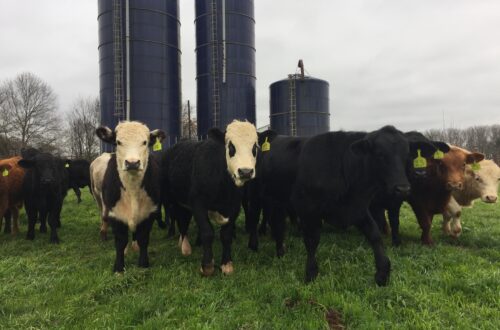
Cattle at LeMaster Grain & Cattle Co.
Like most industries, quality, uniformity, and volume rule the market. With over 7800 cattle farms in our state, marketing for uniformity can be challenging. This challenge is further compounded by the lack of scale caused by the State’s average herd size being around 25 head. Most cattlemen do not produce enough calves to take advantage of load-lot prices. In the economics of scale, cattle are traded on loads of 50,000 lbs. These loads can be comprised in many different ways but are often made up of groups of 60 to 80 calves. Many of our producers will not raise that many calves in 5 years. Clemson Extension, with numerous other organizations, have helped our producers pull together similar calves from different farms to take advantage of the higher prices for load lots. In addition to adding scale, most of these organizations will require some form of value-added marketing. This usually includes weaned, dehorned, castrated, vaccinated, dewormed, graded, and fed for at least 60 days. These practices make for much healthier cattle that will perform well in their next stage of life in the feed yard. Cattle buyers recognize this and gladly pay for it. In addition to the economic incentive, these programs have provided excellent educational opportunities for agents to help farmers prepare their cattle for these programs. Please contact me if you would like to discuss ways to add value to your calf crop. These opportunities are all over our state.
Andy Rollins Upstate Commercial Fruit & Vegetable Agent Cherokee, Greenville, Spartanburg, Union, & York Counties
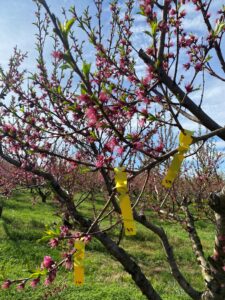
Peach Trees
At the beginning of this year, I continued work with a cellulose nanocrystal particle to verify its ability to frost-protect peach. It was successful but has yet to be commercially available. I spent an inordinate amount of time looking at peach farms devastated by freezing temperatures and writing insurance letters to help support them. I helped start the SCSFGA- South Carolina Small Fruit Growers Association with many farms statewide. This group has formally asked Clemson administrators for Ph.D. assistance with growing small fruits. At this point, asking for funding will go to the state legislature this coming year. This project is excellent for Clemson to participate in, and I look forward to seeing that position develop.
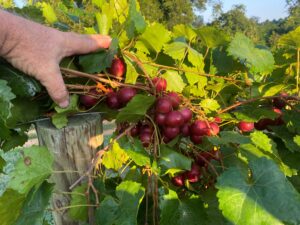
Grapes
I am currently harvesting many grape varieties I have planted and maintained. This demonstration aims to expose this farm to newer varieties, which will assist him. We have some wonderful hybrid grape varieties that are smaller than his muscadine. Still, these are seedless and have very high sugar content and thinner skin. One selection of muscadine is Paulk. It will serve as a better pollinator for Supreme, a female muscadine. We have in the past used Granny Val, which is a bronze grape that comes in very late. I want the grower to see the timing of Paulk and how it compares to Supreme. He is looking to involve it in his next planting of Supreme. Lastly, I worked with one farm on a different form of fumigation that is much safer than the traditional method. We will distribute the collected information to all growers at our production meetings and demonstrate it to the NC Strawberry Growers Association in person. I tested the injection method with a donated product and pulled nematode samples from treated and control areas for comparison.
My work with the cellulose nanocrystal particle and grape and muscadine varieties were out-of-the-ordinary projects I worked on this year. I also held production meetings and problem-solved at on-farm visits, as always. I am honored to serve the farmers, growers, and producers of the Upstate.
Julia Newsome Rural Health & Nutrition Agent Cherokee & Union Counties
I have promoted extension programs and recruited participants at various events/health fairs across Cherokee County this summer. If you see me at a local event, feel free to stop by and ask any questions regarding Clemson Cooperative Extension programing!
4-H Agent, Haven Blackwell and Rural Health Agent Julia Newsome at the Cherokee Farmer’s Market Fun Day
I started two “Health Extension for Diabetes (HED)” cohorts for Cherokee residents: one online and one in-person. I’m excited to share that the Cherokee County Family YMCA has partnered with Clemson Extension for HED in-person programing. Registration is currently closed for both cohorts, but please contact me if you are interested in HED and I will save your information for future programing.
HED is a free diabetes support program recognized by the ADA as a practice-tested diabetes support program. The main goal of this program is to help participants better manage diabetes to prevent or delay complications. HED is 4 months long and includes a series of 8 education sessions and intermittent support sessions. Each session is designed to help participants learn more about diabetes and provide them with necessary skills and support to successfully self-manage diabetes. Participants will receive bi-weekly materials and weekly follow-up to help navigate resources and reach healthy lifestyle goals. A Type 1 or Type 2 diabetes diagnosis is required for enrollment.
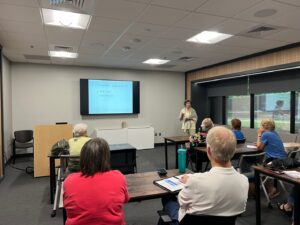
In June, I was invited to the Cherokee Senior Center to hold a “Know Diabetes By Heart (KDBH)” session. If there is an upcoming event or group meeting that you would be interested in having me speak at, I would love to attend. Please feel free to contact me if you have any opportunities or questions.
KDBH is sponsored by the American Diabetes Association (ADA) and American Heart Association (AHA). It is a free education session offered in-person or online. The program aims to help participants better understand the link between diabetes and heart disease. By participating in this one-hour session, you will learn more about risks related to diabetes and heart disease, how to take control of your risks, and learn about community and clinical resources.
It is important for me to be a part of the Cherokee community, so I became a member of the Gaffney Lions Club this August. I’m looking forward to upholding the Clemson Extension standard of service!
Two years ago, a retired US Forest Service ranger named David Hedden entered my office and politely asked if anyone was doing anything to save the hemlock trees in the Upstate. In case you were not aware, there is a tiny insect named the Hemlock Wooly Adelgid (HWA) that is threatening the existence of the Eastern and Carolina Hemlocks trees. Prognosis for the trees is not good. Luckily for David, he stumbled into the right place, and the seed was planted to turn concern and passion into actions.
With the help of Clemson Extension, David and his wife Carla recently formed the non-profit organization called Carolina Hemlocks. The goal of Carolina Hemlocks is to bring together governmental agencies, non-governmental organizations, private landowners, practitioners, and other stakeholders to maintain, re-establish, and enhance the Hemlock tree population in the South Carolina landscape through outreach, resource sharing, collaboration, and applied learning.
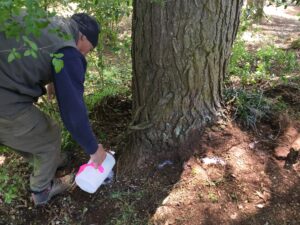
David Hedden with Carolina Hemlocks non-profit, teaching volunteers how to treat infested trees.
To date, this non-profit has treated close to 1,000 private home/landowner trees. Partnering with Clemson Extension, we continually hold educational programs, presentations, and outdoor workshops., We have treated approximately 1,000 Hemlocks in the Greenville Watershed. We have also been cleared by several agencies to treat all trees along the SC Foothills Trail. We have partnered with Clemson Extension, South Carolina Forestry Commission, USFS, SC State Parks, Foothills Trail Conservancy, Duke Energy, and Greenville Watershed to locate, treat, record, and monitor existing hemlock populations. We have trained and utilized volunteers to help treat hemlock trees.
To keep updated on the latest scientific treatment methods, we attend workshops and presentations held by the Tennessee Dept. of Forestry, UGA, Georgia Forestry Commission, and often consult with Dr. Elizabeth McCarty, who is a current expert in the treatment of HWA.
If you have hemlocks trees, know of trees that need treating, or would like to volunteer to help treat, please contact Carolyn Dawson, Clemson Extension Forestry Agent at dawson4@clemson.edu.
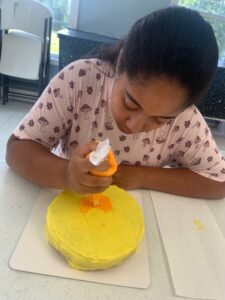 The Cherokee County 4-H Clovers in the Kitchen Club provides a program once a month for kids ages 9 to 18. We want to inspire the youth in our community to learn to cook healthy and nutritious meals for their families. The Clovers in the Kitchen Club has been cooking through the seasons since September. They have learned various valuable skills such as chopping, seasoning, baking, etc. In September, they learned to make nutritious items that can be packed in their lunch boxes. October was full of delicious tailgate food and of course November and December were Thanksgiving and Christmas inspired. We look forward to continuing
 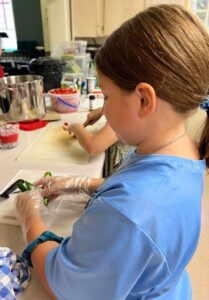 the year and learning new skills to enhance our confidence in the kitchen. Other clubs that Cherokee County 4-H has to offer are Cloverbuds (ages 5-8), Bits and Pieces Horse Club (ages 9-18), Cherokee Charter Academy 4-H Club (students of Cherokee Charter Academy), and Teen Council (ages 14-18). In the months ahead we will have our Peach Country 4-H Livestock Show in March for any youth interested in showing beef, poultry, market hog, or rabbit and Down on the Farm Day in April for second grade classes across Cherokee County. Also, be on the lookout for 4-H summer day camps!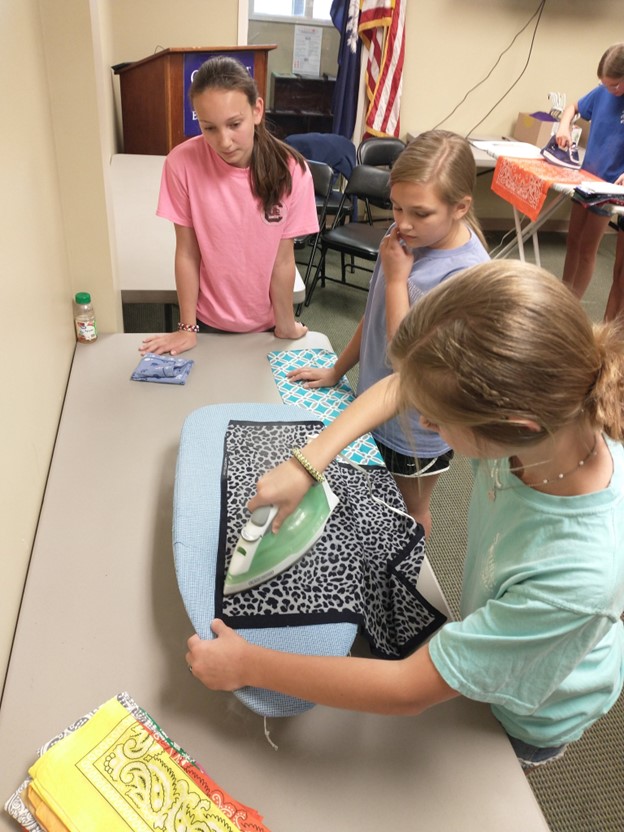
 Hannah McAntyre