Clemson Extension Upstate District

Confined Animal Manure Manager Program Offers On-line Recertification

All SC Confined Animal Facility Growers are required by State Regulation R.61-43 to attend the Confined Animal Manure Manager (CAMM) certification training provided by Clemson Extension, USDA-NRCS, and SCDHEC.  They are then required to obtain 10 hours of recertification credit each 5 years.  These recertification credits are offered around the State on a variety of topics.

The CAMM program team worked diligently to offer live, on-line Zoom recertification trainings beginning in the summer of 2020.  Since that time the team has offered more than 30 on-line recertification trainings for CAMM- certified growers.  The intent is not to replace in-person trainings, but to offer another option for growers to attend the trainings.

Approximately 20% of CAMM-certified growers have attended one or more on-line trainings during the current 5 year period, which ends June 30, 2025.

For more information about the Confined Animal Manure Training Program visit https://www.clemson.edu/extension/camm/ .

An image of a CAMM Zoom introduction screen.
A welcome screen for an on-line CAMM Recertification training. Approximately 20% of certified SC Confined Animal Facility Growers have attended an on-line class since January 2021.

Laurens County Hosts an In-Person Master Gardener Course

The SC Master Gardener Logo

The Laurens County Extension Office is currently hosting an in-person Master Gardener course.  The Master Gardener course began on August 16, 2022 and will meet each Tuesday through December 6.  This year’s course has 10 students.

Students in the course will complete 16 three-classes on subjects including lawn care, vegetable gardening, urban tree care, soils and plant nutrition, tree fruits and small fruits, and many more.  Each class is presented by an Extension Agent or a Master Gardener graduate that has experience in the subject matter, which allows them to provide practical experience along with research-based information.

After completing the course the students will provide 40 hours of community service over the next 12 months to become Certified Master Gardeners.

For more information about the program visit https://www.clemson.edu/extension/mg/ .

Pollen Timing Chart for Honey Bees Offered

There has been an increasing interest in recent years for pollinators of all types.  There has also been an increase in beekeepers and those interested in providing plantings specifically for honey bees.

Honey bee pollen timing chart factsheet image.
The Honey Bee Pollen Timing Chart fact sheet, found on the Clemson Home and Garden Information Center website.

There are a number of plants that are frequented by many types of pollinators, but some of those are used little if at all by honey bees.  To help local residents specifically plant to feed honey bees Bryan Smith developed a Honey Bee Pollen Timing Chart.  The chart not only lists over 70 plants frequented regularly by honey bees, but also provides a tabular graph to show when each plant’s pollen will be available to honey bees.  This chart will help local residents to plant a varied field or bed for honey bees that can provide a food source for them almost all year.

The fact sheet explaining the chart may be found here:

https://hgic.clemson.edu/factsheet/honey-bee-pollen-timing-chart/

The link to the actual chart is in the fact sheet, but may be found here:

https://drive.google.com/file/d/1vh3iSLHF3Tl-BR8pWS8cu3hXd-HvhuYA/view

Area Forestry and Natural Resources Report

Area Forestry and Natural Resources Report

Jeff Fellers

Summer is nearing an end and now is the time to get ready to make our way into the fall and winter.  We have had a busy summer in Extension as operations have returned to normal after the Covid outbreak.  This summer I have hosted two forestry association meetings, hosted a Hardwood Regeneration Workshop, wrapped up Master Tree Farmer with three different field tours across the state and made numerous direct contacts through field visits, office visits, and phone calls.

In May, I hosted a Hardwood Regeneration Workshop in McConnells, South Carolina.  In a state where pine is the number one timber crop, many times our hardwood stands get ignored.  This program was geared towards both landowners and professionals.  The program offered continuing education credits for professional foresters and those that needed pesticide credits.  This was an eight-hour program that went in-depth about how to convert an existing hardwood stand into a hardwood stand with favorable species for timber and wildlife.  The program had a classroom session and field tour that occurred at a demonstration site at Draper Wildlife Management Area.  Participants learned about herbicide prescriptions to control and kill existing timber, the basal area that needed to be left to maintain an existing canopy, and planting techniques for species that would be desirable in this situation.  We had 16 people attend this program, which included both landowners and professionals.  We had seven surveys completed on the program.  Of those seven, five were professionals and two were landowners.  The survey participants represented 903 acres owned and 131,000 acres managed.   Dr. Stephen Peairs (Clemson) and Dr. David Clabo (Georgia) provided the presentation based off of Dr. Peairs research and demonstration on the Draper WMA.  This workshop provided a good example of how research from Clemson University can help our local landowners better manage their hardwood stands.

May was a busy month, as I also hosted a meeting for the Newberry Forestry Association and the Laurens Forest Landowners Association.  The Newberry Forestry Association met for the first time since the Covid outbreak.  We had 29 people in attendance and had a program on Chronic Wasting Disease in Deer presented by Charles Ruth from SC Department of Natural Resources.  The Laurens Forest Landowners Association had 35 people in attendance and had a program on cost share available to landowners.  This program was presented by Chisolm Beckham with the SC Forestry Commission and Lisa Good with the Natural Resource Conservation Service.

Both of these Association also met in August.  The Newberry Forestry Association had 33 in attendance, and the Laurens Forest Landowners Association had 36 in attendance.  Carla Carlos from the SC Forestry Commission presented at both of these meeting on pine genetics.  These groups meet on a quarterly basis with their meetings typically being held in February, May, August, and November.  If you would be interested in attending any of these meetings, please contact me, at fellers@clemson.edu.

Master Tree Farmer was offered this year as a hybrid course.  The majority of the course was virtual with presentations online for participants.  Field tours at the end of the course were optional. We had 180 participants take the class, and roughly 130 participants took part in the field tours.  Field tours were hosted in the Upstate, Midlands, and Coastal area to help reduce travel for the participants.  Field tours were held on private lands where property owners were actively managing their timber.  The property owners provided details on how they managed their property, mistakes they had made, and things that they had done right to help better educate participants in timber management.

I also serve on the Indian Creek Quail Restoration Committee.  This committee puts out two newsletters a year.  One was published in March, and the next will be published in September.  These newsletters are great tools to get more information on managing for Quail.  This committee also hosts two workshops a year.  Our previous workshop was hosted in May, at the Belfast plantation owned by the SC Department of Natural Resources.  Attendees were able to see how the staff at the Belfast Plantation manages the property for Quail.  Participants visited sites that demonstrated timber thinning, beneficial native plant species, prescribed burn areas, and chemically treated areas to benefit habitat for Quail.

Lastly, I always enjoy the one-on-one site visits, phone calls, and office visits.   One-on-one visits provide a personal education experience where landowners learn how to better manage their specific property or natural resources.  This summer I have had 82 direct contacts that touched on subjects from timber management, wildlife management, invasive weed control, pond management and general horticultural/garden questions just to name a few.  Through these methods of direct contact, I have reached at least 100 people and 725 acres of owned property.

It has been a busy summer, with many programs offered for forestry and natural resource education.  If you would like more information on programs available for forestry and natural resource, please contact me, at fellers@clemson.edu.

Development and Implementation of the Clemson Cooperative Extension Service Brewing Program for South Carolina

Craft beer is coming to Clemson!

Upstate Food Systems and Safety Agent Alex Thompson, Clemson Extension Associate Chad Carter, Horticulture Agent Zack Snipes, and Dr. Julie Northcutt are working to develop and implement a brewing program to serve the South Carolina brewing industry and the public through Clemson Cooperative Extension.

According to the South Carolina Brewers Guild, 95 craft breweries in South Carolina produce 105,620 brewery barrels (3,274,220 gallons) of beer annually, with a yearly economic impact of $905 million on the South Carolina economy. The South Carolina brewing industry is a major driving force of economic development across the state. Clemson Cooperative Extension is looking to improve the lives and livelihood of South Carolinians by offering research-based solutions, workforce development programs, and product testing related to brewing science.

Clemson Cooperative Extension funds the development of the Clemson Cooperative Extension Brewing Program through the 2022 Innovation Awards. This award funds the purchase of brewing equipment, lab devices, and the creation of course materials to develop brewing science training for South Carolinians. This program will provide services for stakeholders who own and operate breweries, who currently work at breweries, hope to work in the brewing industry or are just curious about brewing and want to learn more.

Over the coming months, progress will be made towards the first offering in the Clemson Cooperative Extension Service Brewing Program for South Carolina, a “Learn to Brew” workshop that will be open to the public. This workshop will be offered both in-person and online and will teach participants the entirety of the brewing process from grain to glass. Furthermore, an optional program day will be hosted on the Clemson University campus, where participants will get a brewing experience. This workshop portion will allow students to interact with brewing equipment and learn about the brewing process in real-time as they produce beer from raw materials.

Craft beer is a major part of the South Carolina economy, and Clemson Cooperative Extension is poised to assist South Carolina brewers and consumers as the industry continues to grow.

Food Systems and Safety Agent Alex Thompson (center) speaks with Shayna Ferguson (right) and Rebeca Ortega (left) of Shoeless Brewing Co. in Greenville, SC .
Photo Credit: Everett Weaver


Water Resources Update

Questions about pond weeds are common throughout the summer. As water temperatures warm, cyanobacteria blooms can occur more frequently. While there are many cyanobacteria species that can look different in a pond – all are capable of producing toxins, so care should be taken to avoid or limit contact with these blooms as much as possible. The Land Grant Press (LGP) article Introduction to Harmful Algal Blooms (HABs) in South Carolina Freshwater Systems provides more detailed information.

The CU Plant & Pest Diagnostic Clinic can evaluate samples to confirm if a bloom is cyanobacteria and will provide specific control recommendations. See Submitting an Algae Sample for Identification for more information. In the meantime, there are a couple do it yourself tests that help indicate if a bloom is cyanobacteria; instructions are provided in the recently published HGIC Fact Sheet Do It Yourself: Visual Indicators, Stick Test, and Jar Test for Cyanobacteria.

Water planning efforts continue throughout the state to ensure plentiful, clean water for future generations. The recently published LGP article Water Withdrawal Regulations in South Carolina provides an overview to increase understanding of the current rules. The SC Department of Natural Resources is leading creation of River Basin Councils in each of SC’s eight major river basins; these Councils will work over a two-year period to draft a River Basin Plan. The Edisto RBC is nearing completion of the first draft of the Edisto River Basin Plan. The Broad River Basin Council started meeting earlier this year and is currently accepting applications for representatives from Local Government, Industry, or Economic Development.

Upcoming events include the SC Water Chats webinars focusing on Source Water Protection (Free! 9/20 and 9/22, @1:00pm) and several free Adopt-A-Stream volunteer water quality monitoring trainings are offered in Spartanburg this fall. See the Clemson Extension Events Calendar for the latest water-related event information.

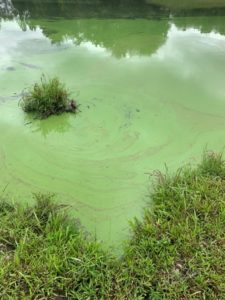
A cyanobacteria bloom, which is capable of producing toxins that can harm pets, livestock, and humans.

South Carolina Certified Landscape Professional (SCCLP) Provides Much Needed Skills to Soon-to-be-Released SC Inmates

Since its inception, the Cooperative Extension Service has served community needs as they grow and change. Recently the South Carolina Department of Corrections (SCDOC) and Clemson Extension partnered to bring a crucial job skills training to inmates that are within one year of scheduled release. The program provides training to persons wishing to rehabilitate themselves and provides skilled labor to a growing labor market deficiency in South Carolina’s green industry.

The SCDOC recruited 40 inmates to participate in the South Carolina Certified Landscape Professional Program. The course lasted ten weeks, and participants received instruction in basic horticultural skills such as soil conditioning, weed management, turf grass management, and integrated pest management concepts to reduce pesticide use. There was a total of four sites that participated via zoom to observe the lectures. Most participants were engaged and asked multiple questions, including how this certification can help them to find gainful employment. The project was funded by an internal grant from Clemson University Cooperative Extension. We are working with SCDOC to seek grant opportunities to sustain the project and offer it to a broader inmate audience.

Upcoming Programs & Events (Union/Laurens/Newberry)

UPCOMING PROGRAMS & EVENTS
(Union County/Laurens County/Newberry County)
4-H Club Meeting Schedule:
Woodsrunners — 1st Thursday of the month @ 7pm
Shooting Sports — 2nd Thursday (BB) and 4th Thursday (archery) of the month @ 7pm
Poultry Club — 3rd Thursday of the month @ 7pm
Baking Buddies — 2nd Tuesday of the month @ 3:30 pm
Recycling Club — 4th Tuesday of the month @ 3:30 pm
Union County FCL Club Schedule:
(Union County Extension Office meeting room.)
Twisted Stitches Crochet – 1st and 3rd Monday of the month @ 9:30am
Patchwork Quilters – Every Wednesday of the month @ 9:00am
Forestry Related Events and Programs:
Laurens County Forestry Association – Tuesday, February 22 at 6:30 pm.  Program will be on Zoning and Land Use.  Contact Jeff Fellers for more information 864-424-8273.

Newberry County Forestry Association – Tuesday, May 10 at 7:00 pm. Program will be on Chronic Wasting Disease in Deer and Impacts it could have on SC deer population.  Contact Jeff Fellers for more information 864-424-8273.

Master Tree Farmer – January 24, 2022, through March 14, 2022.  Master Tree Farmer is a virtual program with an in-person field tour.  Registration has closed for this course, but it will be offered again in the future.  If you are interested in future courses, please contact Jeff Fellers at 864-424-8273.

4-H Forestry Clinic – February 26, 2022, at Harbison State Forest.  This program is for high school youth to learn more about basic forestry skills.  Participants also have the opportunity to compete and represent South Carolina on a National level at the National 4-H Forestry Invitational.  Registration details can be found at the link below.
https://www.eventbrite.com/e/south-carolina-4-h-forestry-tickets-221437705137

Laurens Extension Welcomes New Livestock and Forages Agent

Reid Miller, Livestock and Forages Agent

Laurens Extension is pleased to announce that Mr. Reid Miller will be our new Livestock and Forages Agent.  Reid will be based in Greenwood County, and will cover Greenwood, Laurens and McCormick Counties.  Reid comes to Clemson Extension from the University of Georgia Extension Service, where he served as the Agriculture and Natural Resources Agent in Hart County.  Reid received his Bachelor of Science from Clemson University in Animal and Veterinary Sciences and also has a Master’s of Science in Plant and Environmental Sciences from Clemson University.  Reid has worked in Georgia Extension since 2018 and brings a great set of skills and knowledge to our team.  He has family that farms in Edgefield County and has a good knowledge base for the counties that he will be covering. We are excited to have him join us in Laurens County.

Forestry and Wildlife Agent – Tom Brant

Larger Elm Leaf Beetle larva feeding on elm tree leaves. Photo credit: Tom Brant.

In the last six months there has been an increase in forestry and pond related calls, especially after the staff returned to the offices. I have been answering a wide assortment of questions including several about managing timber and harvesting timber stands. The usual questions are about dying pine trees with bark beetle issues, and about controlling pond weeds.  As fall approaches, questions about buying seedlings and planting trees have increased.  I continue to visit sites on request and walk over timberland properties and provide advice about those properties.  We are continuing our virtual programs, and announcements are sent to my clients as the program information is available.  There was another occurrence of an unusual pest affecting trees in the area.  As if on cue, a number of calls came in about elm trees dying.  It turns out there has been a larger than usual population of Larger Elm Leaf Beetles this late summer.  The larva of these beetles eat the green from the leaves of elm trees and cause what remains to turn brown and fall off.  Many are concerned the trees have died, but they should be fine and leaf out again next spring, though some may try to re-leaf now.   The beetles sometime out pace their natural predators, and their populations explode for a year or two, until the predator populations catch up with them.

I remain in contact with the Laurens County Forest Landowners Association Board members concerning their quarterly meetings and what their plans for these meetings would be.  It is good to say the Association has met in-person twice now and plans to meet for a third time in November.