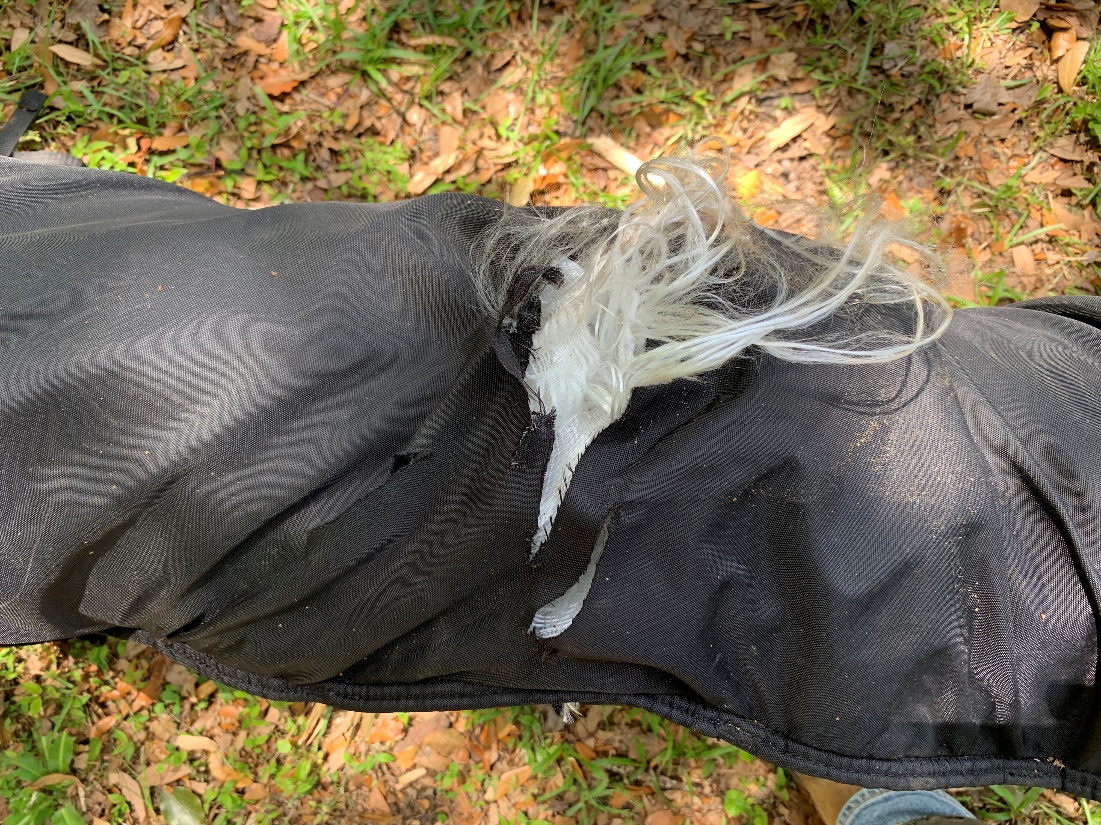
When working with chainsaws, it is important to wear cut-resistant leg protection to reduce the risk of major injuries. While cut-resistant leg protection can be worn as chainsaw pants, the more common option among forest landowners and homeowners is chainsaw chaps. Chainsaw chaps have multiple layers of woven cut-resistant material such as ballistic nylon or Kevlar (Figure 1). Chaps come in different styles, and you can learn more about them and other clothing items to keep you safe when working with chainsaws in the article by Hiesl and Steele (2022).
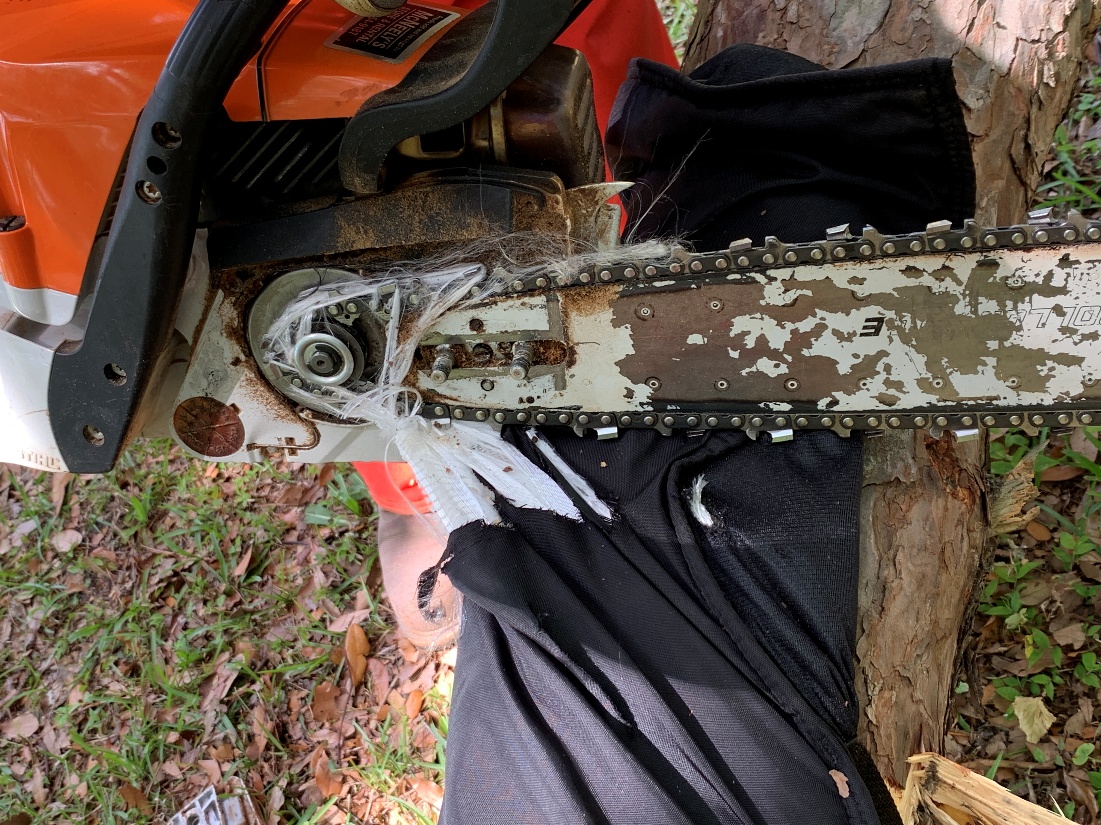
Once the chain on a chainsaw cuts into the chaps, the cut-resistant material gets caught by the individual cutting teeth on the chain and starts wrapping long threads around the sprocket inside the clutch cover (Figure 2). As the layers of cut-resistant material build up around the sprocket, the speed of the saw chain decreases, and the clutch on a gas-powered chainsaw disengages. This happens within a few hundred milliseconds. This video of a cut-resistant leg protection test at the University for Applied Forest Sciences in Rottenburg, Germany, shows what happens when a chainsaw chain cuts into cut-resistant leg protection.
If you have noticed, so far this article has been about gas-powered chainsaws that have a clutch. But what about battery-powered chainsaws that have no clutch but an electric motor? When looking online at chainsaw chaps, some manufacturers provide statements that chaps are only good with gas-powered chainsaws or that the chaps are not made for battery-powered chainsaws. Some of the wording may be like “These chaps are not suitable protection for use with electric chainsaws, due to the high-torque nature of electric motors” or “This garment has been Classified by UL (Underwriter Laboratories Inc.) as chainsaw cut-resistant leg protection for all Operators of Gas Powered Chainsaws”. This would indicate that the chaps are not safe to use with battery-powered chainsaws or that they will not provide any protection for the user. Based on recent research, however, we now know that chainsaw chaps reduce the risk of major injuries from cutting into the leg.
Cut-resistant leg protection in North America (USA), whether it’s chainsaw chaps or pants, is regulated by ASTM Standard F1897. This standard outlines, among other things, the area of protection and the performance requirements for testing. It also references the ASTM testing method F1414 for use with gas-powered chainsaws. In the most recently updated standard, F1897-25 (approved in December of 2025), an Appendix was added summarizing the outcomes of a study on cut-resistance testing with a battery-powered chainsaw using the F1414 method. One outcome was that, at the same cutting speed compared to gas-powered chainsaws, no through-cuts were observed in the back lining of the cut-resistant material. The conclusion is that cut-resistant leg protection certified to the ASTM Standard F1897 provides a similar level of protection with battery-powered chainsaws as with gas-powered chainsaws.
Since the only change between the F1897-20 (approved in 2020) and the F1897-25 standard is the addition of an Appendix outlining the outcomes of the battery-powered chainsaw test, any cut-resistant leg protection certified under either version of the standard will provide some form of protection. The standard to which cut-resistant leg protection is built is usually printed somewhere on the garment tag (Figure 3). With that, if you have cut-resistant leg protection that was manufactured to the ASTM Standard F1897-20 or F1897-25, you will have some protection from major cut injuries in the leg area. So it is recommended to wear chainsaw chaps, or pants, when working with battery-powered chainsaws. As seen in Figure 3, some manufacturers only state the chaps are certified to standard F1897 without specifying the year. In that case, it would be helpful to know the year of manufacture or when the chaps were purchased. Any chaps manufactured or purchased after 2021 should comply with the F1897-20 standard and provide you with some protection.
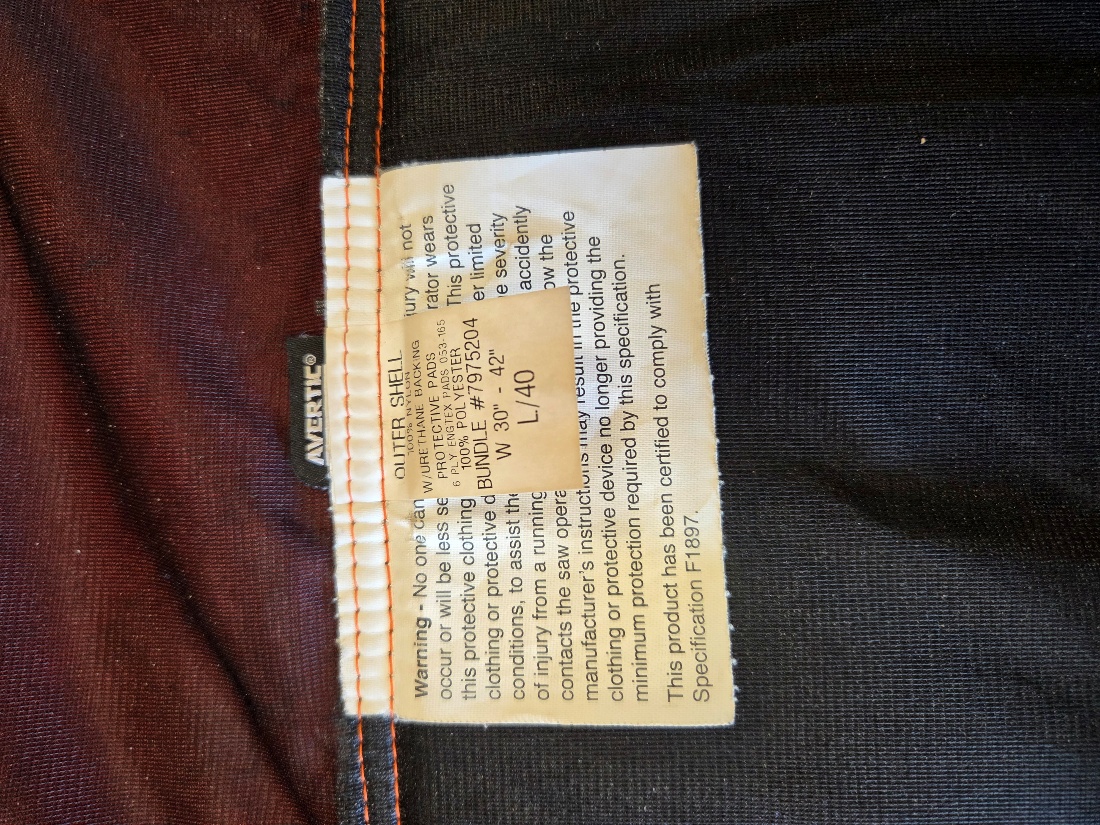
It is important to note that the ASTM F1897 standard applies only to the United States of America. Other regions have their own standards, which may be similar. If your chainsaw chaps or pants do not show the ASTM F1897 standard, you may see ASTM F3325 for the Canadian standard, ISO 11393 for the European standard, or AS/NZ 4453.3 for the Australian/New Zealand standard. Some manufacturers may have their gear certified to multiple standards.
So, to answer the question from the title of this article, yes, chainsaw chaps will protect you when working with battery-powered chainsaws. While there is no clutch to slow down or stall the motor, the cut-resistant material will slow or stop the electric motor in the battery-powered chainsaw and prevent major injuries.
Author
Patrick Hiesl, Cooperative Extension, Forestry and Wildlife Specialist
Clemson University Cooperative Extension Service offers its programs to people of all ages, regardless of race, color, religion, national origin, disability, political beliefs, sex, marital or family status and is an equal opportunity employer.
