Most southern pine seedlings are grown in nursery beds for about one year. Seeds are planted in beds in late March or early April. The young seedlings are then lifted from the beds and prepared for planting during the dormant season from late November to early February, when the required number of cooling hours or temperatures below 50 degrees have been achieved. Once lifted, the seedlings are taken to a packing shed, where their roots are sprayed with a clay slurry or a gel to maintain moisture. Then they are placed in bags or boxes. The bags or boxes are placed in a cooler to maintain dormancy until they can be taken out and planted.
Some southern pine seedlings are grown in containers. The seeds are planted at about the same time and require the same number of cooling hours before planting can begin. The advantage of containerized seedlings is that they can extend the planting season by starting slightly earlier or ending slightly later, depending on soil moisture conditions. Seedling survival is also better compared to bareroot seedlings. The disadvantage is that they are more expensive.
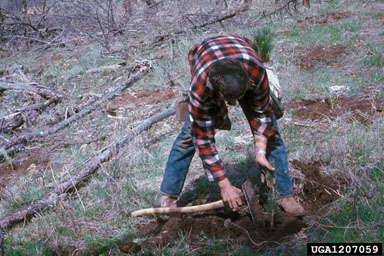
Planting seedlings with a hoedad. Dave Powell, USDA Forest Service (retired), Bugwood.org.
Select high-quality seedlings that are well-suited for your soil conditions and local climate. Before planting, ensure the seedlings are healthy and free of disease. Do not plant any obviously damaged or overly small cull trees. Once the seedlings are removed from the cooler, they need to be kept in a cool, dry, shaded place protected from wind and freezing temperatures. They should be planted as soon as possible. Plant them as early in the season as possible to allow some root development before buds break and growth begins in the spring.
Most tree planters use a dibble bar or a hoedad to make the hole for the seedling, but a shovel or spade will also work. Keep seedlings in a bucket or a planting bag until the hole is ready. Remove only one seedling at a time to ensure the roots remain moist. Place the seedling in the hole with the taproot straight and the root collar at or slightly above the soil surface. Close the hole and pack tightly to remove any air pockets and ensure good soil contact.
By maintaining proper care and planting techniques, the survival and growth of your pine seedlings will be enhanced, and you’ll be one step closer to reaching your forest management plan goals.
Author
Mike Windhorn, Cooperative Extension, Forestry and Wildlife Agent
Clemson University Cooperative Extension Service offers its programs to people of all ages, regardless of race, color, religion, national origin, disability, political beliefs, sex, marital or family status and is an equal opportunity employer.
