Clemson Extension Upstate District

Tractors and Implements for Forest Landowners – Part 3: Implements and Attachments for Property Maintenance

Our Tractors and Implements for Forest Landowners series’s first and second articles covered tractor selection and ground contact implements (see links at the end). This third part will cover implements and attachments for property maintenance that the forest landowner should consider adding to their arsenal.
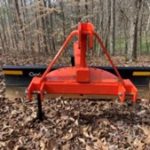
 

Adjustable scrape blade. Photo credit: Stephen Pohlman, Clemson University.


The first implements to discuss are box blades and scrape blades. The same principle applies to these, as did our ground contact implement article. You will want to pay attention to steel thickness and construction, added gussets and bracing, and proper width based on the size of the tractor. Typically, you will want your box and scrape blades to be at least as wide as your rear tires, just to leave a nice finished look behind you instead of tire tracks.

Box blades and scrape blades are often used for the same jobs; however, each has its intended purpose. A box blade is intended to keep things smooth/level. A scrape blade is intended to shape the ground. For example, if you plan to pull a ditch or crown a road, the scrape blade is a much better option. If you already have a surface that you are trying to maintain as smooth and level, then a box blade will be easier. Granted, you can do the same thing with a scrape blade. However, the scrape blade will roll material out one end, or both, during the process. In contrast, a box blade will store the excess material inside the boxed area to later be used for depositing in other holes/depressions. Scrape blades can come in adjustable models that make it easy for the operator to change the angle and pitch of the blade without having to change the tractor’s 3-pt hitch angles. Also, these adjustable models can be manual as well as hydraulic; however, the hydraulic versions will need to utilize the tractor’s rear hydraulic accessory block (‘remotes’ as some call them).


Box blade. Photo credit: Stephen Pohlman, Clemson University.

Box blades and scrape blades are also great prescribed fire management equipment, provided you already have pre-existing fire breaks. Dragging a box blade or scrape blade on these maintained fire breaks will keep you from fracturing the soil surface with a plow. This allows you to keep a hard soil surface that prevents soil erosion and gives you the bare mineral soil that you need to avoid fire from walking across your fire break. The one flaw with this is that leaf/needle litter will quickly fill a box blade and a scrape blade, causing it to ‘jump’ over a rolled-up pile of this material. Thus, the build-up of leaf/needle litter will at some point need to be pushed off to the side out of the fire break while dragging the fire break clean.

Another tool for our tractor is the front end loader. Most tractors in the 20-40hp class seem to come with loaders, but this is not always the case. A front end loader is often included as dealers add them due to customer demand. A front end loader can be a valuable tool if you need to lift things, like implements on and off trailers or lime/fertilizer for food plots, just to name a few. A front end loader can also help walk a stuck tractor out as well, though painstakingly slow. Do keep in mind that many of today’s front end loaders can take advantage of different front end attachments once you take the bucket off. Attachments such as grapple buckets, loader forks, rock buckets, 3-n-1 buckets, post hole diggers, etc., are most common for forest landowners. Some brands utilize the skid steer style attachment method, while others use their own proprietary system. Those with proprietary systems typically have a conversion kit or adaptor if the owner would rather have the skid steer style instead.


Grapple bucket. Photo credit: Stephen Pohlman, Clemson University.

One of the front end loader attachments mentioned above, grapple buckets, makes my life much easier as a forest landowner. Coming from someone who has bent their fair share of grapple buckets, know that they make different ones: standard duty, medium duty, heavy duty, and extreme duty. Each one has thicker and more metal, shields, braces, etc. One major factor to consider when buying a grapple bucket is weight. Make sure that your loader capacity meets not only the weight of the grapple but also the weight of the material you’ll be lifting. There are two kinds of grapple buckets, a brush grapple and a root grapple. By design, one is more clam-shaped, and the other is better at acting like loader forks for picking up and stacking things. Also, grapple buckets tend to have either one big grappling device or two separate clamping devices. The advantage of the two clamping devices is you will get a better bite/grasp on whatever you are trying to hold. Lastly, do know that your tractor will need to have a third function valve added for the front end loader to have the ability to open/close the grapple.

The next article in this series will be about vegetation management. We will get into things like sprayers, rotary cutters, and tree cutters in that article.

In case you missed them, here are the prior articles in this series:
Tractors and Implements for Forest Landowners- Part 1: Tractors- https://blogs.clemson.edu/fnr/2021/10/21/tractors-for-forest-landowners/

Tractors and Implements for Forest Landowners – Part 2: Ground Contact Implements- https://blogs.clemson.edu/fnr/2021/12/13/tractors-and-implements-for-forest-landowners-part-2-ground-contact-implements/

Author(s)

Stephen Pohlman, Cooperative Extension, Forestry and Wildlife Agent

This information is supplied with the understanding that no discrimination is intended and no endorsement of brand names or registered trademarks by the Clemson University Cooperative Extension Service is implied, nor is any discrimination intended by the exclusion of products or manufacturers not named. All recommendations are for South Carolina conditions and may not apply to other areas. 

Clemson University Cooperative Extension Service offers its programs to people of all ages, regardless of race, color, gender, religion, national origin, disability, political beliefs, sexual orientation, gender identity, marital or family status and is an equal opportunity employer.


Woods in Your Backyards Workshop

Carolyn Dawson
Forestry & Wildlife Agent

Do you have 1 to 10 acres of woods in your backyard? Would you like to reduce your lawn, plant trees, and invite wildlife to your suburban lot all while becoming a better steward of your small parcel of land? The Woods In Your Backyard workshop is designed with the small landowner in mind. It will help you to effectively care for forests and wildlife and increase your enjoyment of the land. You will learn to recognize and manage invasive plants & pests. It will identify potential income sources, and help you understand how your land relates to the land around you. Owners of even just a few acres can make a positive difference in their environment through planning and implementing the simple stewardship practices you will learn at The Woods In Your Backyard Workshop. Participants who own land that is forested, have natural areas, or are interested in turning mowed lawns into natural areas, are invited to attend! This workshop is designed specifically (but not exclusively) for smaller landowners, those with 1-10 acres. Please contact Carolyn Dawson, Clemson Extension Forestry agent, at Dawson4@clemson.edu for more information.

Date: October 15, 2022
Place: Hayden Conference Center, Clemson, SC

The Woods In Your Backyard

Do you have 1 to 10 acres of woods in your backyard? Would you like to reduce your lawn, plant trees, and invite wildlife to your suburban lot, all while becoming a better steward of your small parcel of land?

The Woods In Your Backyard workshop is designed with the small landowner in mind. It will help you to effectively care for forests and wildlife and increase your enjoyment of the land. You will learn to recognize and manage invasive plants & pests. It will identify potential income sources and help you understand how your land relates to the land around you.

Owners of even just a few acres can make a positive difference in their environment through planning and implementing the simple stewardship practices you will learn at The Woods In Your Backyard Workshop. Participants who own forested land, have natural areas, or are interested in turning mowed lawns into natural areas, are invited to attend! This workshop is designed specifically (but not exclusively) for smaller landowners, those with 1-10 acres.

Please contact Carolyn Dawson, Clemson Extension Forestry agent, at Dawson4@clemson.edu for more information. Date: October 15th, Hayden Conference Center, Clemson, SC

To register for the workshop click here.

Stephen Pohlman – Forestry Agent – Its Time to Get Privot Under Control

It is time to get privet under control with a method that works in the late fall that most people can do! Glyphosate is a non-restricted-use product that can be found at local places and at an affordable price. It is a non-selective herbicide product, thus why we want to use this method in the late fall. Let me explain why.

The non-native invasive plant known simply as privet can be a worthy adversary for anyone unlucky enough to have this plant on their property. (For simplicity in this article, we are going to refer to all the various species of privet as simply privet).

Chinese Privet Leaves. Photo courtesy of Chris Evans, University of Illinois, Bugwood.org

One of the best ways to control privet is with a glyphosate application in late fall to early winter. Typically, around late October /early November until about December is the time-frame depending on geographic location in the state. The best time is when the desirable plant species you want to keep have gone dormant, yet the privet still has green leaves on its branches and the temperatures are still mild. Avoid cold weather, especially as temperatures begin to get near freezing.

Examples of situations to use this method. If you have young hardwoods that you are trying to keep but want the privet gone, you want the hardwood sprouts/saplings to drop their leaves while the privet still has theirs. The downside to this method is if you have small pines or other conifers that you are trying to save, as these will retain green needles during this time period and are susceptible, Extreme caution and care should be exercised if this is the case. The good news is that most of the time, privet thickets are usually so thick that nothing is growing underneath them to have to worry about.

Glyphosate comes in many different forms with the most common being Ready To Use (RTU) or 41% concentrate products. When performing privet control, the applicator will want to use a 41% or higher percentage concentrate product. RTU products oftentimes do not achieve good control due to the lower amount of material in the percent solution. The applicator will need to read the herbicide label of the product they are using, as this will tell them how many ounces/gal and/or percent solution to be applying for foliar privet control.

Surfactants help in the efficiency of the herbicide by improving absorption into the waxy covering on the leaves. Not all glyphosate products contain a Chinese Privet Flowers. Photo courtesy of Chris Evans, University of Illinois, Bugwood.org.surfactant already added. Reading the label on the product you have will tell if the product has a surfactant and/or if it should be added in the tank mix. If the label says to add a surfactant, choose one that is a non-ionic surfactant. Marking dyes can be added to the tank mix as well. In certain situations, such as treating in strips due to making passes, marking dyes are very helpful. Just know that if you add marking dye to your tank mix you can expect it on everything. Most places (such as farm & garden, feed & seed, agricultural cooperatives, etc.) should carry these products if needed.

The application method used to apply your glyphosate solution depends greatly on the situation you have and your equipment. Backpack sprayers, ATV sprayers, and tractor 3-point hitch mounted sprayers are popular methods of delivering this foliar application method. The applicator will want to spray foliage till wet, but not to the point of running off. Complete coverage of all foliage from top to bottom is key in getting control. The more leaf surface area you can contact with herbicide, the more material that will be absorbed into the plant, the better your chance at control. If equipment is not capable of delivering the herbicide to the top of the privet, you will want to explore other options, such as cutting/mulching the privet down first and then spraying the plant once it sprouts back. Another option may be to do a basal bark application on the bigger privet stems as a follow-up treatment.

Follow-up treatments are a must. As you eliminate mature plants and sunlight can hit the forest floor, something is going to grow in its place. Oftentimes it will be with germinated privet seed and/or root sprouts, not to mention new seed from neighboring properties. The key to eradication is persistence, thus spray those new stems as soon as possible and every time they re-sprout.

If controlling privet in and around water, make sure that you are using a glyphosate product and surfactant that have an aquatic label. Glyphosate products and surfactants used to control terrestrial plants oftentimes have formulations that are harmful to many aquatic organisms. Companies do make aquatic labeled products (such as glyphosate, surfactants, etc.) that have a different formulation designed to not harm aquatic organisms (fish, frogs, turtles, salamanders, etc.). Remember, the label is federal law.

Keep in mind drift concerns on windy days, especially since using a non-selective herbicide, to prevent killing and/or damaging desirable plant species.

You can use this method at other times of the year too. Just remember that glyphosate will kill other plants as the product lands on their green leaves/needles. Thus, the great thing about jumping on privet control soon, as desirable species are going into dormancy and privet is still hanging on.

This article was originally featured in the Fall 2019 Version of CU in The Woods newsletter.

Author(s)

Stephen Pohlman, Cooperative Extension, Forestry and Wildlife Agent

This information is supplied with the understanding that no discrimination is intended and no endorsement of brand names or registered trademarks by the Clemson University Cooperative Extension Service is implied, nor is any discrimination intended by the exclusion of products or manufacturers not named. All recommendations are for South Carolina conditions and may not apply to other areas. Use pesticides only according to the directions on the label. All recommendations for pesticide use are for South Carolina only and were legal at the time of publication, but the status of registration and use patterns are subject to change by action of state and federal regulatory agencies. Follow all directions, precautions and restrictions that are listed.

Clemson University Cooperative Extension Service offers its programs to people of all ages, regardless of race, color, gender, religion, national origin, disability, political beliefs, sexual orientation, gender identity, marital or family status and is an equal opportunity employer.

Previous Next


Growing Our Future

The Growing Our Future Annual Forestry Meeting took place on June 1, 2022.  There were nearly 200 in attendance including landowners, resource management professionals, vendors, and speakers.  Participants learned how to manage their forested lands to better meet their objectives, as well as, obtaining higher returns on their investments.

Growing Our Future Annual Forestry Meeting


Speakers included Dr. Tom Dobbins (CUCES Director), Ryan Bean (CUCES FNR Agent), Scott Phillips (SCFC Director), Dr. Stephen Peairs (CUCES FNR Specialist), Dr. Cory Heaton (CUCES FNR Specialist), Scott Jones (FLA CEO), Dr. Roger Lowe (UGA Specialist), Cam Crawford (FASC CEO), Dr. Walt McPhail (SC Tree Farm), Chisolm Beckham (SCFC Cost-Share), and Eddie Reese (NRCS Cost-Share).

Area Forestry and Natural Resources Report

Area Forestry and Natural Resources Report

Jeff Fellers

Summer is nearing an end and now is the time to get ready to make our way into the fall and winter.  We have had a busy summer in Extension as operations have returned to normal after the Covid outbreak.  This summer I have hosted two forestry association meetings, hosted a Hardwood Regeneration Workshop, wrapped up Master Tree Farmer with three different field tours across the state and made numerous direct contacts through field visits, office visits, and phone calls.

In May, I hosted a Hardwood Regeneration Workshop in McConnells, South Carolina.  In a state where pine is the number one timber crop, many times our hardwood stands get ignored.  This program was geared towards both landowners and professionals.  The program offered continuing education credits for professional foresters and those that needed pesticide credits.  This was an eight-hour program that went in-depth about how to convert an existing hardwood stand into a hardwood stand with favorable species for timber and wildlife.  The program had a classroom session and field tour that occurred at a demonstration site at Draper Wildlife Management Area.  Participants learned about herbicide prescriptions to control and kill existing timber, the basal area that needed to be left to maintain an existing canopy, and planting techniques for species that would be desirable in this situation.  We had 16 people attend this program, which included both landowners and professionals.  We had seven surveys completed on the program.  Of those seven, five were professionals and two were landowners.  The survey participants represented 903 acres owned and 131,000 acres managed.   Dr. Stephen Peairs (Clemson) and Dr. David Clabo (Georgia) provided the presentation based off of Dr. Peairs research and demonstration on the Draper WMA.  This workshop provided a good example of how research from Clemson University can help our local landowners better manage their hardwood stands.

May was a busy month, as I also hosted a meeting for the Newberry Forestry Association and the Laurens Forest Landowners Association.  The Newberry Forestry Association met for the first time since the Covid outbreak.  We had 29 people in attendance and had a program on Chronic Wasting Disease in Deer presented by Charles Ruth from SC Department of Natural Resources.  The Laurens Forest Landowners Association had 35 people in attendance and had a program on cost share available to landowners.  This program was presented by Chisolm Beckham with the SC Forestry Commission and Lisa Good with the Natural Resource Conservation Service.

Both of these Association also met in August.  The Newberry Forestry Association had 33 in attendance, and the Laurens Forest Landowners Association had 36 in attendance.  Carla Carlos from the SC Forestry Commission presented at both of these meeting on pine genetics.  These groups meet on a quarterly basis with their meetings typically being held in February, May, August, and November.  If you would be interested in attending any of these meetings, please contact me, at fellers@clemson.edu.

Master Tree Farmer was offered this year as a hybrid course.  The majority of the course was virtual with presentations online for participants.  Field tours at the end of the course were optional. We had 180 participants take the class, and roughly 130 participants took part in the field tours.  Field tours were hosted in the Upstate, Midlands, and Coastal area to help reduce travel for the participants.  Field tours were held on private lands where property owners were actively managing their timber.  The property owners provided details on how they managed their property, mistakes they had made, and things that they had done right to help better educate participants in timber management.

I also serve on the Indian Creek Quail Restoration Committee.  This committee puts out two newsletters a year.  One was published in March, and the next will be published in September.  These newsletters are great tools to get more information on managing for Quail.  This committee also hosts two workshops a year.  Our previous workshop was hosted in May, at the Belfast plantation owned by the SC Department of Natural Resources.  Attendees were able to see how the staff at the Belfast Plantation manages the property for Quail.  Participants visited sites that demonstrated timber thinning, beneficial native plant species, prescribed burn areas, and chemically treated areas to benefit habitat for Quail.

Lastly, I always enjoy the one-on-one site visits, phone calls, and office visits.   One-on-one visits provide a personal education experience where landowners learn how to better manage their specific property or natural resources.  This summer I have had 82 direct contacts that touched on subjects from timber management, wildlife management, invasive weed control, pond management and general horticultural/garden questions just to name a few.  Through these methods of direct contact, I have reached at least 100 people and 725 acres of owned property.

It has been a busy summer, with many programs offered for forestry and natural resource education.  If you would like more information on programs available for forestry and natural resource, please contact me, at fellers@clemson.edu.

Annual Tree Farm Field Tour

The South Carolina Tree Farm Committee’s Annual Field Tour & Awards Ceremony will be held at Bill McCrary’s Fairfield Co. Tree Farm in Winnsboro, SC on Sept. 15, 2022.

McCrary is 2021 SC Tree Farmer of the Year. Early in his career, as a forester working for Georgia-Pacific Corp., he received the Outstanding Young Forester Leadership Award from the SC Chapter of the Society of American Foresters. He was a two-time District 6 Tree Farmer of the Year prior to becoming SC Tree Farmer of the Year.

TOUR STOPS: Learn the history of the SC Piedmont and how the landscape was transformed into a thriving pine forest; learn about strategic integration of timber production and wildlife management objectives; gain insights on using prescribed fire for wildlife habitat management; learn about the many benefits of ponds; and learn how no-till planting can help reduce overall costs, as well as save time while rebuilding your soil.

LEARN MORE AND REGISTER ONLINE

Cost is $40 per person.

Woods In Your Backyard Workshop

Do you have 1 to 10 acres of woods in your backyard? Would you like to reduce your lawn, plant trees, and invite wildlife to your suburban lot, all while becoming a better steward of your small parcel of land?

The Woods In Your Backyard workshop is designed with the small landowner in mind. It will help you to effectively care for forests and wildlife and increase your enjoyment of the land. You will learn to recognize and manage invasive plants & pests. It will identify potential income sources and help you understand how your land relates to the land around you.

Owners of even just a few acres can make a positive difference in their environment through planning and implementing the simple stewardship practices you will learn at The Woods In Your Backyard Workshop. Participants who own forested land, have natural areas, or are interested in turning mowed lawns into natural areas, are invited to attend! This workshop is designed specifically (but not exclusively) for smaller landowners, those with 1-10 acres.

Please contact Carolyn Dawson, Clemson Extension Forestry agent, at Dawson4@clemson.edu for more information. Date: October 15th, Hayden Conference Center, Clemson, SC

To register for workshop click here.


South Carolina to Issue Handy New Card for Ag Sales Tax Exemptions : SCATE will Debut February 1,2022

South Carolina to Issue Handy New Card for Ag Sales Tax Exemptions

SCATE Will Debut February 1, 2022

By Eva Moore, South Carolina Department of Agriculture


In 2022, the South Carolina Department of Agriculture is rolling out a handy new card for farmers to use for agricultural sales tax exemptions.

South Carolina state law offers several sales tax exemptions for items used in agricultural production. For many years, farmers have had to fill out a paper form, the ST-8F, to receive these exemptions.

But after April 1, 2022, farmers must instead show their SCATE (South Carolina Agricultural Tax Exemption) card to retailers to demonstrate they are eligible for these exemptions.

The program is similar to Georgia’s GATE card, but unlike in Georgia, South Carolina users do not need to meet a minimum farm income threshold to be eligible.

It’s important to understand that state law is not changing. Farmers will still be able to receive the same exemptions as before.

A SCATE card costs $24 and is good for three years.

You can apply for your SCATE card starting Feb. 1, 2022, using the online portal at scatecard.com or call 1-803-734-2210 Option 1 Debbie. You must apply and pay online or pay over the phone; there is no paper application.

You’ll need the following information in order to apply:

  • Taxpayer ID Number – personal [SSN] or business [FEIN]
  • Valid email address
  • Credit card or bank account number

Questions about SCATE? Contact the South Carolina Department of Agriculture at scate@scda.sc.gov or 803-734-2210 Option 1 Debbie . For questions specifically about tax exemptions, you can email the South Carolina Department of Revenue at FarmExemption@dor.sc.gov. You can also read the FAQs at scatecard.com.
