Clemson Extension Upstate District

Water Resources

Winter view of a healthy pond.

Heather Nix
Water Resource Agent

The Water Resources Team continues to develop a variety of educational materials and programs, including these new offerings:

Water planning efforts continue throughout the state to ensure plentiful, clean water for future generations. The SC Department of Natural Resources (SCDNR) is leading the creation of River Basin Councils in each of SC’s eight major river basins; these Councils will work over a two-year period to draft a River Basin Plan.

  • The Edisto River Basin Council has released a draft of the Edisto River Basin Plan for public comment.
  • The Broad River Basin Council  formed in 2022, and ongoing monthly meetings are open to the public; applications may be accepted for a representative from a Local Government located within the Broad River Basin.
  • The Saluda River Basin Council is currently being formed and will likely begin meeting in Spring 2023.

Upcoming events: Our free Adopt-A-Stream volunteer water quality monitoring training is available on various dates. Registration is currently open for the Spring 2023 Post-Construction BMP Inspector certification and re-certification. Please keep an eye on the Clemson Extension Events Calendar for information on additional events.

What’s Going On In Saluda County, S.C.

Upcoming events sign

Saluda County Upcoming Events


February 24, 2024  Saluda County Cattlemens 32nd Annual Heifer Sale starts at 12:00, Noon

February 27, 2024 – Saluda 4-H Livestock Club Meeting here at the office at 4:00pm

March 3,2024 – Registration Deadline for the 4-H Pullet Chain Poultry Project

March 5, 2024 – State 4-H Legislative Day , Columbia SC

March 6, 2024  – Saluda County CAMM Training at Hollywood Ruritan for 10am to 12.
March 6, 2024 – Saluda County Private Applicators Recertification for Recert. Credits up to 3 Credits Meeting at 1 to 4pm at Hollywood Ruritan in Saluda, SC

March 8, 2024 –  Deadline to register for the 4H Dairy Judging Contest.

March 22, 2024–  4-H Dairy Judging Competition in Pendleton and Dairy Spring Show. Also, deadline to Register for the 4H Livestock Judging Competition.

April 5, 2024 – Deadline to Register For the 4-H Small Garden Project
April 5, 2024 – 4-H Livestock  Judging Competition in Pendleton

April 19-24 – Nation 4-H Conference in Washington, DC

Lauren Black Venegas – 4-H Spring and Summer Recap 2022 and Upcoming Events

Saluda County 4-H is celebrating the past year while looking forward to the New Year in 4-H. This past 4-H year had several great summer workshops, state winners in different program areas, and multiple youth learning new things.

Here is a recap of this summer workshops:

All things Nature camp-we planted a pollinator garden box outside our front office.

Summer Recovery Camp with Saluda School District-we learned how things grow, how things are made and where they come from, Holidays around the world, and Lunch Box fun.

Canning Camp-We learned about canning tomatoes and recipes that use tomatoes.

Cooking Like a Chef Camp-a 2-day camp where they made healthy recipes while learning knife skills and other cooking skills.

Art and Craft Camp-we learned about weaving and made our own tapestry.

STEM Camp-We went on an adventure with Journey to Mars, making scooter bots, learned about coding, and designed their own toothpick bridge.

Kids in the Kitchen Camp-We made different easy recipes that would create a great dinner or meal for the family.

Sewing Camp-Youth made their own pajama pants.

Livestock Camp-We had seven different livestock species there, the youth rotated to each animal to learn about taking care of the animal and how to show the animal.

At State 4-H Congress, Mya Chapman, was recognize as a State Portfolio Winner and won National 4-H Conference Trip and Scholarship.

We also have State Winners in the following areas:

Jonathon Chapman-State Junior Winner in Garden.

Tori Templeton-State Cloverbud Winner in Beef.

Tabitha Swygert-State Senior Winner in Swine.

Avery Quattlebaum-State Senior Winner in Healthy Lifestyles.

Thomas Corley-State Divisional HOA Winner-R in 4-H Shotgun Program.

This past school year Saluda 4-H partners with Saluda District Water and Soil Conservation to help youth learn about growing tomatoes. We passed out about 75 tomato plants to youth that participate in 4-H after school program. We had 5 youth complete the program completely with completing a record book, entering the tomato contest, and submitting demonstrations and presentations about their tomatoes.

We are excited to have this year’s State Bee Project winners in Saluda County.

Senior Division winner was Mya Chapman and Junior Division winner is Jonathon Chapman.

We are looking forward to a great New 4-H year! Starting in September we will have our after school clubs starting.

Hollywood Elementary has 2 clubs Little Leaf and Lucky Leaf.

Saluda Primary-Elementary has 2 clubs-Saluda Mini Clovers and Saluda Clovers NEW!

Saluda Middle School has 1 club-Saluda Cloverleaf!

In October we will be starting our specialty clubs:

Cooking Clubs-2 Saluda Mini Cooking and Saluda Cooking Chef Club NEW!

Livestock Club NEW!

Sewing Club!

Shotgun Club-Richland Creek Top Guns 4-H Club

If you have any questions, please let Lauren Black Venegas know at lblack4@clemson.edu.We will also be offering All Things Workshop series. Registration for these workshops will come out at soon. Our first is September 30th, All Things Fall Workshop.

Tractors and Implements for Forest Landowners – Part 3: Implements and Attachments for Property Maintenance

Our Tractors and Implements for Forest Landowners series’s first and second articles covered tractor selection and ground contact implements (see links at the end). This third part will cover implements and attachments for property maintenance that the forest landowner should consider adding to their arsenal.


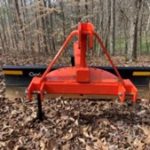
Adjustable scrape blade. Photo credit: Stephen Pohlman, Clemson University.


The first implements to discuss are box blades and scrape blades. The same principle applies to these, as did our ground contact implement article. You will want to pay attention to steel thickness and construction, added gussets and bracing, and proper width based on the size of the tractor. Typically, you will want your box and scrape blades to be at least as wide as your rear tires, just to leave a nice finished look behind you instead of tire tracks.

Box blades and scrape blades are often used for the same jobs; however, each has its intended purpose. A box blade is intended to keep things smooth/level. A scrape blade is intended to shape the ground. For example, if you plan to pull a ditch or crown a road, the scrape blade is a much better option. If you already have a surface that you are trying to maintain as smooth and level, then a box blade will be easier. Granted, you can do the same thing with a scrape blade. However, the scrape blade will roll material out one end, or both, during the process. In contrast, a box blade will store the excess material inside the boxed area to later be used for depositing in other holes/depressions. Scrape blades can come in adjustable models that make it easy for the operator to change the angle and pitch of the blade without having to change the tractor’s 3-pt hitch angles. Also, these adjustable models can be manual as well as hydraulic; however, the hydraulic versions will need to utilize the tractor’s rear hydraulic accessory block (‘remotes’ as some call them).


Box blade. Photo credit: Stephen Pohlman, Clemson University.

Box blades and scrape blades are also great prescribed fire management equipment, provided you already have pre-existing fire breaks. Dragging a box blade or scrape blade on these maintained fire breaks will keep you from fracturing the soil surface with a plow. This allows you to keep a hard soil surface that prevents soil erosion and gives you the bare mineral soil that you need to avoid fire from walking across your fire break. The one flaw with this is that leaf/needle litter will quickly fill a box blade and a scrape blade, causing it to ‘jump’ over a rolled-up pile of this material. Thus, the build-up of leaf/needle litter will at some point need to be pushed off to the side out of the fire break while dragging the fire break clean.

Another tool for our tractor is the front end loader. Most tractors in the 20-40hp class seem to come with loaders, but this is not always the case. A front end loader is often included as dealers add them due to customer demand. A front end loader can be a valuable tool if you need to lift things, like implements on and off trailers or lime/fertilizer for food plots, just to name a few. A front end loader can also help walk a stuck tractor out as well, though painstakingly slow. Do keep in mind that many of today’s front end loaders can take advantage of different front end attachments once you take the bucket off. Attachments such as grapple buckets, loader forks, rock buckets, 3-n-1 buckets, post hole diggers, etc., are most common for forest landowners. Some brands utilize the skid steer style attachment method, while others use their own proprietary system. Those with proprietary systems typically have a conversion kit or adaptor if the owner would rather have the skid steer style instead.


Grapple bucket. Photo credit: Stephen Pohlman, Clemson University.

One of the front end loader attachments mentioned above, grapple buckets, makes my life much easier as a forest landowner. Coming from someone who has bent their fair share of grapple buckets, know that they make different ones: standard duty, medium duty, heavy duty, and extreme duty. Each one has thicker and more metal, shields, braces, etc. One major factor to consider when buying a grapple bucket is weight. Make sure that your loader capacity meets not only the weight of the grapple but also the weight of the material you’ll be lifting. There are two kinds of grapple buckets, a brush grapple and a root grapple. By design, one is more clam-shaped, and the other is better at acting like loader forks for picking up and stacking things. Also, grapple buckets tend to have either one big grappling device or two separate clamping devices. The advantage of the two clamping devices is you will get a better bite/grasp on whatever you are trying to hold. Lastly, do know that your tractor will need to have a third function valve added for the front end loader to have the ability to open/close the grapple.

The next article in this series will be about vegetation management. We will get into things like sprayers, rotary cutters, and tree cutters in that article.

In case you missed them, here are the prior articles in this series:
Tractors and Implements for Forest Landowners- Part 1: Tractors- https://blogs.clemson.edu/fnr/2021/10/21/tractors-for-forest-landowners/

Tractors and Implements for Forest Landowners – Part 2: Ground Contact Implements- https://blogs.clemson.edu/fnr/2021/12/13/tractors-and-implements-for-forest-landowners-part-2-ground-contact-implements/

Author(s)

Stephen Pohlman, Cooperative Extension, Forestry and Wildlife Agent

This information is supplied with the understanding that no discrimination is intended and no endorsement of brand names or registered trademarks by the Clemson University Cooperative Extension Service is implied, nor is any discrimination intended by the exclusion of products or manufacturers not named. All recommendations are for South Carolina conditions and may not apply to other areas. 

Clemson University Cooperative Extension Service offers its programs to people of all ages, regardless of race, color, gender, religion, national origin, disability, political beliefs, sexual orientation, gender identity, marital or family status and is an equal opportunity employer.


Travis Mitchell – Area Livestock and Forages Agent

The summer months have been busy in Saluda county as livestock & forage producers have worked tirelessly harvesting hay and silage and weaning their fall-born calf crop.  As we transition into the fall, we begin preparing our clientele for new challenges they may face.  The Saluda County Cattleman’s Association held a meeting on September 6th to prepare producers for controlling fall army worms.  Clemson Extension Agent Brian Beer gave a detailed presentation on army worm identification, scouting tips, and control options.  Over 90 producers were in attendance for the meeting.

The Saluda County 4-H Livestock shows will take place on September 14th and 15th at the Central Milk Producers Show & Sale Arena.  Both will be well attended as youth from across South Carolina exhibited their prize show animals.

4-H Helping Youth Thrive

Helping Youth Thrive LogoFor over 120 years, 4-H Youth Development has engaged youth with high-quality developmental settings with an emphasis on academic motivation and success, social competence, high personal Deelopmental context chartstandards, connection, personal responsibility, and contribution to others through leadership and civic engagement. The 4-H Thriving Model is the theory of change for positive youth development in 4-H. The model illustrates the process of positive youth development in 4-H programs by connecting high-quality program settings to the promotion of youth thriving.

The Regional 4-H PYD Champion Network consists of 4-H professionals from Land-Grant Universities (LGUs) across the five Extension Regions. Clemson University Cooperative Extension is proud to support Patricia Whitener as a champion for SC 4-H and part of the southeastern regional working group. Her focus as a thrive champion is on capacity-building efforts for 4-H professionals and volunteers with both Clemson University and SC State. Her focus is on promoting a consistent, correct, and complete understanding of positive youth development throughout the state and region.

Patricia has received $25,000 through a competitive distribution of Extension Innovation funding to further the implementation and adoption of the 4-H Thrive model.  This will be accomplished through PYD capacity building with 4-H professionals and volunteers, leading to improved PYD programming, and stronger and clearer program impact. Ultimately the aim of the thrive sessions is to educate and empower 4-H professionals and to secure the position of SC 4-H as a regional leader in positive youth development programming through delivering professional development, developing effective professional development evaluation, and supporting quality program implementation standards. The impact of the initiative is widespread. Research demonstrates youth programs must be done well if they are to make a positive difference in the lives of youth. Long-term outcomes of quality Developmental Context (i.e., 4-H programs) are academic or vocational success, civic engagement, employability and economic stability, happiness, and wellbeing.

Patricia Whitener, 4-H Youth Development Agent


Health Extension for Diabetes

Health Extension for Diabetes, a community support groupClemson Cooperative Extension’s Rural Health and Nutrition Team offers a fantastic resource for those living with diabetes in Greenville County through the Health Extension for Diabetes (HED) program. The Health Extension for Diabetes program is an American Diabetes Association recognized practice-tested diabetes support program for people with either type 1 or type 2 diabetes. The purpose of the program is to provide you with the knowledge and skills you need, along with the necessary support, to prevent complications associated with diabetes. The program is delivered through a series of 16 online group education and support sessions over 4 months.

Each session lasts an hour and incorporates education as well as support group components. The goal of the program is to help provide participants with the education, resources, and support they need to better manage diabetes. Session topics include healthy eating, physical activity, managing stress, medications and monitoring, and more. You must be 18 years old to participate and have a diagnosis of type 1 or type 2 diabetes.

Please contact Ellie Lane at jelane@clemson.edu or 864-986-1138 for more information or any questions. Follow this link for additional information and to register for an upcoming class: https://clemson.ca1.qualtrics.com/jfe/form/SV_07gV9gl3ZHOAohU.

Ellie Lane, Statewide Rural Health and Nutrition Extension Agent

Home Canning and Food Safety Training for Upstate South Carolina

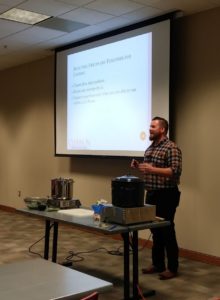
Food Systems and Safety Agent Alex Thompson Hosts a Canning Demonstration

Food Systems and Safety Agent Alex Ryan Thompson is helping to educate Upstate South Carolina residents on various food safety topics. As a part of the Food Systems and Safety program team with Clemson Cooperative Extension, Alex Ryan Thompson hosts home canning workshops covering all forms of canning. Types of canning are boiling water baths, pickling, jams and jellies, and pressure canning. These workshops are hands-on experiences where participants will learn about the process of canning, the scientific principles behind canning, and how to identify research-based canning recipes-Alex hosts canning workshops across the Upstate. No previous canning knowledge is required to attend these workshops. For the most current schedule of upcoming workshops and to register, visit the Food Systems and Safety team page here: https://www.clemson.edu/extension/food/events.html\

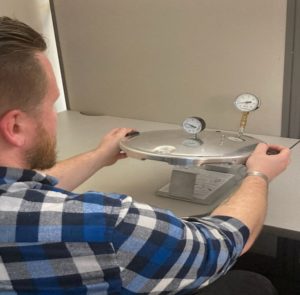
Upstate South Carolina residents who own pressure canners can also reach out to Clemson Cooperative Extension to have their pressure canners inspected and their dial gauges tested for accuracy. The Food Systems and Safety team recommends having pressure canners inspected and dial gauges tested annually to ensure safe pressure canning. Contact your local Extension office to schedule an appointment to check your pressure canner.

Testing a pressure canner gauge

Furthermore, the Food Systems and Safety Team hosts ServSafe Food Handler and Manager trainings and can proctor ServSafe examinations for Upstate South Carolina residents. If you or someone you know needs ServSafe training, contact your local Extension office to schedule training or an examination.

Whether you want to know if your leftovers in the refrigerator are safe to eat or want to start a food business, the Food Systems and Safety team with Clemson Cooperative Extension is here to help!

Contact:
Alex Ryan Thompson
Food Systems and Safety Agent
Clemson Cooperative Extension
352 Halton Rd Suite 302Greenville, South Carolina 29607Phone: (864) 365-0628
Email: art6@clemson.edu


Stephen Pohlman – Forestry Agent – Its Time to Get Privot Under Control

It is time to get privet under control with a method that works in the late fall that most people can do! Glyphosate is a non-restricted-use product that can be found at local places and at an affordable price. It is a non-selective herbicide product, thus why we want to use this method in the late fall. Let me explain why.

The non-native invasive plant known simply as privet can be a worthy adversary for anyone unlucky enough to have this plant on their property. (For simplicity in this article, we are going to refer to all the various species of privet as simply privet).

Chinese Privet Leaves. Photo courtesy of Chris Evans, University of Illinois, Bugwood.org

One of the best ways to control privet is with a glyphosate application in late fall to early winter. Typically, around late October /early November until about December is the time-frame depending on geographic location in the state. The best time is when the desirable plant species you want to keep have gone dormant, yet the privet still has green leaves on its branches and the temperatures are still mild. Avoid cold weather, especially as temperatures begin to get near freezing.

Examples of situations to use this method. If you have young hardwoods that you are trying to keep but want the privet gone, you want the hardwood sprouts/saplings to drop their leaves while the privet still has theirs. The downside to this method is if you have small pines or other conifers that you are trying to save, as these will retain green needles during this time period and are susceptible, Extreme caution and care should be exercised if this is the case. The good news is that most of the time, privet thickets are usually so thick that nothing is growing underneath them to have to worry about.

Glyphosate comes in many different forms with the most common being Ready To Use (RTU) or 41% concentrate products. When performing privet control, the applicator will want to use a 41% or higher percentage concentrate product. RTU products oftentimes do not achieve good control due to the lower amount of material in the percent solution. The applicator will need to read the herbicide label of the product they are using, as this will tell them how many ounces/gal and/or percent solution to be applying for foliar privet control.

Surfactants help in the efficiency of the herbicide by improving absorption into the waxy covering on the leaves. Not all glyphosate products contain a Chinese Privet Flowers. Photo courtesy of Chris Evans, University of Illinois, Bugwood.org.surfactant already added. Reading the label on the product you have will tell if the product has a surfactant and/or if it should be added in the tank mix. If the label says to add a surfactant, choose one that is a non-ionic surfactant. Marking dyes can be added to the tank mix as well. In certain situations, such as treating in strips due to making passes, marking dyes are very helpful. Just know that if you add marking dye to your tank mix you can expect it on everything. Most places (such as farm & garden, feed & seed, agricultural cooperatives, etc.) should carry these products if needed.

The application method used to apply your glyphosate solution depends greatly on the situation you have and your equipment. Backpack sprayers, ATV sprayers, and tractor 3-point hitch mounted sprayers are popular methods of delivering this foliar application method. The applicator will want to spray foliage till wet, but not to the point of running off. Complete coverage of all foliage from top to bottom is key in getting control. The more leaf surface area you can contact with herbicide, the more material that will be absorbed into the plant, the better your chance at control. If equipment is not capable of delivering the herbicide to the top of the privet, you will want to explore other options, such as cutting/mulching the privet down first and then spraying the plant once it sprouts back. Another option may be to do a basal bark application on the bigger privet stems as a follow-up treatment.

Follow-up treatments are a must. As you eliminate mature plants and sunlight can hit the forest floor, something is going to grow in its place. Oftentimes it will be with germinated privet seed and/or root sprouts, not to mention new seed from neighboring properties. The key to eradication is persistence, thus spray those new stems as soon as possible and every time they re-sprout.

If controlling privet in and around water, make sure that you are using a glyphosate product and surfactant that have an aquatic label. Glyphosate products and surfactants used to control terrestrial plants oftentimes have formulations that are harmful to many aquatic organisms. Companies do make aquatic labeled products (such as glyphosate, surfactants, etc.) that have a different formulation designed to not harm aquatic organisms (fish, frogs, turtles, salamanders, etc.). Remember, the label is federal law.

Keep in mind drift concerns on windy days, especially since using a non-selective herbicide, to prevent killing and/or damaging desirable plant species.

You can use this method at other times of the year too. Just remember that glyphosate will kill other plants as the product lands on their green leaves/needles. Thus, the great thing about jumping on privet control soon, as desirable species are going into dormancy and privet is still hanging on.

This article was originally featured in the Fall 2019 Version of CU in The Woods newsletter.

Author(s)

Stephen Pohlman, Cooperative Extension, Forestry and Wildlife Agent

This information is supplied with the understanding that no discrimination is intended and no endorsement of brand names or registered trademarks by the Clemson University Cooperative Extension Service is implied, nor is any discrimination intended by the exclusion of products or manufacturers not named. All recommendations are for South Carolina conditions and may not apply to other areas. Use pesticides only according to the directions on the label. All recommendations for pesticide use are for South Carolina only and were legal at the time of publication, but the status of registration and use patterns are subject to change by action of state and federal regulatory agencies. Follow all directions, precautions and restrictions that are listed.

Clemson University Cooperative Extension Service offers its programs to people of all ages, regardless of race, color, gender, religion, national origin, disability, political beliefs, sexual orientation, gender identity, marital or family status and is an equal opportunity employer.

Previous Next

 

Development and Implementation of the Clemson Cooperative Extension Service Brewing Program for South Carolina

Craft beer is coming to Clemson!

Upstate Food Systems and Safety Agent Alex Thompson, Clemson Extension Associate Chad Carter, Horticulture Agent Zack Snipes, and Dr. Julie Northcutt are working to develop and implement a brewing program to serve the South Carolina brewing industry and the public through Clemson Cooperative Extension.

According to the South Carolina Brewers Guild, 95 craft breweries in South Carolina produce 105,620 brewery barrels (3,274,220 gallons) of beer annually, with a yearly economic impact of $905 million on the South Carolina economy. The South Carolina brewing industry is a major driving force of economic development across the state. Clemson Cooperative Extension is looking to improve the lives and livelihood of South Carolinians by offering research-based solutions, workforce development programs, and product testing related to brewing science.

Clemson Cooperative Extension funds the development of the Clemson Cooperative Extension Brewing Program through the 2022 Innovation Awards. This award funds the purchase of brewing equipment, lab devices, and the creation of course materials to develop brewing science training for South Carolinians. This program will provide services for stakeholders who own and operate breweries, who currently work at breweries, hope to work in the brewing industry or are just curious about brewing and want to learn more.

Over the coming months, progress will be made towards the first offering in the Clemson Cooperative Extension Service Brewing Program for South Carolina, a “Learn to Brew” workshop that will be open to the public. This workshop will be offered both in-person and online and will teach participants the entirety of the brewing process from grain to glass. Furthermore, an optional program day will be hosted on the Clemson University campus, where participants will get a brewing experience. This workshop portion will allow students to interact with brewing equipment and learn about the brewing process in real-time as they produce beer from raw materials.

Craft beer is a major part of the South Carolina economy, and Clemson Cooperative Extension is poised to assist South Carolina brewers and consumers as the industry continues to grow.

Food Systems and Safety Agent Alex Thompson (center) speaks with Shayna Ferguson (right) and Rebeca Ortega (left) of Shoeless Brewing Co. in Greenville, SC .
Photo Credit: Everett Weaver