Marion Barnes, Senior County Extension Agent Clemson University
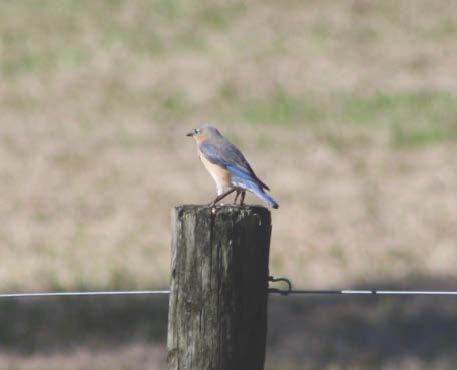
With all the winter weather conditions of late, it is not too early to be thinking of spring! The Eastern Bluebird is one of South Carolina’s most colorful year-round feathered residents and is often referred to as a harbinger of spring. Early settlers called them the “blue robin”. These birds get their name from the male with its reddish or rust colored throat and chest, white underbelly and brilliant blue plumage on its back. The females are a grayish blue with a duller, rust-colored breast. Many birding enthusiasts admire bluebirds for their colorful appearance, gentle disposition, devotion to family, and soft, low-pitched call.
The Eastern Bluebird habitat consists of a mix of open pastures, fields and park-like meadows with scattered trees, open woodlands and forest edges with hollow tree cavities for nesting. Eastern bluebirds can also be found in urban areas with large open lawns, good nesting sites and abundant insect populations for food. Considered secondary cavity nesters, unable to excavate their own cavities, they seek out abandoned woodpecker cavities and other natural openings.
From the mid 1920’s to the 1970’s the Eastern Bluebird species began to decline due to a number of factors including loss of nesting sites attributed to increased urbanization, changing forestry and agricultural farming practices, competition for nesting cavities from introduced exotic species such as the European House Sparrow and European Starling and severe winter and spring ice storms in the Eastern U.S. Bluebird populations declined over 90% during this time and were listed as an endangered species in the 1970’s. Eastern Bluebird populations have stabilized thanks to efforts by homeowners and conservation groups to provide nest boxes and improve habitat suitable for these birds to thrive.
Year-round residents in the low country of South Carolina, bluebirds’ nesting season typically runs from February through September, with peak mating activity in April. Male bluebirds locate a suitable nesting site, establish a territory and sing to attract a female and warn other male bluebirds to stay away. Females build the nest, a neat, cup-shaped structure made of fine grass and pine straw. After mating, the female lays a total of 1 to 6 eggs and immediately begins incubation, which lasts about two weeks. Chicks usually remain in the nest for another two to three weeks before fledging. Bluebirds can raise two to three broods a year in South Carolina.
Bluebirds are primarily insectivores, feeding mainly on insects, which make up approximately 2/3rds of their diets; the remainder consists of wild fruits and berries, especially during winter, when insects are less common. Listed in a 1915 USDA Farmers’ Bulletin 630 titled, “Some Common Birds Useful to the Farmer”, bluebirds are praised for the amount of harmful insects they consume, especially grasshoppers and caterpillars that damage crops.
One of the biggest challenges the Eastern Bluebird faces today is finding suitable nesting sites. What can we do to help? Fortunately, bluebirds regularly use nest boxes provided by homeowners and landowners. Providing nest boxes can be a rewarding hobby for individuals, clubs, and classes. Nest boxes are usually erected in February, but due to multiple broods, they can be placed at any time of the year. Nest boxes are easy to build and maintain, and numerous plans and designs have proven successful.
When considering the construction of bluebird nest boxes, here are a few things to keep in mind:
- Make boxes the correct size & use a design that is easy to clean and inspect
- Use rough cut cedar or cypress lumber ¾ to 1 inch thick (insulation & resists decay)
- Avoid the use of treated wood for box construction
- Entry holes should not be larger than 1.5 inches to deter predators, including the European Starling
- Provide drain and ventilation holes (to keep young birds dry and to prevent overheating)
- Do not add perches since they attract house sparrows
- Mount on a smooth, round pole, such as a metal electrical conduit, that helps deter intruders
- Provide predator protection by installing a baffle or other type of predator guard
- Place nest boxes at least 5 feet in height, keeping in mind that higher placement makes monitoring difficult
- Place nest boxes in good bluebird habitat, open areas such as around open fields and pastures, gardens, and large lawns where insects are plentiful.
- Avoid areas with heavy insecticide use, as these areas can reduce insect populations and may unintentionally harm bluebirds.
- Place nest boxes at least 100 yards apart (if possible) since male bluebirds are very territorial.
- Locate nest boxes at least 50 feet from wooded areas to avoid competition from birds like house wrens, chickadees, nuthatches and titmice who will use the nest boxes.
- Face nest boxes away from prevailing winds and within 25 to 100 feet of perches, such as fences, utility wires, small trees, and shrubs. These structures are used by bluebirds for feeding and by young birds for perches during their first flights.
For more information on attracting Eastern Bluebirds to your property, contact your local county Extension agent. You can also view a copy of HGIC Factsheet HGIC 2908 Providing for Bluebirds: Guidance for Bluebird Nest Box Establishment in South Carolina or Eastern Bluebirds from the Alabama Cooperative Extension System for additional information on bluebirds.
Information for this article was taken in part from Clemson University HGIC Factsheet 2908, Providing for Bluebirds: Guidance for Bluebird Nest Box Establishment in South Carolina and Eastern Bluebirds, Alabama Cooperative Extension System.
