Anna Sara Hill, Horticulture Extension Agent
Of all the fruit and nut trees you can grow in the backyard, pecan trees are among the thirstiest. Producing a healthy crop of high-quality pecans requires an enormous amount of water, especially during the growing season.
From the time nuts are set until they are fully developed, pecan trees rely on a consistent supply of moisture. Their greatest water demand occurs from August through October, during nut fill, when kernels are developing and gaining weight. During this period, a mature pecan tree can use as much as 350 gallons of water per day.
Most of the water a pecan tree absorbs comes from the upper 32 inches of soil, making it important to keep that root zone consistently moist. In a typical year, rainfall provides only about one-half to two-thirds of the approximately 60 inches of water a mature pecan tree needs annually for optimum production. The remaining water must come from irrigation
During drought years, supplemental irrigation becomes even more critical to prevent stress and protect the developing crop. Even a short period of drought stress during nut fill can result in poorly filled nuts, lower yields, and reduced nut quality. If rainfall is lacking, irrigation must be used to replace the moisture deficit and keep trees growing without interruption.
Young pecan trees require special attention because their root systems are still developing. The first three years after planting are the most important for establishing a healthy pecan tree. From spring bud break through early August, provide about 1 inch of water per week to trees younger than 4 years old through rainfall or irrigation. As the trees enter the nut-fill period in early August, increase watering to approximately 2 inches per week until the shucks begin splitting in October.
Whenever possible, water deeply and less frequently rather than applying small amounts every day. Deep watering encourages roots to grow farther into the soil, making trees more resilient during dry weather.
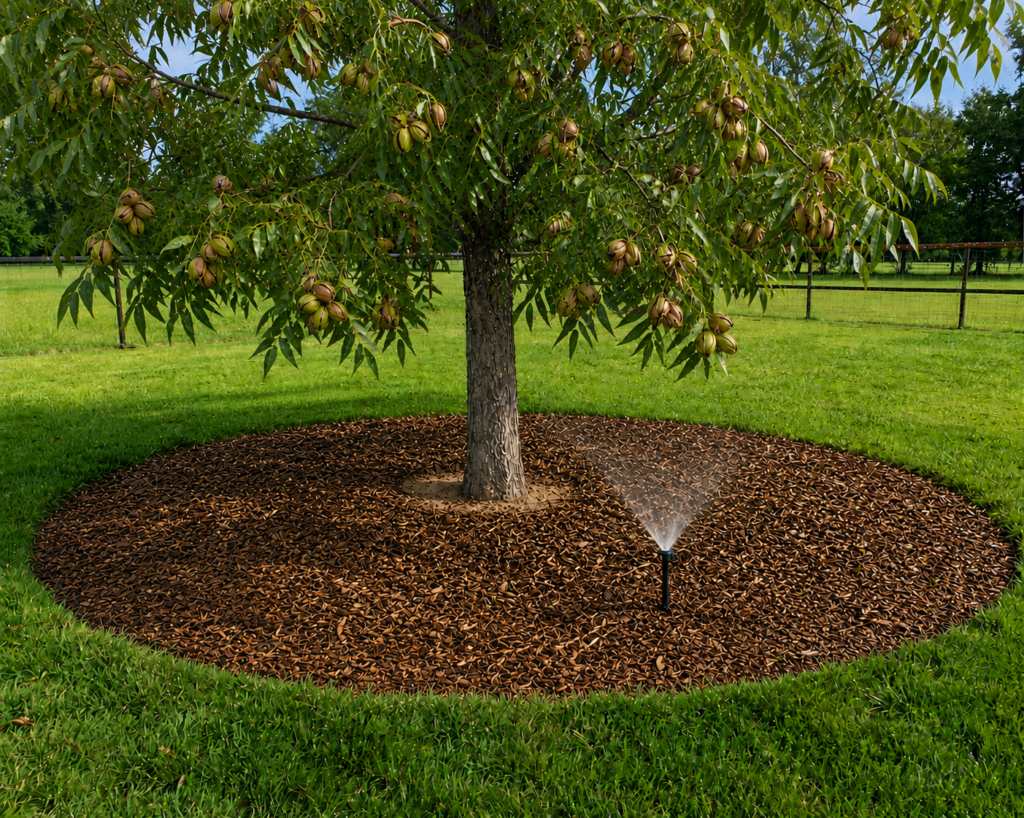
One of the best ways to conserve soil moisture is to apply a 1- to 2-inch layer of mulch, such as pine straw, shredded bark, wood chips, or leaves. Mulch helps reduce evaporation, moderates soil temperature, and suppresses weeds that compete for moisture.
Spread the mulch in a wide circle around the tree, but leave a gap of several inches around the trunk. Keeping mulch away from the base of the tree helps prevent excess moisture against the bark, reducing the risk of decay, disease, and insect problems.
Think of water as the fuel that powers pecan production. Trees that receive adequate moisture throughout the growing season produce healthier leaves, stronger shoots, and better-filled nuts. Consistent watering also helps reduce stress, allowing trees to devote more energy to producing quality crops.
Simply put, water is not just beneficial for pecan trees; it is essential for a consistent, quality nut crop!
